What Ballast Issues Must a Relief Chief Engineer Receive?
Updated
A useful relief handover explains the next operational decision, not just the machinery’s current status. Unfinished treatment, uncertain tank contents and unresolved authority conditions must remain visible when responsibility changes.
Request BWTS spare parts, annual calibration or ballast-water testing
Key takeaways
- Hand over tank-specific status.
- Keep unexplained resets visible.
- Verify current instruments and documents.
- List outstanding authority conditions.
- Demonstrate vessel-specific understanding.
- Assign owners and deadlines.
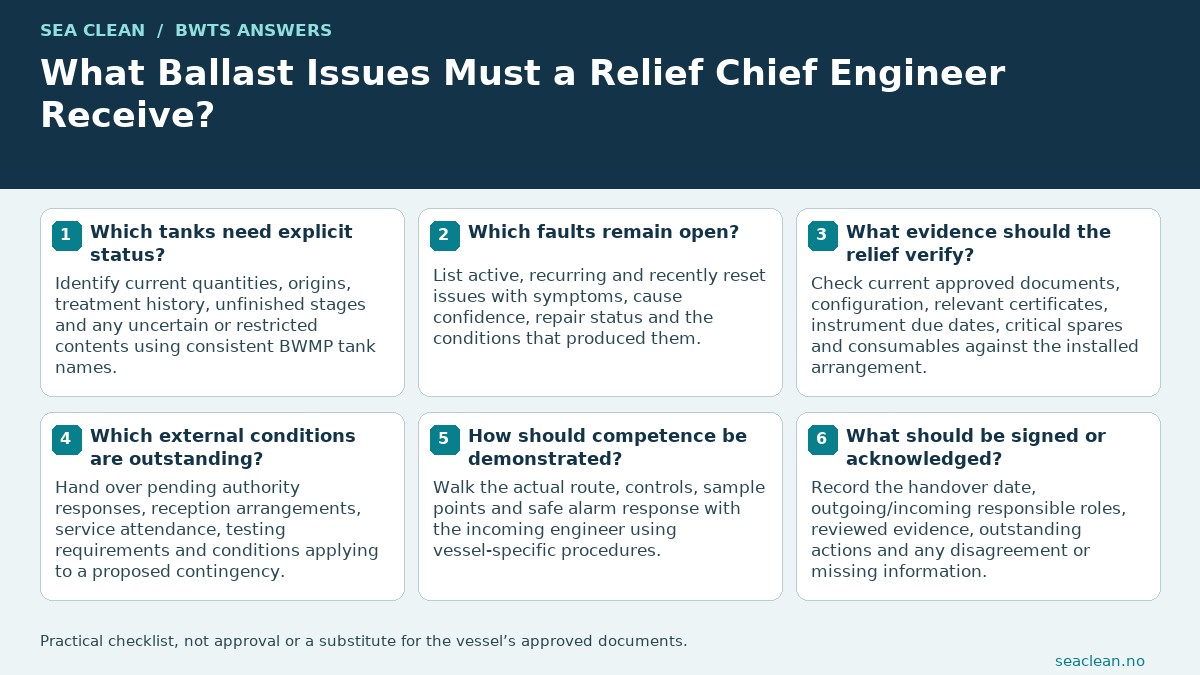
Which tanks need explicit status?
Identify current quantities, origins, treatment history, unfinished stages and any uncertain or restricted contents using consistent BWMP tank names.
Do not summarise mixed or interrupted treatment as 'all ballast treated'. Show the evidence and limitation for each affected tank.
Which faults remain open?
List active, recurring and recently reset issues with symptoms, cause confidence, repair status and the conditions that produced them.
A reset alarm should not disappear from the handover if its cause remains unknown. Link exports, troubleshooting records and required failure entries.
Related guidance: BWM Compliance Responsibility Matrix for Shipowners, Managers, Masters and Chief Engineers
What evidence should the relief verify?
Check current approved documents, configuration, relevant certificates, instrument due dates, critical spares and consumables against the installed arrangement.
Prioritise evidence affecting the next operation. A large folder of old certificates is not a substitute for identifying the current instrument and scope.
Which external conditions are outstanding?
Hand over pending authority responses, reception arrangements, service attendance, testing requirements and conditions applying to a proposed contingency.
Separate acknowledgments from actual instructions. Record who owns each follow-up and the operational deadline.
How should competence be demonstrated?
Walk the actual route, controls, sample points and safe alarm response with the incoming engineer using vessel-specific procedures.
A signed receipt of documents does not show the person understands a restricted mode or an unfinished treatment stage.
Related guidance: Which Ballast Records Need Custody Control After Management Changes?
What should be signed or acknowledged?
Record the handover date, outgoing/incoming responsible roles, reviewed evidence, outstanding actions and any disagreement or missing information.
Keep the master informed of operational restrictions. A relief signature must not be used to transfer an unresolved issue into an unqualified 'ready' status.
Frequently asked questions
Is 'BWTS operational' enough?
No. It does not describe affected tank histories, restrictions or unfinished stages.
Should repaired alarms remain in the handover?
Include relevant history and any recurring or unresolved cause, not just active alarms.
Does document receipt prove competence?
No. Use vessel-specific discussion or demonstration of the required tasks.
Who should know about discharge restrictions?
The master and responsible operational/management personnel, including the relief team.
Sources
- IMO — BWMS Code, MEPC.300(72) — Approval framework, monitoring, system design limitations and biological performance; not a universal maker procedure.
- IMO — BWM.2/Circ.80/Rev.1: record-keeping and reporting — The linked PDF is the revised circular dated 24 October 2024, despite its shorter filename.
- IMO — BWM Convention and implementation guidelines
Related articles
- How Do You Verify a Ballast Laboratory’s Actual Testing Scope?
- Which Ballast Records Need Custody Control After Management Changes?
- BWM Compliance Responsibility Matrix for Shipowners, Managers, Masters and Chief Engineers
- BWMS Logs and Record Books: Building a PSC Evidence Pack
- What Is a Ballast Water Treatment System? Explained
- How Does BWTS Installation Work? Step by Step
Request spares, calibration or ballast-water testing
Include BWMS brand/model, vessel/IMO number, port/terminal, date/ETA and scope or part numbers. These links prepare an email draft; you must send it yourself.
- Request a parts quote — Sensors, TRO reagents, calibration kits and replacement parts. Confirm compatibility, availability and delivery for your installed system.
- Request a calibration booking — Annual instrument calibration with a calibration certificate for the work completed. OEM instructions, drift or applicable rules may require earlier work.
- Request testing coordination — Arrange sampling and testing with an appropriately qualified party for your IMO D-2, commissioning or other stated purpose.
Authorised Headway agent. Other-brand enquiries are independently reviewed; no OEM authorisation is claimed. Sea Clean is not an accredited laboratory or approving authority. Calibration does not demonstrate biological D-2 compliance. Attendance, testing scope and parts delivery are confirmed per enquiry.