Which Ballast Records Need Custody Control After Management Changes?
Updated
Changing management does not erase ballast-water record duties or the vessel’s history. Agree who holds originals, who controls archives and how records remain available for inspection before accounts and document systems change.
Request BWTS spare parts, annual calibration or ballast-water testing
Key takeaways
- Retention survives management changes.
- Inventory books and integral diagrams.
- Distinguish originals from copies.
- Protect electronic verification history.
- Transfer open operational issues.
- Verify access with sample records.
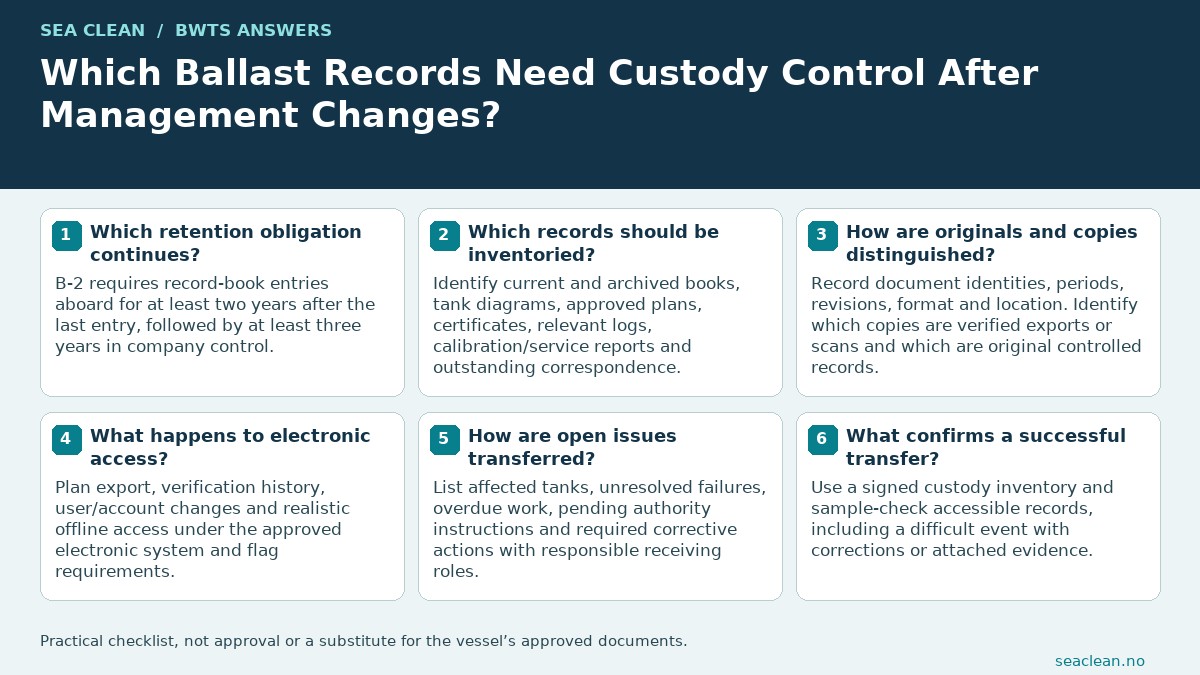
Which retention obligation continues?
B-2 requires record-book entries aboard for at least two years after the last entry, followed by at least three years in company control.
Confirm the applicable flag/company arrangement for custody through the transition. Do not interpret a contract end as permission to delete the history.
Which records should be inventoried?
Identify current and archived books, tank diagrams, approved plans, certificates, relevant logs, calibration/service reports and outstanding correspondence.
Distinguish statutory records from supporting operational evidence and their applicable retention rules. Not every file has the same custody or retention basis.
Related guidance: BWM Compliance Responsibility Matrix for Shipowners, Managers, Masters and Chief Engineers
How are originals and copies distinguished?
Record document identities, periods, revisions, format and location. Identify which copies are verified exports or scans and which are original controlled records.
A bulk folder transfer without an index can lose the relationship between a book, its integral diagram and the correct vessel period.
What happens to electronic access?
Plan export, verification history, user/account changes and realistic offline access under the approved electronic system and flag requirements.
Do not rely on former employees’ credentials or an outgoing manager’s subscription. Confirm lawful access and custody before withdrawing the old route.
How are open issues transferred?
List affected tanks, unresolved failures, overdue work, pending authority instructions and required corrective actions with responsible receiving roles.
A completed document transfer does not close an operational nonconformity. Preserve the issue’s original evidence and disposition status.
Related guidance: Must an Installed BWMS Be Replaced When Its Type-Approval Certificate Expires?
What confirms a successful transfer?
Use a signed custody inventory and sample-check accessible records, including a difficult event with corrections or attached evidence.
Resolve missing periods or unreadable exports explicitly. The receiving team should not have to reconstruct key history from an unverified email archive.
Frequently asked questions
Can the outgoing manager delete its archive immediately?
Not without satisfying applicable custody and retention obligations and confirming a complete accepted transfer.
Does a scanned cover transfer the whole book?
No. Entries, diagrams, signatures and relevant verification/correction evidence must remain accessible.
Do open failures close at takeover?
No. Transfer their status, evidence, restrictions and responsible actions.
Should custody be documented?
Yes. Record periods, formats, originals, access and responsible receiving parties.
Sources
- IMO — BWMS Code, MEPC.300(72) — Approval framework, monitoring, system design limitations and biological performance; not a universal maker procedure.
- IMO — BWM.2/Circ.80/Rev.1: record-keeping and reporting — The linked PDF is the revised circular dated 24 October 2024, despite its shorter filename.
- IMO — BWM Convention and implementation guidelines
Related articles
- What Ballast Issues Must a Relief Chief Engineer Receive?
- Must an Installed BWMS Be Replaced When Its Type-Approval Certificate Expires?
- BWM Compliance Responsibility Matrix for Shipowners, Managers, Masters and Chief Engineers
- BWMS Logs and Record Books: Building a PSC Evidence Pack
- VGP vs VIDA: What Vessel Operators Need to Know
- What Is a Ballast Water Treatment System? Explained
Request spares, calibration or ballast-water testing
Include BWMS brand/model, vessel/IMO number, port/terminal, date/ETA and scope or part numbers. These links prepare an email draft; you must send it yourself.
- Request a parts quote — Sensors, TRO reagents, calibration kits and replacement parts. Confirm compatibility, availability and delivery for your installed system.
- Request a calibration booking — Annual instrument calibration with a calibration certificate for the work completed. OEM instructions, drift or applicable rules may require earlier work.
- Request testing coordination — Arrange sampling and testing with an appropriately qualified party for your IMO D-2, commissioning or other stated purpose.
Authorised Headway agent. Other-brand enquiries are independently reviewed; no OEM authorisation is claimed. Sea Clean is not an accredited laboratory or approving authority. Calibration does not demonstrate biological D-2 compliance. Attendance, testing scope and parts delivery are confirmed per enquiry.