Can You Trust a BWTS Check Made with an Expired Reference?
Updated
An overdue reference undermines the evidence chain, but the response needs more than replacing a label. Establish whether reference reliability was demonstrated and which acceptance decisions depended on it.
Request BWTS spare parts, annual calibration or ballast-water testing
Key takeaways
- Identify the exact reference control.
- List every affected check.
- Use later as-found evidence carefully.
- Review the acceptance uncertainty.
- Recheck where the evidence is insufficient.
- Control references before each job.
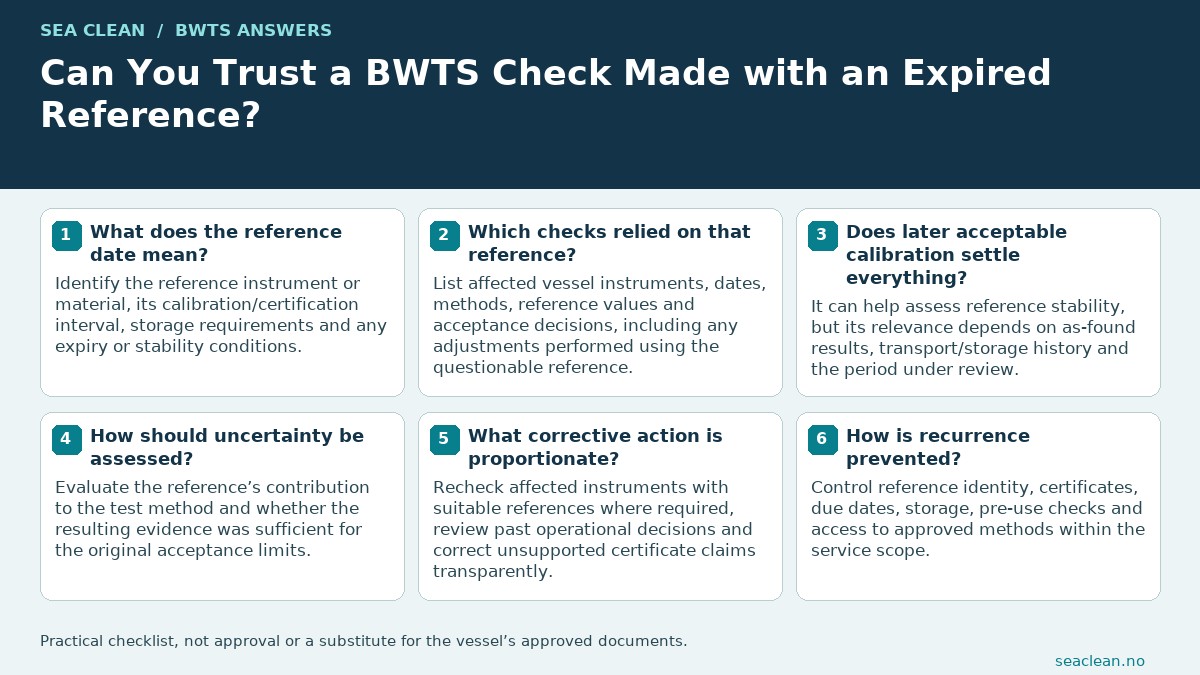
What does the reference date mean?
Identify the reference instrument or material, its calibration/certification interval, storage requirements and any expiry or stability conditions.
A chemical reference’s expiry and a meter’s recalibration date are different controls. Review the relevant certificate rather than treating them interchangeably.
Which checks relied on that reference?
List affected vessel instruments, dates, methods, reference values and acceptance decisions, including any adjustments performed using the questionable reference.
Preserve worksheets and original results. Without that list, a later good reference result cannot be linked to the earlier checks.
Related guidance: BWTS Calibration Certificates: What Vessel Operators Should Check
Does later acceptable calibration settle everything?
It can help assess reference stability, but its relevance depends on as-found results, transport/storage history and the period under review.
Do not claim perfect historical accuracy merely because the reference now passes. State what the evidence supports and where uncertainty remains.
How should uncertainty be assessed?
Evaluate the reference’s contribution to the test method and whether the resulting evidence was sufficient for the original acceptance limits.
An omitted uncertainty or expired certificate does not justify inventing a safety margin. Seek competent metrology review when decisions near limits are involved.
What corrective action is proportionate?
Recheck affected instruments with suitable references where required, review past operational decisions and correct unsupported certificate claims transparently.
Keep provider responsibility and vessel disposition distinct. A revised report must identify the change rather than silently replacing the original evidence.
Related guidance: What If a BWTS Sensor Is Found Outside Calibration Tolerance?
How is recurrence prevented?
Control reference identity, certificates, due dates, storage, pre-use checks and access to approved methods within the service scope.
Purchasing should require traceable reference evidence and as-found results, not merely a supplier statement that all tools are 'certified'.
Frequently asked questions
Does expiry prove the reference was wrong?
Not by itself, but it creates an evidence gap that needs a defensible review.
Can a new certificate validate every old check?
No. Assess the relevant period, stability history and original decisions.
Are reference solutions and meters controlled identically?
No. Their expiry, stability, calibration and storage requirements differ.
Should a replacement certificate hide the problem?
No. Preserve the original and identify the correction, basis and affected scope.
Sources
- IMO — BWMS Code, MEPC.300(72) — Approval framework, monitoring, system design limitations and biological performance; not a universal maker procedure.
- NIST — Metrological traceability
- US EPA — 2013 VGP — Part 2.2.3.5.1.1.3 where applicable; verify the current VGP/VIDA transition for the voyage.
Related articles
- What If a BWTS Calibration Falls Due During a Voyage?
- What If a BWTS Sensor Is Found Outside Calibration Tolerance?
- BWTS Calibration Certificates: What Vessel Operators Should Check
- BWTS Metrology Scope of Work: What a Purchase Order Must Define
- What Is a Ballast Water Treatment System? Explained
- How Does BWTS Installation Work? Step by Step
Request spares, calibration or ballast-water testing
Include BWMS brand/model, vessel/IMO number, port/terminal, date/ETA and scope or part numbers. These links prepare an email draft; you must send it yourself.
- Request a parts quote — Sensors, TRO reagents, calibration kits and replacement parts. Confirm compatibility, availability and delivery for your installed system.
- Request a calibration booking — Annual instrument calibration with a calibration certificate for the work completed. OEM instructions, drift or applicable rules may require earlier work.
- Request testing coordination — Arrange sampling and testing with an appropriately qualified party for your IMO D-2, commissioning or other stated purpose.
Authorised Headway agent. Other-brand enquiries are independently reviewed; no OEM authorisation is claimed. Sea Clean is not an accredited laboratory or approving authority. Calibration does not demonstrate biological D-2 compliance. Attendance, testing scope and parts delivery are confirmed per enquiry.