What Should Be Checked Before Restarting BWTS After a Pump Trip?
Updated
A pump trip can interrupt treatment without rebooting the controller. Review hydraulic and treatment-state consequences before interpreting a successful pump restart as a completed compliant operation.
Request BWTS spare parts, annual calibration or ballast-water testing
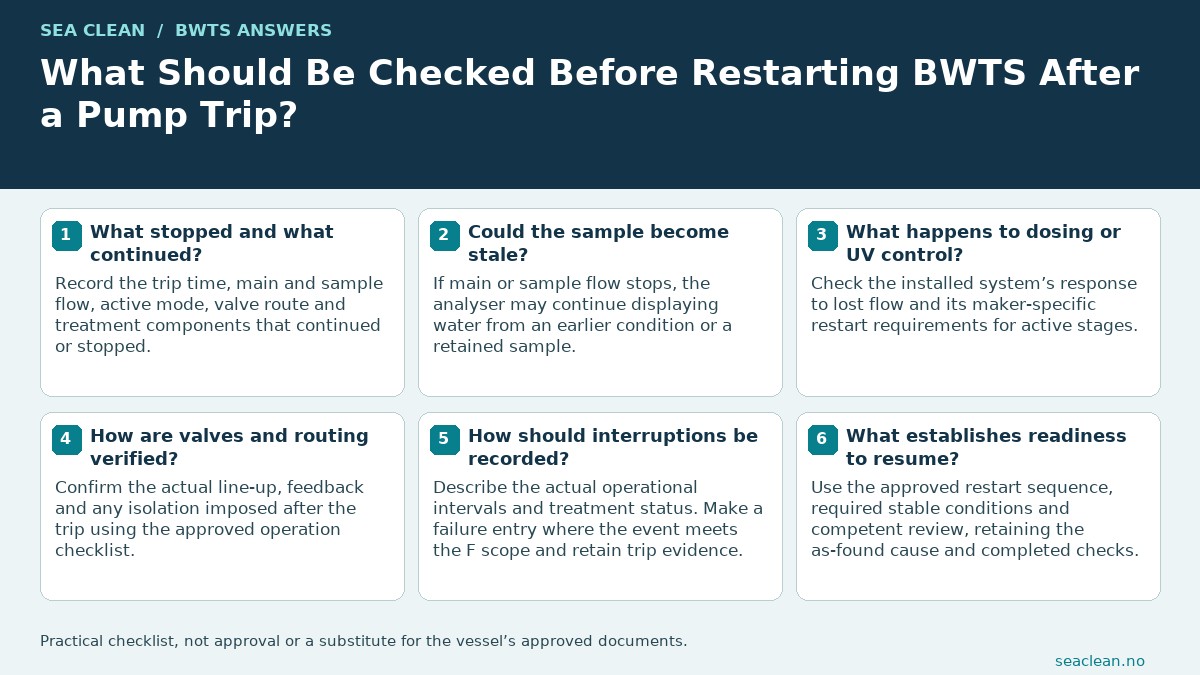
Key takeaways
- Identify all interrupted components.
- Check for stale sample readings.
- Use maker-specific stage recovery.
- Verify the real valve route.
- Record material interruptions.
- Escalate repeated or unexplained trips.
What stopped and what continued?
Record the trip time, main and sample flow, active mode, valve route and treatment components that continued or stopped.
Distinguish a pump-only event from loss of control, chemicals, ventilation or monitoring. Different interruptions can require different approved responses.
Could the sample become stale?
If main or sample flow stops, the analyser may continue displaying water from an earlier condition or a retained sample.
Confirm representative delivery is restored before relying on the indication. A normal value during no flow may not describe the restarted discharge.
Related guidance: BWMS Management Plan Change Control: When Does a Revision Need Approval?
What happens to dosing or UV control?
Check the installed system’s response to lost flow and its maker-specific restart requirements for active stages.
Do not assume a generic reset restores the intended treatment sequence. Avoid manual dosing or control overrides outside the approved procedure.
How are valves and routing verified?
Confirm the actual line-up, feedback and any isolation imposed after the trip using the approved operation checklist.
A pump running into an incorrect route is not a successful BWMS restart. Consider safety, pressure and vessel stability before resuming flow.
How should interruptions be recorded?
Describe the actual operational intervals and treatment status. Make a failure entry where the event meets the F scope and retain trip evidence.
Do not use a single start/end pair to imply uninterrupted treatment if the pause materially affected the operation.
Related guidance: How Should You Track Ballast from Different Ports in One Tank?
What establishes readiness to resume?
Use the approved restart sequence, required stable conditions and competent review, retaining the as-found cause and completed checks.
If the trip’s cause remains unexplained or recurs, escalate rather than repeatedly restarting. Review affected water separately from machinery restoration.
Frequently asked questions
Does pump restart prove treatment restart?
No. Check the system’s relevant stages, monitoring and approved recovery sequence.
Can a reading during no flow be relied on?
It may represent retained water; verify representative sample delivery after flow resumes.
Does every cargo pause require a failure entry?
No. Apply the actual F scope and record the operation honestly.
Can repeated reset attempts replace diagnosis?
No. Recurrence or unknown cause needs appropriate investigation and escalation.
Sources
- IMO — BWMS Code, MEPC.300(72) — Approval framework, monitoring, system design limitations and biological performance; not a universal maker procedure.
- IMO — BWM.2/Circ.80/Rev.1: record-keeping and reporting — The linked PDF is the revised circular dated 24 October 2024, despite its shorter filename.
- IMO — BWM Convention and implementation guidelines
Related articles
- Is a Port’s Acknowledgment the Same as Ballast Discharge Permission?
- How Should You Track Ballast from Different Ports in One Tank?
- BWMS Management Plan Change Control: When Does a Revision Need Approval?
- BWTS Contingency Notification Pack: What to Send Flag and Port
- What Is a Ballast Water Treatment System? Explained
- How Does BWTS Installation Work? Step by Step
Request spares, calibration or ballast-water testing
Include BWMS brand/model, vessel/IMO number, port/terminal, date/ETA and scope or part numbers. These links prepare an email draft; you must send it yourself.
- Request a parts quote — Sensors, TRO reagents, calibration kits and replacement parts. Confirm compatibility, availability and delivery for your installed system.
- Request a calibration booking — Annual instrument calibration with a calibration certificate for the work completed. OEM instructions, drift or applicable rules may require earlier work.
- Request testing coordination — Arrange sampling and testing with an appropriately qualified party for your IMO D-2, commissioning or other stated purpose.
Authorised Headway agent. Other-brand enquiries are independently reviewed; no OEM authorisation is claimed. Sea Clean is not an accredited laboratory or approving authority. Calibration does not demonstrate biological D-2 compliance. Attendance, testing scope and parts delivery are confirmed per enquiry.