Is a Port’s Acknowledgment the Same as Ballast Discharge Permission?
Updated
A received email, automated report confirmation or agent acknowledgment may only confirm delivery. Establish whether the competent authority actually directed or permitted the specific proposed operation before relying on the message.
Request BWTS spare parts, annual calibration or ballast-water testing
Key takeaways
- Receipt is not automatically permission.
- Confirm the competent sender.
- Match the exact vessel and operation.
- Check every condition.
- Reassess material changes.
- Retain original instructions and evidence.
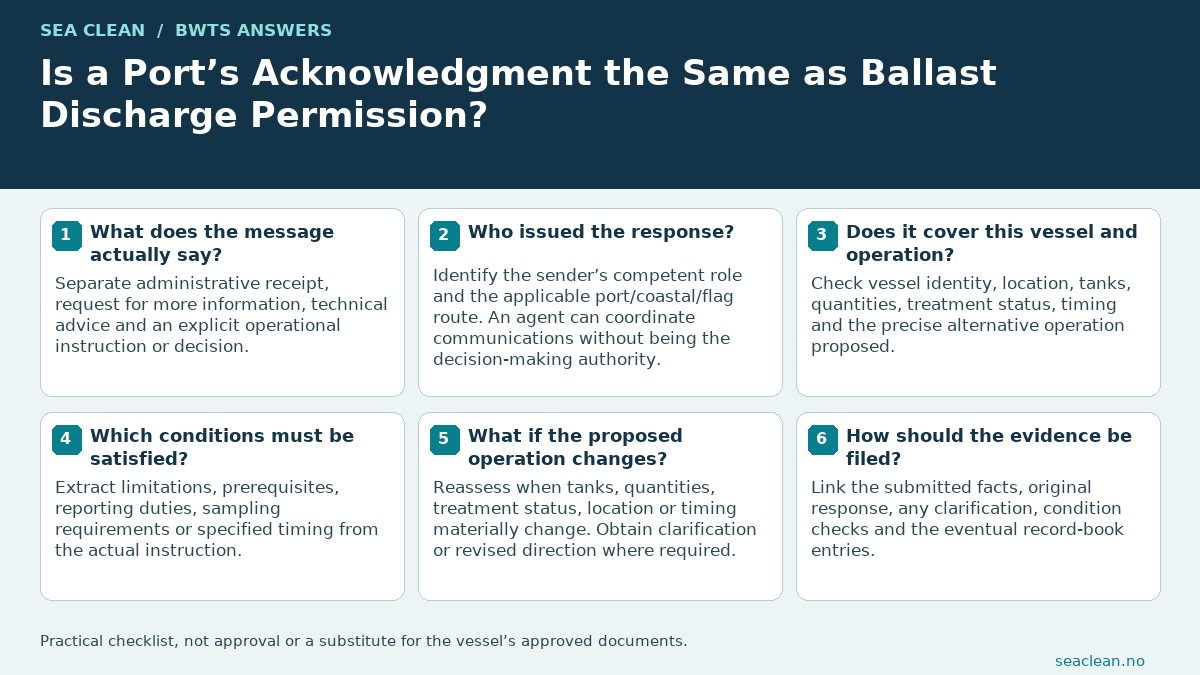
What does the message actually say?
Separate administrative receipt, request for more information, technical advice and an explicit operational instruction or decision.
Do not treat silence or an automated portal receipt as permission. Preserve the original wording and its date/time.
Who issued the response?
Identify the sender’s competent role and the applicable port/coastal/flag route. An agent can coordinate communications without being the decision-making authority.
Confirm unclear authority through the approved contacts. A forwarded message may omit conditions or the original scope.
Related guidance: BWMS Management Plan Change Control: When Does a Revision Need Approval?
Does it cover this vessel and operation?
Check vessel identity, location, tanks, quantities, treatment status, timing and the precise alternative operation proposed.
A previous voyage’s arrangement or a sister vessel’s acceptance is not automatically applicable to the current circumstances.
Which conditions must be satisfied?
Extract limitations, prerequisites, reporting duties, sampling requirements or specified timing from the actual instruction.
Assign responsible people and evidence for each condition. Do not begin the operation based on the headline response while overlooking its qualifications.
What if the proposed operation changes?
Reassess when tanks, quantities, treatment status, location or timing materially change. Obtain clarification or revised direction where required.
Keep the master’s operational control explicit. A commercial instruction should not supersede applicable authority restrictions or vessel safety.
Related guidance: What Should Be Checked Before Restarting BWTS After a Pump Trip?
How should the evidence be filed?
Link the submitted facts, original response, any clarification, condition checks and the eventual record-book entries.
Record what actually occurred rather than stating 'port approved' without scope. Keep unresolved questions visible until answered.
Frequently asked questions
Does an automated confirmation authorise discharge?
Not unless the applicable system explicitly makes that decision and scope clear; ordinary receipt alone is not permission.
Can an agent approve the contingency?
Do not assume that. Confirm the competent authority and the agent’s actual role.
Can last month’s permission be reused?
Only where its actual scope and applicable rules support the current operation.
What if an authority’s wording is ambiguous?
Seek clarification before relying on it for a restricted operation.
Sources
- IMO — BWMS Code, MEPC.300(72) — Approval framework, monitoring, system design limitations and biological performance; not a universal maker procedure.
- IMO — BWM.2/Circ.80/Rev.1: record-keeping and reporting — The linked PDF is the revised circular dated 24 October 2024, despite its shorter filename.
- IMO — BWM Convention and implementation guidelines
Related articles
- Can a Leaking Valve Undermine a Correct BWMS Reading?
- What Should Be Checked Before Restarting BWTS After a Pump Trip?
- BWMS Management Plan Change Control: When Does a Revision Need Approval?
- BWTS Contingency Notification Pack: What to Send Flag and Port
- TRO Neutralisation Before Ballast Discharge
- TRO Neutralization Before Ballast Discharge: Requirements
Request spares, calibration or ballast-water testing
Include BWMS brand/model, vessel/IMO number, port/terminal, date/ETA and scope or part numbers. These links prepare an email draft; you must send it yourself.
- Request a parts quote — Sensors, TRO reagents, calibration kits and replacement parts. Confirm compatibility, availability and delivery for your installed system.
- Request a calibration booking — Annual instrument calibration with a calibration certificate for the work completed. OEM instructions, drift or applicable rules may require earlier work.
- Request testing coordination — Arrange sampling and testing with an appropriately qualified party for your IMO D-2, commissioning or other stated purpose.
Authorised Headway agent. Other-brand enquiries are independently reviewed; no OEM authorisation is claimed. Sea Clean is not an accredited laboratory or approving authority. Calibration does not demonstrate biological D-2 compliance. Attendance, testing scope and parts delivery are confirmed per enquiry.