How Should You Track Ballast from Different Ports in One Tank?
Updated
A tank’s latest uptake port does not necessarily describe all water inside it. Retained ballast and subsequent additions can have different origins, treatment histories and restrictions that must remain traceable.
Request BWTS spare parts, annual calibration or ballast-water testing
Key takeaways
- Establish the starting tank inventory.
- Keep each uptake event traceable.
- Do not erase retained-water history.
- Mixing is not treatment.
- Use tank logs to support port reports.
- Hand over origins and restrictions.
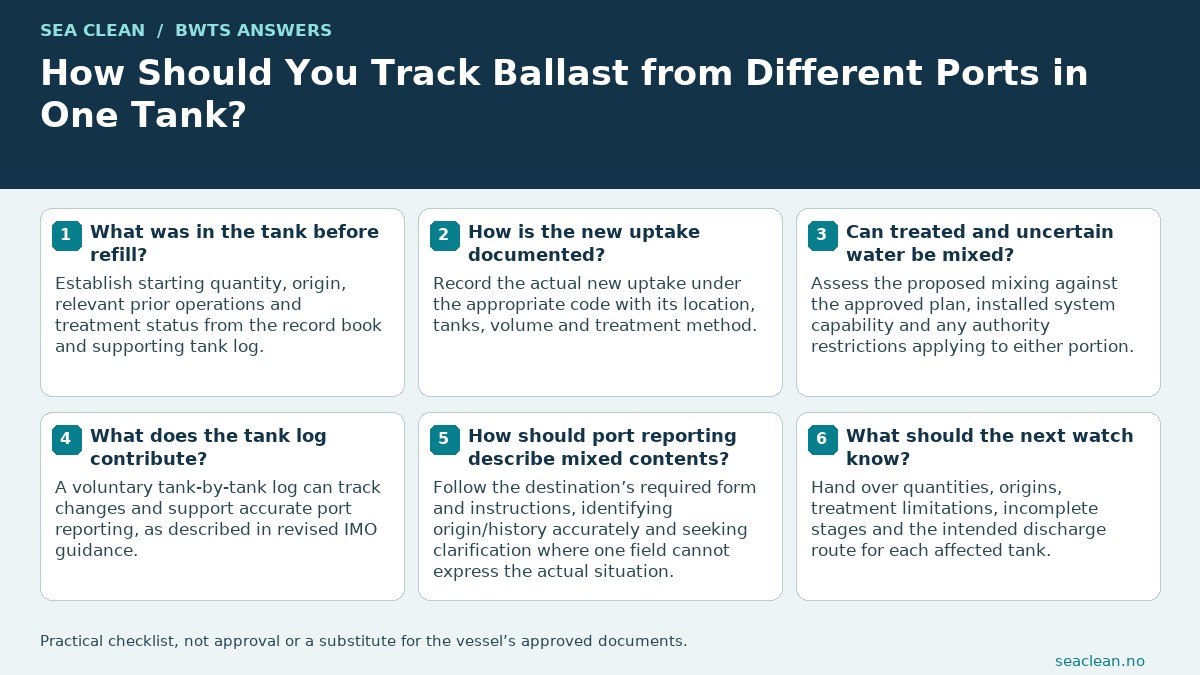
What was in the tank before refill?
Establish starting quantity, origin, relevant prior operations and treatment status from the record book and supporting tank log.
Do not assume the tank was empty because it was previously discharged. Residual water and unrecorded transfers can matter to the inventory history.
How is the new uptake documented?
Record the actual new uptake under the appropriate code with its location, tanks, volume and treatment method.
Keep the retained and added quantities linked. The new entry should not erase the earlier history or relabel all contents as coming from the latest port.
Related guidance: BWMS Management Plan Change Control: When Does a Revision Need Approval?
Can treated and uncertain water be mixed?
Assess the proposed mixing against the approved plan, installed system capability and any authority restrictions applying to either portion.
Mixing does not retrospectively treat uncertain water. Avoid treating dilution or a later good sensor indication as a universal recovery method.
What does the tank log contribute?
A voluntary tank-by-tank log can track changes and support accurate port reporting, as described in revised IMO guidance.
It complements the statutory record book. Keep the two consistent rather than maintaining competing histories with different tank names or unexplained quantities.
How should port reporting describe mixed contents?
Follow the destination’s required form and instructions, identifying origin/history accurately and seeking clarification where one field cannot express the actual situation.
Do not choose a convenient single port to avoid a question. Retain the submitted report and supporting explanation.
Related guidance: How Does a Tank Refill Affect BWMS Holding-Time Requirements?
What should the next watch know?
Hand over quantities, origins, treatment limitations, incomplete stages and the intended discharge route for each affected tank.
Reconcile new transfers before the next operation. A colour-coded spreadsheet is only useful if it preserves the underlying evidence and uncertainty.
Frequently asked questions
Does the newest port become the whole tank’s origin?
Not automatically. Earlier retained water and transfers remain part of the history.
Can dilution clear untreated-water status?
No. Follow an approved management route rather than assuming dilution is recovery.
Is a voluntary tank log useful?
Yes, for inventory and port reporting, but it does not replace required record-book entries.
What if a reporting form cannot describe mixed origins?
Use the authority’s instructions and seek clarification rather than submitting a misleading simplified history.
Sources
- IMO — BWMS Code, MEPC.300(72) — Approval framework, monitoring, system design limitations and biological performance; not a universal maker procedure.
- IMO — BWM.2/Circ.80/Rev.1: record-keeping and reporting — The linked PDF is the revised circular dated 24 October 2024, despite its shorter filename.
- IMO — BWM Convention and implementation guidelines
Related articles
- What Should Be Checked Before Restarting BWTS After a Pump Trip?
- How Does a Tank Refill Affect BWMS Holding-Time Requirements?
- BWMS Management Plan Change Control: When Does a Revision Need Approval?
- BWTS Contingency Notification Pack: What to Send Flag and Port
- What Is a Tank’s Status After BWMS Failure During Uptake?
- What Is a Ballast Water Treatment System? Explained
Request spares, calibration or ballast-water testing
Include BWMS brand/model, vessel/IMO number, port/terminal, date/ETA and scope or part numbers. These links prepare an email draft; you must send it yourself.
- Request a parts quote — Sensors, TRO reagents, calibration kits and replacement parts. Confirm compatibility, availability and delivery for your installed system.
- Request a calibration booking — Annual instrument calibration with a calibration certificate for the work completed. OEM instructions, drift or applicable rules may require earlier work.
- Request testing coordination — Arrange sampling and testing with an appropriately qualified party for your IMO D-2, commissioning or other stated purpose.
Authorised Headway agent. Other-brand enquiries are independently reviewed; no OEM authorisation is claimed. Sea Clean is not an accredited laboratory or approving authority. Calibration does not demonstrate biological D-2 compliance. Attendance, testing scope and parts delivery are confirmed per enquiry.