Emergency BWTS Parts Supply at Port
Updated
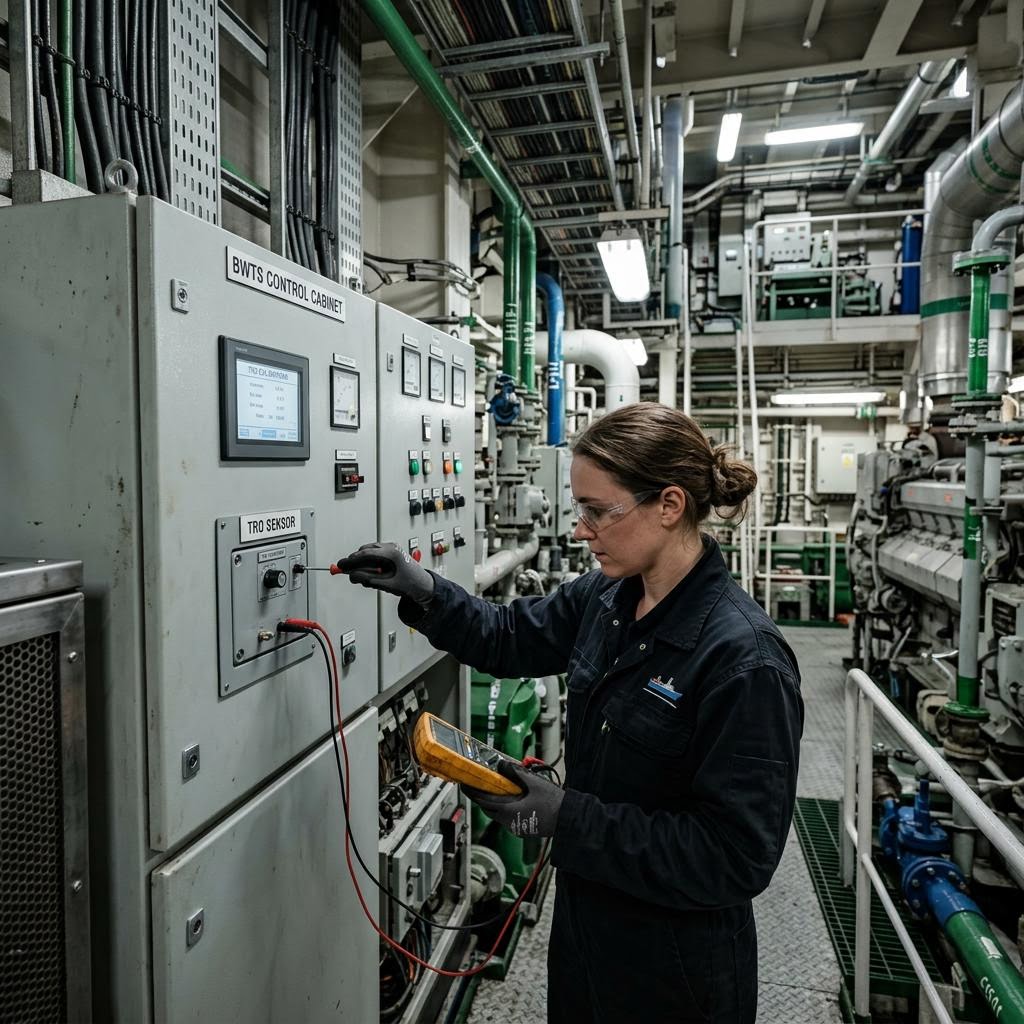
When a BWTS fails in service the vessel faces both an operational problem and a compliance one, often under the time pressure of a port call. Handling it well means accurate diagnosis, invoking the right contingency measures under the BWM Convention, sourcing the correct part fast and clearing it through customs before the ship must sail.
Key takeaways
- Diagnose the actual failed part before ordering; many BWTS alarms are fouling, expired reagent or tripped supplies, not broken parts.
- A BWMS failure is not automatic non-compliance; invoke contingency measures and document them per BWM.2/Circ.81 and the BWM Plan.
- Record the failure in the Ballast Water Record Book and notify port State and flag to keep a breakdown from becoming a detention.
- Supplier-held regional stock and verified equivalents are the fastest routes to a same-day or next-day fix.
- Customs clearance, not transit time, usually decides whether a part beats the ship's departure; use ship-spares-in-transit and a local agent.
- After repair, verify correct operation, update records, and add the failed item to the spares plan to prevent recurrence.
The first hour: diagnose before you order
An emergency parts response starts with correct diagnosis, because ordering the wrong part wastes the one resource that is shortest in an emergency: time. The alarm code, the symptom and the system's logs usually point to the failed component, whether a UV lamp, a sensor, a power supply fault or a filter problem. Confirming the actual failed part, ideally with support from the OEM or a knowledgeable agent, before placing an order prevents a costly second iteration.
Many apparent failures are not parts failures at all. A high differential pressure alarm may be a fouled filter needing cleaning rather than a broken part; a TRO fault may be exhausted or expired reagent rather than a dead analyzer; a UV fault may be a tripped supply rather than a failed lamp. Working through the troubleshooting logic first can resolve the issue without any part, or at least correctly identify the part that is genuinely needed.
Having the system documentation, alarm list and OEM or agent contact readily available turns this first hour from panic into procedure. The crews and managers who handle BWTS emergencies best are those who have the diagnostic information and support contacts prepared in advance rather than searching for them under pressure.
Staying compliant: contingency under the BWM Convention
A BWTS failure does not automatically mean a violation, because the regulatory framework anticipates breakdowns. Under the BWM Convention and related IMO guidance (notably the guidance on contingency measures, BWM.2/Circ.81), a vessel whose BWMS becomes inoperable can use contingency measures and is expected to record the failure and report it to the relevant authorities, port State and flag as appropriate.
Contingency options depend on the situation and the ship's approved Ballast Water Management Plan, and may include ballast water exchange to the D-1 standard where feasible and acceptable to the port State, transfer to a reception facility, retaining ballast on board, or treatment by an alternative approved means. The key is that the failure and the contingency action are documented in the Ballast Water Record Book, demonstrating that the vessel is managing the situation responsibly rather than ignoring it.
Prompt notification matters for avoiding escalation. Port State Control treats a documented, reported failure with a clear repair plan very differently from an undocumented non-compliance discovered at inspection. Reporting the failure, stating the contingency in use and showing the repair is in hand is what keeps a breakdown from becoming a detention.
Sourcing the part fast
Once the correct part is identified, speed depends on where stock exists and how quickly it can reach the vessel before it sails. An authorised agent or supplier who holds common BWTS spares regionally can often dispatch a UV lamp, sensor, reagent or seal kit within a day, which is far faster than waiting for a built-to-order item from the OEM factory. This is where supplier-held stock proves its value in an emergency.
Verified equivalents can be the difference between a same-day fix and a week's delay for commodity and some treatment items, provided the specification is confirmed. For a failed commodity sensor or seal, a correctly specified equivalent available locally beats a genuine part that must be flown in. For treatment-critical items, the equivalent must be verified against the approved specification, which an experienced supplier can do quickly.
Clear communication of the vessel's situation lets the supplier prioritise and route the part correctly: the exact part needed, the deadline of the port call, the berth and agent, and any customs constraints. Sea Clean AS works to a rapid-dispatch model, including same-day delivery at partner ports and short worldwide lead times, precisely for these urgent ballast situations.
Customs and last-mile delivery under time pressure
Even a part in regional stock is useless if it cannot clear customs and reach the quay before the ship sails. Emergency shipments need correct documentation prepared at dispatch and a local agent who can expedite clearance, ideally using ship-spares-in-transit procedures that simplify importation for a vessel in international trade. Customs delay, not transit time, is the usual cause of a missed window.
Choosing how to deliver depends on the deadline. For a long enough port call, road or courier delivery from regional stock may suffice; for a tight window, a dedicated courier to the quay coordinated with the ship's agent may be needed. If the part is a dangerous good, such as reagent or acid, the transport mode is constrained by IMDG and IATA rules, which must be factored into the routing decision.
Coordination between supplier, local agent, ship's agent and the vessel is what makes last-mile emergency delivery succeed. Each party needs the tracking, paperwork and timing, and someone must own the coordination so the handoffs do not drop. A supplier and agency network experienced in port deliveries handles this routinely, which is the practical advantage of using a ballast-specialist supplier in a crisis.
After the repair: records and prevention
Once the part is fitted and the system restored, the repair, the parts used and the return to compliant operation should be recorded in the Ballast Water Record Book and the planned maintenance system. This closes the contingency loop begun when the failure was reported and gives the next surveyor a clear, honest account of the event and its resolution.
Depending on the system and the nature of the repair, the OEM or class may expect functional verification after a significant repair, and in some cases re-checking that the system still performs to specification. Confirming correct operation, including TRO or UV dose verification as appropriate, before relying on the system for compliant discharge protects against a repeat failure or an undetected problem.
Every emergency is also a lesson for inventory planning. A part that failed in service and was not in stock is a candidate for the onboard or supplier-held spares list, and the diagnostic delay is a prompt to improve documentation and support contacts. Turning each emergency into an inventory and procedure improvement steadily reduces the frequency and severity of the next one.
Frequently asked questions
Is my vessel automatically non-compliant if the BWTS fails?
No. The BWM Convention framework anticipates breakdowns, and IMO guidance on contingency measures (BWM.2/Circ.81) allows alternatives such as ballast water exchange to D-1 where acceptable, retention on board, or use of a reception facility. The failure and the contingency action must be recorded in the Ballast Water Record Book and reported to the port State and flag.
What should I do first when the BWTS alarms in port?
Diagnose before ordering. Check the alarm code and logs, and rule out non-parts causes like a fouled filter, expired reagent or a tripped supply, with OEM or agent support if needed. Confirming the genuinely failed part first avoids wasting your scarcest resource, time, on the wrong order.
How fast can an emergency BWTS part actually arrive?
For common consumables and parts held in regional stock, often within a day, and sometimes same-day at partner ports, provided customs clearance is arranged. Built-to-order assemblies from the factory take far longer, which is why supplier-held stock and verified equivalents matter in an emergency. The limiting factor is usually customs clearance and the port-call window, not transit.
Will Port State Control detain a ship with a failed BWTS?
Not necessarily, if the failure is documented, reported and being actively managed with an appropriate contingency and a clear repair plan. PSC reacts far more severely to undocumented non-compliance discovered at inspection. Honest recording in the Ballast Water Record Book and prompt notification are what keep a breakdown from escalating to detention.
Sources
Related articles
- Contingency Measures When a BWTS Fails: Managing Temporary Non-Compliance
- Lead Times and Global Parts Logistics for Ballast Water Systems
- Troubleshooting Common BWTS Alarms and Faults
- Ballast Water Record Book: Entries, Format and PSC Expectations
- Sourcing Genuine vs Equivalent BWTS Spare Parts
- Common Headway Z-Filter Wear Parts and Replacement Intervals