BWTS Crew Training After Retrofit: What Is Required?
Updated
After a BWTS retrofit the crew must be familiarised with operating the system, responding to alarms, taking samples, maintaining and calibrating sensors, and completing the ballast water record book. Familiarisation is normally delivered by the manufacturer or a service agent at commissioning, backed by the operating manual and the ship's ballast water management plan. Ongoing competence relies on handover procedures and refresher training as crews rotate.
Request BWTS spare parts, annual calibration or ballast-water testing
Key takeaways
- A BWTS is only as compliant as the crew operating it, so familiarisation is essential to turn installed hardware into reliable compliance.
- Core competences are running a full ballast cycle, responding to alarms, sampling, calibrating sensors, managing consumables, and keeping the record book.
- Initial familiarisation is normally delivered by the manufacturer or an authorized service agent at commissioning, on the actual equipment.
- Record-keeping errors are among the most common port state control findings, making record-book training disproportionately valuable.
- Competence must be carried forward through onboard handover procedures and refresher training as crews rotate.
- Training tracks the technology: neutralisation and hydrogen safety for electrolysis systems, lamp and quartz-sleeve maintenance for UV.
Why Is Crew Training Essential After a Retrofit?
A BWTS is only as compliant as the crew operating it. The most sophisticated type-approved system will fail compliance if the crew cannot run it correctly, respond to alarms, or complete the records that demonstrate treatment. Training turns installed hardware into reliable compliance.
The BWM Convention framework expects the ship's personnel to be familiar with the ballast water management plan and the equipment, and port state control checks that the crew can operate the system and produce accurate records. An inspector who finds a crew unable to demonstrate a ballasting operation has a serious finding.
Crews rotate, so training is not a one-time event at commissioning but an ongoing responsibility maintained through handovers, the operating manual, and refresher training. A ship two crew changes past commissioning can lose competence quickly without this.
What Must the Crew Be Able to Do?
The core competences are operating the system through a full ballasting and deballasting cycle, understanding and responding to the alarms the system raises, and knowing the contingency procedures if the system fails. The crew must be able to run treatment as a routine part of cargo operations, not as a special event.
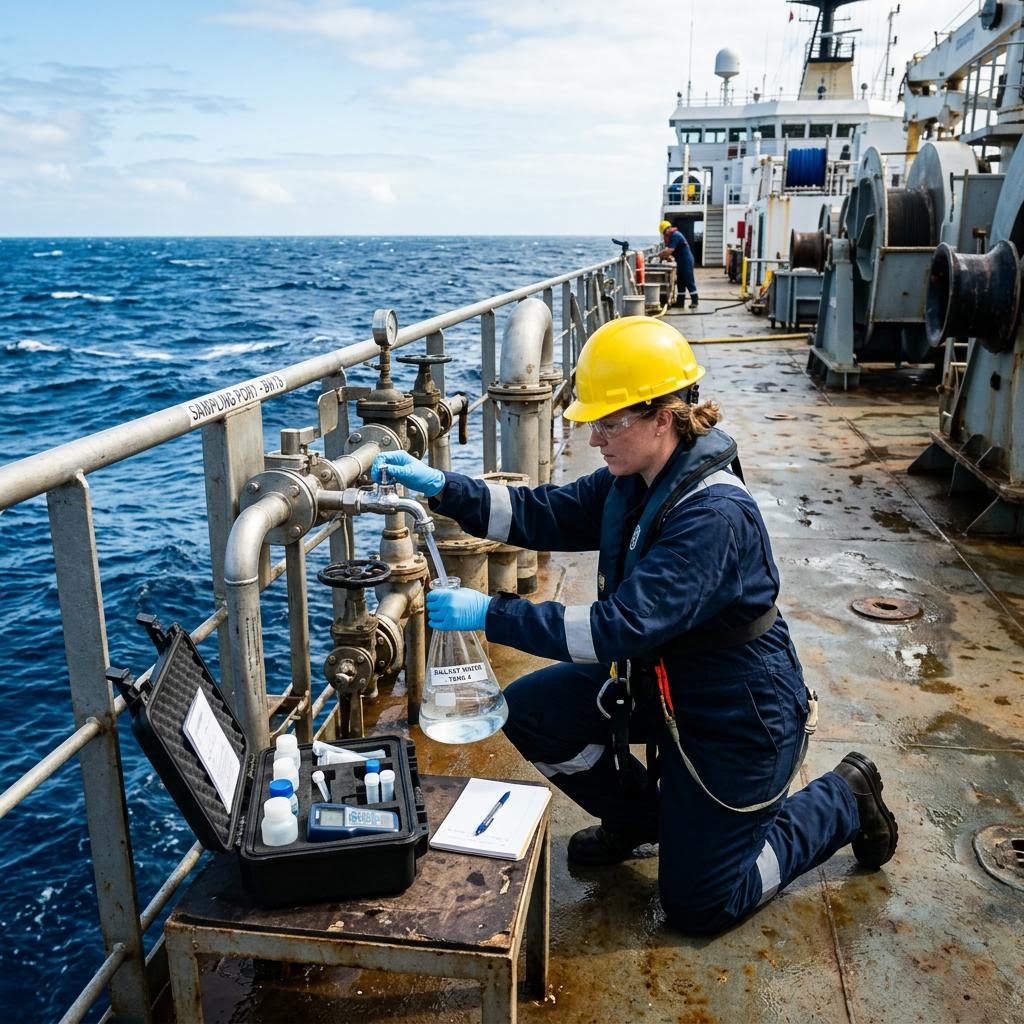
They must also be able to take ballast water samples at the designated points, maintain and calibrate the TRO or UV-intensity sensors on schedule, manage reagents and consumables within shelf life, and keep the ballast water record book accurately and up to date.
For electrochlorination systems the crew must understand neutralisation and the safe handling of sodium thiosulfate and manage hydrogen-related safety; for UV systems, lamp and quartz-sleeve maintenance. The competences track the technology installed.
Who Provides the Training and When?
Initial familiarisation is normally delivered by the manufacturer or an authorized service agent at commissioning, when the system is first run and the crew can learn on the actual equipment. This hands-on session, tied to the commissioning test, is the anchor of crew competence.
The operating manual, the ship's ballast water management plan, and any manufacturer training materials support and extend that initial session, and are the reference the crew returns to. Some operators supplement with computer-based or classroom training ashore.
Because commissioning familiarisation only reaches the crew aboard at the time, the operator's onboard handover and familiarisation procedures must carry competence forward to later crews. This is a ship-management responsibility, not just a manufacturer one.
What Does Compliance and Record-Keeping Training Cover?
The crew must be able to complete the ballast water record book accurately, recording every ballasting, deballasting, and treatment operation, along with any system faults and contingency measures. Record-keeping errors are among the most common port state control findings, so this training is disproportionately valuable.
They must understand the D-2 standard the ship must meet, the role of the type approval certificate, and how the self-monitoring data — flow, TRO, alarms — supports the compliance case. Understanding why the records matter improves how carefully they are kept.
Sampling competence matters too: knowing where and how to take a representative sample if requested by an inspector, and understanding the difference between the ship's own indicative monitoring and detailed analysis. Sea Clean AS coordinates sampling with independent ISO 17025 laboratories and is not itself an accredited lab.
How Is Competence Maintained as Crews Rotate?
The single biggest risk to sustained compliance is competence loss across crew changes. A robust onboard familiarisation checklist for joining officers and engineers, a well-maintained operating manual, and clear handover notes preserve the knowledge the commissioning session established.
Refresher training — whether onboard, computer-based, or ashore — helps, especially where a system is operated infrequently and skills fade between uses. Operators with fleets often standardise training so a crew moving between similar ships stays competent.
Documenting who has been familiarised, and when, both supports safe operation and provides evidence to port state control that the operator takes crew competence seriously. This documentation is part of a defensible compliance posture.
How Can Sea Clean Support Crew Training?
Sea Clean AS can provide onboard familiarisation and technical support around commissioning and service attendance, helping crews learn operation, alarm response, sensor calibration, and record-keeping on the actual installed equipment. As an authorized Headway agent it supports OceanGuard directly.
For other brands Sea Clean provides independent, brand-agnostic technical support and can help crews understand operation and maintenance, without claiming manufacturer-authorized status it does not hold. It states its authorized-agent scope clearly.
In Norway and the North Sea region attendance is available 0–24 hours; elsewhere it is arranged by prior agreement. Sea Clean coordinates any biological sampling with independent ISO 17025 laboratories and does not itself act as an accredited laboratory.
Frequently asked questions
Who trains the crew on a newly retrofitted BWTS?
Initial familiarisation is normally delivered by the manufacturer or an authorized service agent at commissioning, when the crew can learn on the actual equipment. The operating manual, the ballast water management plan, and any manufacturer training materials support that session and serve as ongoing reference.
What does a port state control inspector expect the crew to demonstrate?
That they can operate the system, respond to alarms, take a representative sample if asked, and produce an accurate, up-to-date ballast water record book. A crew unable to demonstrate a ballasting operation or with a poorly kept record book is a serious finding.
How do we keep competence as crews change?
Through a robust onboard familiarisation checklist for joining officers and engineers, a well-maintained operating manual, clear handover notes, and refresher training. Documenting who was familiarised and when supports both safe operation and the compliance case to inspectors.
Does the crew need training on sensor calibration?
Yes. The crew must maintain and calibrate the TRO or UV-intensity sensors on schedule and manage reagents within shelf life, because drifting or uncalibrated sensors undermine both performance and the compliance record. This is part of the routine competence expected after a retrofit.
Sources
Related articles
Request spares, calibration or ballast-water testing
Include BWMS brand/model, vessel/IMO number, port/terminal, date/ETA and scope or part numbers. These links prepare an email draft; you must send it yourself.
- Request a parts quote — Sensors, TRO reagents, calibration kits and replacement parts. Confirm compatibility, availability and delivery for your installed system.
- Request a calibration booking — Annual instrument calibration with a calibration certificate for the work completed. OEM instructions, drift or applicable rules may require earlier work.
- Request testing coordination — Arrange sampling and testing with an appropriately qualified party for your IMO D-2, commissioning or other stated purpose.
Authorised Headway agent. Other-brand enquiries are independently reviewed; no OEM authorisation is claimed. Sea Clean is not an accredited laboratory or approving authority. Calibration does not demonstrate biological D-2 compliance. Attendance, testing scope and parts delivery are confirmed per enquiry.