BWTS Retrofit Guide for Existing Vessels
Updated
A BWTS retrofit on an existing vessel typically runs 6–12 months from feasibility study to commissioning, with 3–5 weeks of on-board installation, and costs USD 0.8–3 million depending on ballast capacity and vessel type. The critical path is engineering — a 3D scan, class-approved drawings, and power availability — not the hardware lead time. Under the BWM Convention regulation D-2 every existing ship carrying ballast internationally must have an approved system fitted.
Request BWTS spare parts, annual calibration or ballast-water testing
Key takeaways
- The BWM Convention regulation D-2 requires every ship carrying ballast internationally to have an approved treatment system; for most of the fleet the IOPP-linked deadline has already passed.
- A full retrofit typically takes 6–12 months from feasibility to commissioning, with 3–5 weeks of concentrated on-board installation work.
- Installed cost is indicative and ranges from roughly USD 0.8 million for a small vessel to USD 3 million or more for a large tanker or bulker.
- Engineering — 3D laser scanning, class-approved drawings, and confirmed electrical margin — is the true critical path, not hardware lead time.
- The installed system must hold a type approval certificate under MEPC.300(72) and be commissioning-tested under MEPC.325(75), which is an indicative test, not a full D-2 validation.
- Technology choice follows trading pattern: UV is salinity-independent but power-hungry, while electrochlorination is compact but salinity-dependent and needs neutralisation.
Why Do Existing Vessels Need a BWTS Retrofit?
The IMO Ballast Water Management Convention entered into force on 8 September 2017 and requires every ship carrying ballast water internationally to meet the D-2 discharge standard, which limits viable organisms to fewer than 10 per cubic metre for organisms ≥50 micrometres and fewer than 10 per millilitre for the 10–50 micrometre range. Existing ships transitioned from the D-1 exchange standard to D-2 on a schedule tied to the International Oil Pollution Prevention (IOPP) renewal survey.
For the overwhelming majority of the world fleet that renewal window has now passed, so a vessel trading internationally without an approved and commissioned system is out of compliance and exposed to port state control detention. The retrofit is therefore not optional for a ship that intends to keep discharging ballast at foreign ports.
A retrofit differs fundamentally from a newbuild installation because the ship was not designed around the system. Engine-room space is already committed, the ballast piping runs where the original yard put it, and electrical margin on the switchboard may be tight. That is why retrofit projects live or die on engineering discipline rather than on the treatment technology itself.
How Do You Choose the Right Technology?
The two dominant approaches are UV disinfection and electrochlorination (side-stream or full-flow electrolysis), both preceded by filtration to a typical 40–50 micrometre screen. UV systems are salinity-independent and store no chemicals, but they draw high electrical power at rated flow and are sensitive to low UV transmittance in turbid or coloured water. Electrochlorination systems dose oxidant generated from seawater chloride, so they are salinity-dependent and require neutralisation on discharge but tend to draw less power at large flow rates.
Selection should follow the vessel's actual trading pattern: a tanker or bulker with large ballast capacity and low-salinity loading ports has different constraints from a coastal vessel in consistent seawater. Ballast pump capacity sets the required treatment flow rate, and the type approval certificate must cover that flow, the salinity range, and the water temperature the ship will actually encounter.
Space and power availability frequently narrow the choice before performance does. A compact engine room may not accommodate a full-flow electrolysis reactor and its degassing arrangement, while a UV system's power demand may exceed available generator margin during ballasting. Match the type-approved envelope to the ship, not the marketing brochure.
What Engineering Comes Before Installation?
The foundation of a successful retrofit is an accurate as-built model of the installation space, produced by 3D laser scanning of the engine room or pump room. The scan feeds a point cloud that lets engineers route piping, position the skid, and plan cable runs without repeated ship visits, and it exposes clashes with existing systems before any steel is cut.
From the model the design team produces general arrangement drawings, a piping and instrumentation diagram, structural foundation drawings, and an electrical load and cable schedule. These are submitted to the vessel's classification society for approval in principle and then for detailed drawing approval before fabrication begins.
The electrical study is often the quietest showstopper. A large UV or electrolysis system adds a significant load during ballasting, and if the existing generators cannot carry it alongside the ballast pumps and normal sea load, the project scope grows to include generator or switchboard work. Confirming power margin early prevents an expensive surprise at the yard.
How Is the System Installed On Board?
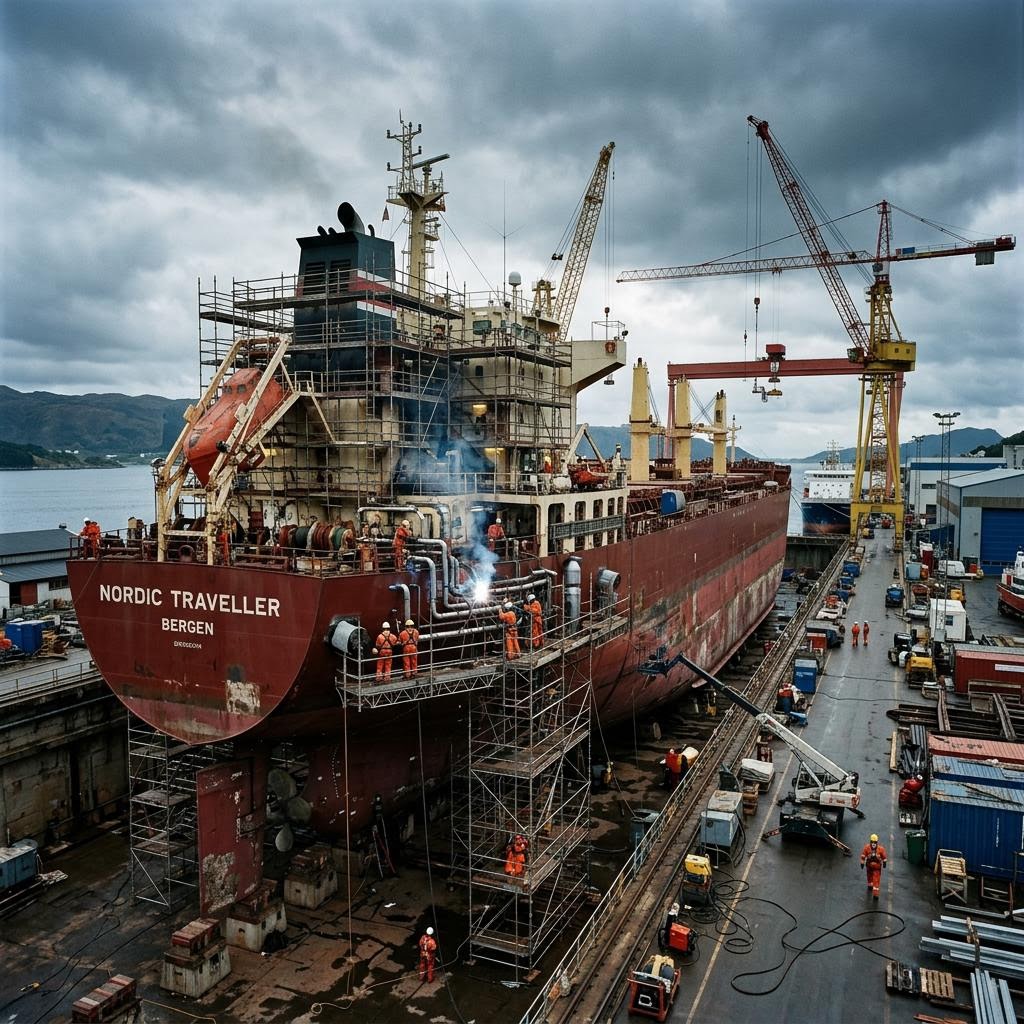
Installation can be done in drydock during a scheduled docking, alongside at a repair berth, or progressively by a riding crew while the ship trades. Drydock offers the cleanest access and the ability to open the sea chests, but it competes for time against every other docking job. A riding-crew approach spreads the work across voyages but demands careful hot-work permits and gas-freeing on tankers.
Typical on-board mechanical and electrical work — mounting the skid and filter, tie-ins to the ballast main, cable pulling, and instrument fitting — runs about three to five weeks of concentrated effort for a mid-size vessel, though pre-fabrication of pipe spools ashore shortens the ship time considerably.
The tie-in points into the existing ballast piping and the interface with the ballast pumps and valves are the highest-risk mechanical work. Poor pipe support, undersized spools that add pressure drop, or valves that no longer seat all show up later as flow and TRO problems, so this is where quality control matters most.
How Do Class Approval and Commissioning Work?
The installed system must carry a type approval certificate issued under the IMO BWMS Code, MEPC.300(72), and the installation drawings must be approved by the vessel's classification society. Class attends to verify the installation matches the approved drawings and that safety items — hydrogen venting on electrolysis systems, explosion protection in tanker pump rooms — are correctly executed.
Commissioning testing under IMO resolution MEPC.325(75) is mandatory for systems installed after its effective date. It verifies that the mechanical, electrical, self-monitoring, and control functions operate correctly and includes an indicative biological sample. This is an indicative test that confirms the system was installed and functions properly; it is not a full D-2 compliance validation.
The vessel also needs an approved ballast water management plan reflecting the installed equipment, a ballast water record book, and crew familiarisation before the system is used in service. Sea Clean AS can coordinate commissioning support and, for biological sampling, works with independent ISO 17025 laboratories rather than acting as an accredited lab itself.
How Should You Plan the Project and Budget?
A realistic timeline is six to twelve months from feasibility study to commissioning, dominated by engineering, class approval, and equipment procurement rather than by the physical installation. Booking the technology and the yard slot early, and completing the 3D scan and drawing approval before the docking, keeps the ship time short and predictable.
Installed cost is highly variable but typically falls between roughly USD 0.8 million for a small, straightforward vessel and USD 3 million or more for a large tanker or bulker with high ballast capacity, complex piping, and added electrical work. These figures are indicative and move with steel prices, yard rates, and the amount of hot work required.
Sea Clean AS is an authorized agent for Headway Technology and supports OceanGuard retrofits directly; for other brands it provides independent, brand-agnostic engineering, parts, and service. In Norway and the North Sea region attendance is available 0–24 hours; elsewhere it is arranged by prior agreement.
Frequently asked questions
Is a BWTS retrofit still required if my ship is nearly at scrapping age?
If the vessel carries ballast water internationally and will do so past its IOPP renewal deadline, it needs an approved system to remain compliant. Some owners of near-end-of-life ships restrict trading or scrap early rather than retrofit; the decision is commercial, but trading non-compliant risks port state control detention.
How long will my ship be out of service for the retrofit?
The concentrated on-board work is typically 3–5 weeks for a mid-size vessel, but pre-fabricating pipe spools ashore and completing the 3D scan and drawing approval beforehand can shorten the ship time. A riding-crew approach can spread much of the work across trading voyages.
What is the single biggest risk in a BWTS retrofit?
Insufficient engineering up front. Space clashes, undersized piping that adds pressure drop, and inadequate electrical margin are far more common causes of failed projects than the treatment technology. An accurate 3D scan and an early electrical load study prevent most of them.
Does the retrofit need classification society approval?
Yes. The installation drawings must be approved by the vessel's classification society and the installed system must carry a valid type approval certificate under the IMO BWMS Code. Class also attends the installation and commissioning to verify it matches the approved design.
Sources
Related articles
- How Much Does a BWTS Retrofit Cost in 2026?
- 3D Scanning and Engineering for BWTS Retrofits
- Choosing a BWTS: Retrofit vs Newbuild Considerations
- BWTS Retrofit Timeline Planning and Yard Selection
- BWTS Retrofit for Bulk Carriers and Gravity Ballasting
- Retrofit BWTS for Tankers: Explosion-Proof Requirements
Request spares, calibration or ballast-water testing
Include BWMS brand/model, vessel/IMO number, port/terminal, date/ETA and scope or part numbers. These links prepare an email draft; you must send it yourself.
- Request a parts quote — Sensors, TRO reagents, calibration kits and replacement parts. Confirm compatibility, availability and delivery for your installed system.
- Request a calibration booking — Annual instrument calibration with a calibration certificate for the work completed. OEM instructions, drift or applicable rules may require earlier work.
- Request testing coordination — Arrange sampling and testing with an appropriately qualified party for your IMO D-2, commissioning or other stated purpose.
Authorised Headway agent. Other-brand enquiries are independently reviewed; no OEM authorisation is claimed. Sea Clean is not an accredited laboratory or approving authority. Calibration does not demonstrate biological D-2 compliance. Attendance, testing scope and parts delivery are confirmed per enquiry.