TRO Sensor Reagent Supply and Shelf Life Management
Updated
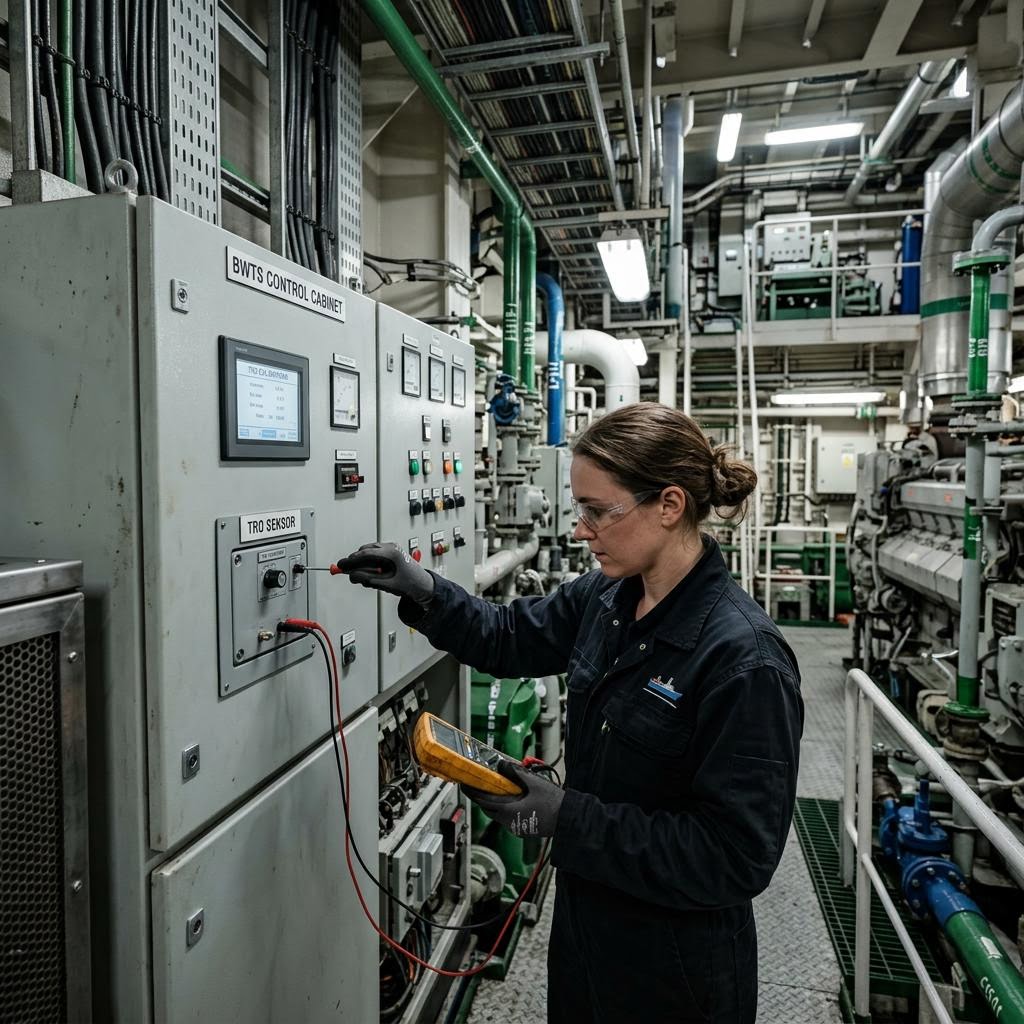
TRO analyzers verify that electrochemical BWTS deliver and then neutralize active oxidants, and their accuracy depends entirely on fresh, correctly stored reagent. Poor reagent management produces false TRO readings that can cause both compliance failures and unsafe over-dosing, so supply and shelf life deserve disciplined planning.
Key takeaways
- TRO analyzers verify both adequate dosing and neutralization, so reagent is a treatment-critical consumable, not a minor store.
- Reagent formulation is matched to the specific analyzer model; confirm by part number, not generic DPD description.
- Shelf life is commonly one to two years; expired reagent reads low and must not be used for compliance.
- Rotate stock first-expiry-first-out and log batch and expiry data in the PMS for auditable control.
- Store reagent cool, out of sunlight and within the SDS temperature range; heat dramatically shortens life.
- Calibrate to the OEM schedule and cross-check against a handheld DPD test when readings are doubted.
What TRO reagent does and why it is consumable-critical
Electrochlorination, electrolysis and chemical injection BWTS create active substances, measured as total residual oxidant (TRO), to disinfect ballast water. A TRO analyzer confirms the system generated enough oxidant during treatment and, crucially, that the oxidant has been neutralized below the discharge limit before deballasting. That analyzer is a wet-chemistry instrument that consumes reagent on every measurement cycle.
Many marine TRO monitors, including HF Scientific CLX-based analyzers used in several BWMS, rely on colorimetric chemistry related to the DPD method, where reagent reacts with oxidant to produce a colour proportional to concentration. The reading is only as good as the reagent. Degraded or wrong reagent gives a wrong number, and because the TRO value drives both dosing and neutralization control, the consequences propagate through the whole treatment cycle.
This makes TRO reagent a treatment-critical consumable rather than a minor store. A vessel that runs out of reagent, or runs on expired reagent, effectively loses its compliance monitoring even if the treatment hardware is healthy. Reagent supply must therefore be planned with the same rigour as UV lamps or electrodes.
Reagent chemistry and matching the analyzer
Reagents are formulated for the specific analyzer model and measurement range, so a CLX-series monitor uses a defined reagent formulation that is not freely interchangeable with reagents for other instruments. Within a given BWMS, the reagent part number is fixed by the analyzer the OEM fitted, and several BWMS brands share the same underlying HF Scientific platform, which is why cross-referencing reagent part numbers across systems is possible.
Different reagent formulations cover different oxidant ranges and water chemistries. Using a reagent intended for a different range or instrument can give readings that are biased, non-linear or simply meaningless. The correct practice is to source the reagent specified for your exact analyzer model, confirmed by part number rather than by generic description such as DPD reagent.
Because the same analyzers appear in multiple BWMS, a fleet operator can standardise reagent purchasing once the cross-reference is established. Sea Clean AS supplies TRO reagents cross-referenced to common analyzer platforms, which lets owners running mixed BWMS fleets simplify reagent stock without mismatching chemistry.
Shelf life, expiry and stock rotation
TRO reagents have a finite shelf life, commonly in the range of one to two years from manufacture depending on the formulation, after which the active chemistry degrades and readings drift low. Every batch carries a manufacturing or expiry date, and expired reagent must not be used for compliance monitoring because it understates true oxidant levels.
Stock rotation on a first-expiry-first-out basis is essential. Ordering reagent well ahead of need is sensible, but over-stocking risks reagent expiring on the shelf, so order quantity should be matched to consumption rate and the realistic shelf life remaining at delivery. Recording batch numbers and expiry dates in the planned maintenance system makes rotation auditable and prevents accidental use of out-of-date stock.
Consumption rate depends on how often the analyzer cycles, which depends on ballasting frequency and the analyzer's sampling interval. A vessel ballasting frequently consumes reagent faster, so per-vessel consumption should be measured rather than assumed. That figure drives both reorder quantity and reorder timing.
Storage conditions that preserve reagent
Temperature is the main enemy of reagent stability. Reagents should be stored within the manufacturer's specified range, typically cool and away from heat sources and direct sunlight, and many benefit from cool storage while avoiding freezing, which can damage the chemistry. A reagent locker that bakes in an engine room or sits in tropical sun ages stock far faster than its nominal shelf life implies.
Reagents are chemicals with safety data sheets, so storage must also follow the MSDS for the product, including segregation, ventilation and spill provisions. Crews should handle reagents with appropriate PPE and dispose of expired or spent reagent according to the SDS and the vessel's waste procedures rather than discharging it casually.
Sealed containers and avoiding contamination matter too. Once opened, some reagents have a shorter in-use life and can be spoiled by contamination from dirty sample lines or incorrect handling. Following the OEM's procedure for changing reagent, including priming and purging lines, ensures the analyzer reads the new reagent correctly rather than a diluted mix of old and new.
Calibration, verification and false readings
Fresh reagent is necessary but not sufficient; the analyzer also needs periodic calibration and verification. Following the OEM calibration schedule, using the correct calibration standards, confirms the instrument converts colour to concentration accurately. Skipping calibration lets slow drift go undetected even with good reagent.
False TRO readings have two dangerous failure modes. A reading that is falsely low during treatment can make the system over-dose to compensate, raising oxidant beyond what neutralization can handle and risking an over-limit discharge or corrosion. A reading that is falsely low at discharge, from degraded reagent, can pass water that still contains oxidant above the neutralization target. Both stem from poor reagent or calibration discipline.
Cross-checking the analyzer occasionally against an independent measurement, such as a handheld DPD test, is a sound verification practice during commissioning and troubleshooting. If the inline analyzer and a fresh manual test disagree, reagent age, calibration or sample-line condition is the usual cause, and reagent should be the first thing checked.
Frequently asked questions
What is the shelf life of TRO reagent?
Typically one to two years from manufacture, depending on the formulation, with an expiry date marked on each batch. Beyond that the active chemistry degrades and readings drift low, so expired reagent must not be used for compliance monitoring. Order to consumption rate and rotate stock first-expiry-first-out.
Can I use reagent from a different brand in my analyzer?
Only if it is the formulation specified for your exact analyzer model, confirmed by part number. Several BWMS share the same HF Scientific CLX platform, so the same reagent can serve multiple systems, but reagents for different instruments or ranges are not interchangeable and produce biased readings.
How should TRO reagent be stored on board?
Cool, dry, out of direct sunlight and within the manufacturer's temperature range, following the product safety data sheet for segregation and ventilation. Avoid heat sources and freezing, keep containers sealed, and dispose of expired or spent reagent per the SDS and vessel waste procedures.
What happens if the analyzer runs on degraded reagent?
It reads oxidant lower than the true value. During treatment that can drive over-dosing and corrosion or over-limit discharge; at neutralization it can pass water that still contains oxidant above the target. Both are serious, which is why reagent freshness and calibration are checked before trusting a doubtful reading.
Sources
Related articles
- TRO Monitoring in Ballast Water Systems: Measuring Total Residual Oxidant
- HF Scientific TRO Sensors and Analyzers in BWTS
- Neutralisation Systems and Sodium Thiosulfate Dosing in BWTS
- Electrochlorination BWTS Explained: Electrolysis, TRO Generation and Neutralisation
- Sourcing Genuine vs Equivalent BWTS Spare Parts
- Common Headway Z-Filter Wear Parts and Replacement Intervals