Can a Leaking Valve Undermine a Correct BWMS Reading?
Updated
A treatment sensor can correctly measure its own stream while another path allows water around it. Route integrity and actual valve behaviour therefore matter as much as a normal display.
Request BWTS spare parts, annual calibration or ballast-water testing
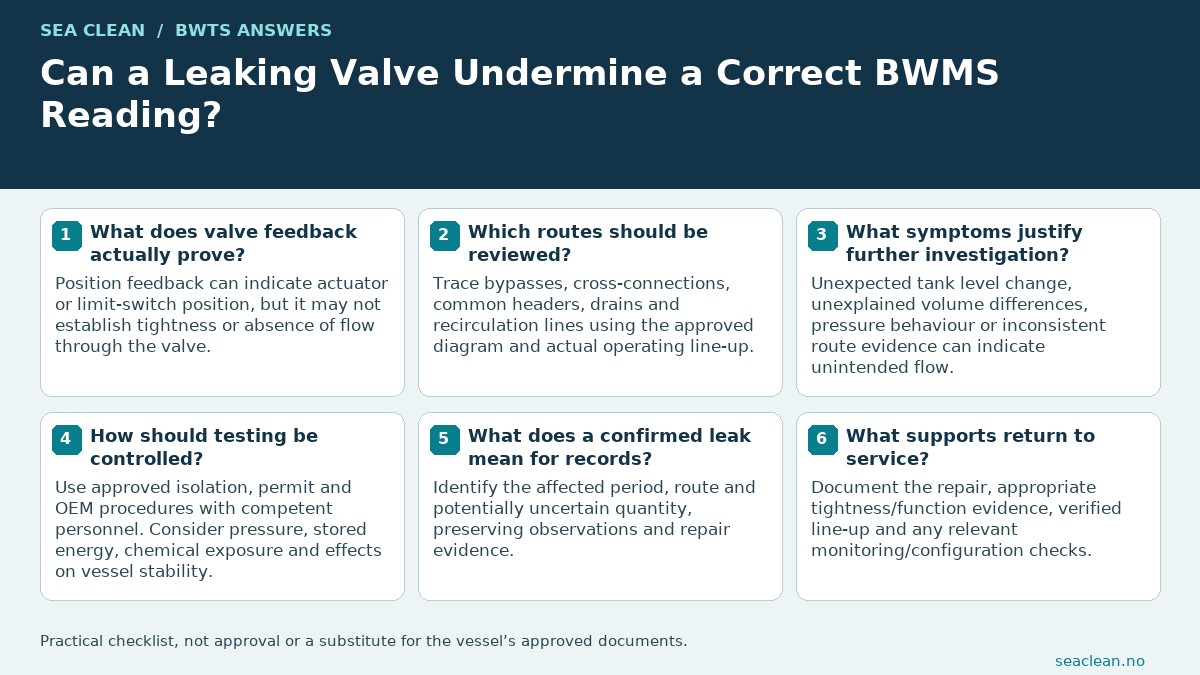
Key takeaways
- Feedback is not always tightness evidence.
- Trace routes outside monitoring.
- Investigate inconsistent flow symptoms.
- Test only under safe approved procedures.
- Bound affected operations and quantities.
- Separate repair from past treatment.
What does valve feedback actually prove?
Position feedback can indicate actuator or limit-switch position, but it may not establish tightness or absence of flow through the valve.
Use the installed design’s stated capabilities. Do not interpret a 'closed' icon as universal proof of isolation.
Which routes should be reviewed?
Trace bypasses, cross-connections, common headers, drains and recirculation lines using the approved diagram and actual operating line-up.
Identify which branches lie outside the treatment/monitoring boundary. A correct sensor value cannot represent water it never sees.
Related guidance: BWMS Management Plan Change Control: When Does a Revision Need Approval?
What symptoms justify further investigation?
Unexpected tank level change, unexplained volume differences, pressure behaviour or inconsistent route evidence can indicate unintended flow.
These symptoms are not a diagnosis by themselves. Compare alternative explanations before attributing the issue to a leaking bypass valve.
How should testing be controlled?
Use approved isolation, permit and OEM procedures with competent personnel. Consider pressure, stored energy, chemical exposure and effects on vessel stability.
Do not improvise live valve tests, force actuators or defeat interlocks during a discharge to gather evidence.
What does a confirmed leak mean for records?
Identify the affected period, route and potentially uncertain quantity, preserving observations and repair evidence.
Assess operational and notification implications through the responsible route. Do not rewrite all water as approved treatment merely because the leak was later repaired.
Related guidance: Is a Port’s Acknowledgment the Same as Ballast Discharge Permission?
What supports return to service?
Document the repair, appropriate tightness/function evidence, verified line-up and any relevant monitoring/configuration checks.
Keep equipment restoration separate from disposition of affected ballast. A successful valve test does not retrospectively establish treatment of past flow.
Frequently asked questions
Does a closed icon prove zero leakage?
Not necessarily. Check what the installed feedback system actually verifies.
Can a normal TRO value cover bypass flow?
No. It represents the sampled stream, not every possible route.
Should a valve be forced during live discharge?
No. Use approved safe isolation and testing methods.
Does repair validate earlier ballast?
No. The affected operational history needs a separate assessment.
Sources
- IMO — BWMS Code, MEPC.300(72) — Approval framework, monitoring, system design limitations and biological performance; not a universal maker procedure.
- IMO — BWM.2/Circ.80/Rev.1: record-keeping and reporting — The linked PDF is the revised circular dated 24 October 2024, despite its shorter filename.
- IMO — BWM Convention and implementation guidelines
Related articles
- What Should Be Checked Before Discharging Long-Stored Ballast?
- Is a Port’s Acknowledgment the Same as Ballast Discharge Permission?
- BWMS Management Plan Change Control: When Does a Revision Need Approval?
- BWTS Contingency Notification Pack: What to Send Flag and Port
- What Is a Ballast Water Treatment System? Explained
- How Does BWTS Installation Work? Step by Step
Request spares, calibration or ballast-water testing
Include BWMS brand/model, vessel/IMO number, port/terminal, date/ETA and scope or part numbers. These links prepare an email draft; you must send it yourself.
- Request a parts quote — Sensors, TRO reagents, calibration kits and replacement parts. Confirm compatibility, availability and delivery for your installed system.
- Request a calibration booking — Annual instrument calibration with a calibration certificate for the work completed. OEM instructions, drift or applicable rules may require earlier work.
- Request testing coordination — Arrange sampling and testing with an appropriately qualified party for your IMO D-2, commissioning or other stated purpose.
Authorised Headway agent. Other-brand enquiries are independently reviewed; no OEM authorisation is claimed. Sea Clean is not an accredited laboratory or approving authority. Calibration does not demonstrate biological D-2 compliance. Attendance, testing scope and parts delivery are confirmed per enquiry.