Must an Installed BWMS Be Replaced When Its Type-Approval Certificate Expires?
Updated
The BWMS Code distinguishes a type-approval certificate’s validity period from the operational validity of an approved installed system. Expiry alone is not a blanket replacement instruction, but the vessel must still satisfy its applicable approval and operating conditions.
Request BWTS spare parts, annual calibration or ballast-water testing
Key takeaways
- Expiry alone is not automatic replacement.
- Distinguish equipment and vessel certificates.
- Verify the correct approval history.
- Review modifications independently.
- Retain operating limitations.
- Document the actual replacement basis.
What does the BWMS Code say?
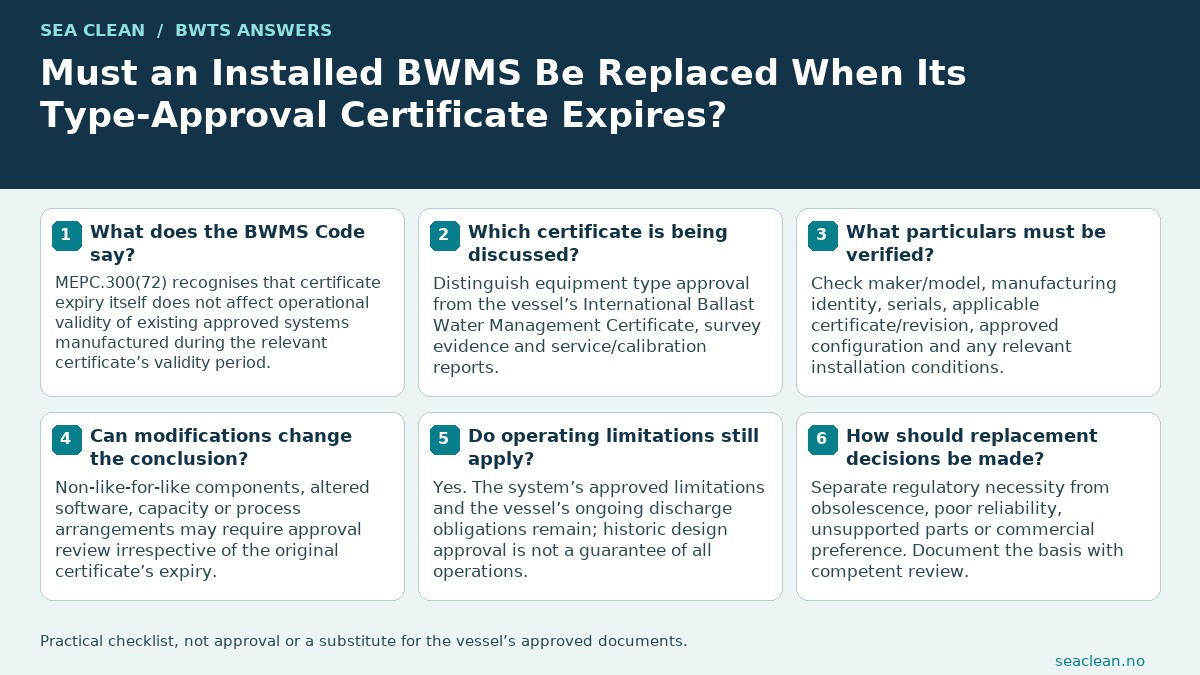
MEPC.300(72) recognises that certificate expiry itself does not affect operational validity of existing approved systems manufactured during the relevant certificate’s validity period.
It states that the system need not be renewed or replaced due to expiry of that certificate alone. Read the actual certificate and applicable vessel circumstances.
Which certificate is being discussed?
Distinguish equipment type approval from the vessel’s International Ballast Water Management Certificate, survey evidence and service/calibration reports.
An expired vessel certificate or overdue survey is a separate issue. Do not extend the equipment-design principle to every document with an expiry date.
Related guidance: BWM Compliance Responsibility Matrix for Shipowners, Managers, Masters and Chief Engineers
What particulars must be verified?
Check maker/model, manufacturing identity, serials, applicable certificate/revision, approved configuration and any relevant installation conditions.
A photocopy for a different product or later model does not establish the installed system’s basis. Request the correct approval history where evidence is missing.
Can modifications change the conclusion?
Non-like-for-like components, altered software, capacity or process arrangements may require approval review irrespective of the original certificate’s expiry.
Do not use historic approval to authorise a changed configuration. Identify the responsible OEM/Administration review route and retain its scope.
Do operating limitations still apply?
Yes. The system’s approved limitations and the vessel’s ongoing discharge obligations remain; historic design approval is not a guarantee of all operations.
Check current technical condition, manuals, monitoring and any relevant authority instructions instead of relying on the certificate date alone.
Related guidance: How Should a BWMS Return to Service After Lay-Up?
How should replacement decisions be made?
Separate regulatory necessity from obsolescence, poor reliability, unsupported parts or commercial preference. Document the basis with competent review.
Avoid premature replacement or unsupported reassurance based only on expiry. Vessel/Administration requirements and any separate US approval context must be assessed individually.
Frequently asked questions
Does expiry automatically invalidate installed equipment?
Not under the principle stated in MEPC.300(72) for the relevant approved/manufactured systems; verify the actual circumstances.
Does this extend a vessel’s statutory certificate?
No. Vessel certification and surveys are separate.
Can the original certificate approve a different sensor?
Not automatically. Review configuration and substitution requirements.
Can obsolescence still justify replacement?
Yes, but that is a separate reliability/support or project decision, not expiry alone.
Sources
- IMO — BWMS Code, MEPC.300(72) — Approval framework, monitoring, system design limitations and biological performance; not a universal maker procedure.
- IMO — BWM.2/Circ.80/Rev.1: record-keeping and reporting — The linked PDF is the revised circular dated 24 October 2024, despite its shorter filename.
- IMO — BWM Convention and implementation guidelines
Related articles
- Which Ballast Records Need Custody Control After Management Changes?
- How Should a BWMS Return to Service After Lay-Up?
- BWM Compliance Responsibility Matrix for Shipowners, Managers, Masters and Chief Engineers
- BWMS Logs and Record Books: Building a PSC Evidence Pack
- When Does a BWMS Modification Need Approval?
- What Is a Ballast Water Treatment System? Explained
Request spares, calibration or ballast-water testing
Include BWMS brand/model, vessel/IMO number, port/terminal, date/ETA and scope or part numbers. These links prepare an email draft; you must send it yourself.
- Request a parts quote — Sensors, TRO reagents, calibration kits and replacement parts. Confirm compatibility, availability and delivery for your installed system.
- Request a calibration booking — Annual instrument calibration with a calibration certificate for the work completed. OEM instructions, drift or applicable rules may require earlier work.
- Request testing coordination — Arrange sampling and testing with an appropriately qualified party for your IMO D-2, commissioning or other stated purpose.
Authorised Headway agent. Other-brand enquiries are independently reviewed; no OEM authorisation is claimed. Sea Clean is not an accredited laboratory or approving authority. Calibration does not demonstrate biological D-2 compliance. Attendance, testing scope and parts delivery are confirmed per enquiry.