What Is a Tank’s Status After BWMS Failure During Uptake?
Updated
A treatment failure part-way through filling does not make the whole tank either automatically compliant or automatically recoverable. Establish the actual route, affected time interval and mixed contents before planning what happens next.
Request BWTS spare parts, annual calibration or ballast-water testing
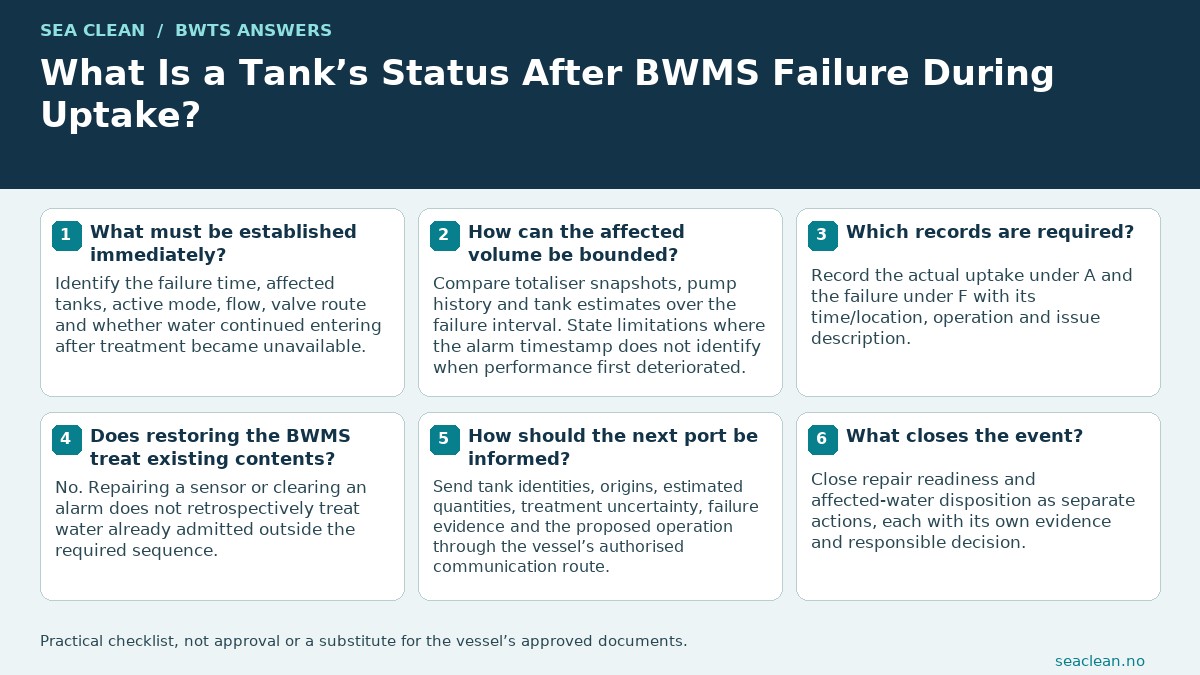
Key takeaways
- Identify whether uptake continued.
- Bound the affected time and volume.
- Record A and F as applicable.
- Repair does not treat past uptake.
- Disclose mixed or uncertain contents.
- Close equipment and water status separately.
What must be established immediately?
Identify the failure time, affected tanks, active mode, flow, valve route and whether water continued entering after treatment became unavailable.
Follow safety and OEM stop instructions. Protect stability, but do not defeat interlocks merely to complete the planned filling sequence.
How can the affected volume be bounded?
Compare totaliser snapshots, pump history and tank estimates over the failure interval. State limitations where the alarm timestamp does not identify when performance first deteriorated.
Separate water known to have followed the approved treatment sequence from uncertain or untreated portions. Avoid assigning the entire tank a convenient single status.
Related guidance: BWTS Record Book Entries After an Alarm, Repair or Failed Operation
Which records are required?
Record the actual uptake under A and the failure under F with its time/location, operation and issue description.
Where the failure is unresolved, revised IMO guidance calls for a second F entry when the BWMS is rectified and made operational.
Does restoring the BWMS treat existing contents?
No. Repairing a sensor or clearing an alarm does not retrospectively treat water already admitted outside the required sequence.
Check whether the approved system and plan provide an appropriate treatment route for those contents; do not improvise recirculation as a universal remedy.
How should the next port be informed?
Send tank identities, origins, estimated quantities, treatment uncertainty, failure evidence and the proposed operation through the vessel’s authorised communication route.
Ask for applicable direction before a restricted operation. Describe the limitation accurately rather than stating 'BWMS now operational' as if it resolved all stored water.
Related guidance: What Should You Preserve After a BWMS Power Loss?
What closes the event?
Close repair readiness and affected-water disposition as separate actions, each with its own evidence and responsible decision.
The master’s handover should identify tanks still restricted or uncertain. A completed maintenance job must not automatically close the ballast-management issue.
Frequently asked questions
Is the whole tank treated after an alarm reset?
No. Resetting or restoring equipment does not establish the treatment history of the stored water.
Can volume be calculated from flow times duration?
Only with a defensible interval and measurement basis; identify uncertainty and compare other evidence.
Does every alarm require Code F?
F covers failures/inoperabilities and relevant critical alarms, not routine information and warnings.
Can circulation always recover the tank?
No. Recovery must follow the installed system’s approved capability, plan and applicable authority direction.
Sources
- IMO — BWM.2/Circ.80/Rev.1: record-keeping and reporting — The linked PDF is the revised circular dated 24 October 2024, despite its shorter filename.
- IMO — MEPC.369(80): revised record-book form
- IMO — BWMS Code, MEPC.300(72) — Approval framework, monitoring, system design limitations and biological performance; not a universal maker procedure.
Related articles
- What Should an Electronic Ballast Record Book Export Preserve?
- What Should You Preserve After a BWMS Power Loss?
- BWTS Record Book Entries After an Alarm, Repair or Failed Operation
- BWMS Logs and Record Books: Building a PSC Evidence Pack
- How Should You Track Ballast from Different Ports in One Tank?
- What Is a Ballast Water Treatment System? Explained
Request spares, calibration or ballast-water testing
Include BWMS brand/model, vessel/IMO number, port/terminal, date/ETA and scope or part numbers. These links prepare an email draft; you must send it yourself.
- Request a parts quote — Sensors, TRO reagents, calibration kits and replacement parts. Confirm compatibility, availability and delivery for your installed system.
- Request a calibration booking — Annual instrument calibration with a calibration certificate for the work completed. OEM instructions, drift or applicable rules may require earlier work.
- Request testing coordination — Arrange sampling and testing with an appropriately qualified party for your IMO D-2, commissioning or other stated purpose.
Authorised Headway agent. Other-brand enquiries are independently reviewed; no OEM authorisation is claimed. Sea Clean is not an accredited laboratory or approving authority. Calibration does not demonstrate biological D-2 compliance. Attendance, testing scope and parts delivery are confirmed per enquiry.