How Do You Record a Partial Ballast Discharge from Several Tanks?
Updated
A partial discharge should leave a clear account of which water left and what remained. Combining several tanks is only useful when the entry still identifies their operations and any differing treatment conditions.
Request BWTS spare parts, annual calibration or ballast-water testing
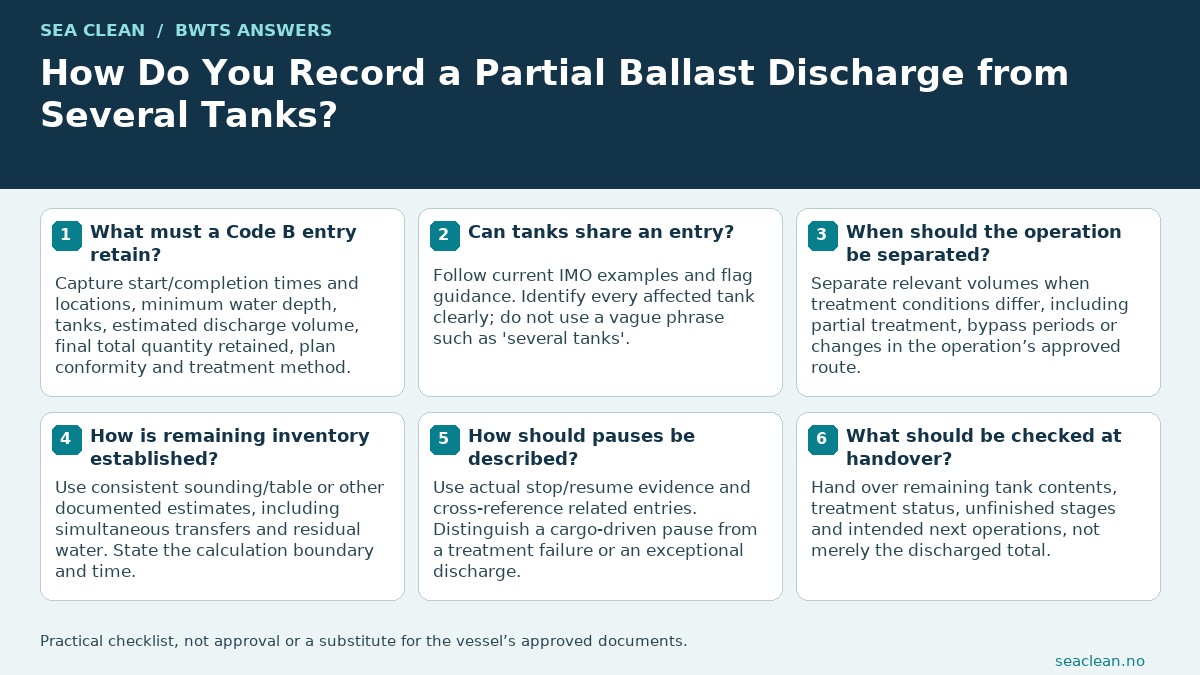
Key takeaways
- Name each affected tank.
- Separate discharge from retained volume.
- Split different treatment conditions.
- Keep tank-level supporting estimates.
- Explain pauses and failures.
- Hand over remaining treatment status.
What must a Code B entry retain?
Capture start/completion times and locations, minimum water depth, tanks, estimated discharge volume, final total quantity retained, plan conformity and treatment method.
The quantity retained is not automatically zero. A partial emptying must distinguish transferred volume from water still aboard.
Can tanks share an entry?
Follow current IMO examples and flag guidance. Identify every affected tank clearly; do not use a vague phrase such as 'several tanks'.
Maintain supporting tank-by-tank quantities when needed to reconstruct origin, treatment and remaining contents, especially for subsequent port reporting.
Related guidance: Ballast Water Record Book: Printable PDF, IMO Requirements and Calibration
When should the operation be separated?
Separate relevant volumes when treatment conditions differ, including partial treatment, bypass periods or changes in the operation’s approved route.
Revised guidance calls for multiple entries where more than one treatment method applies. A single 'approved BWMS' label must not conceal untreated portions.
How is remaining inventory established?
Use consistent sounding/table or other documented estimates, including simultaneous transfers and residual water. State the calculation boundary and time.
Retain the tank-level worksheet; the final ship-wide quantity alone cannot explain which tank will supply the next discharge.
How should pauses be described?
Use actual stop/resume evidence and cross-reference related entries. Distinguish a cargo-driven pause from a treatment failure or an exceptional discharge.
Record relevant BWMS failures under F and exceptional events under the appropriate code. Commercial sequencing does not remove those obligations.
Related guidance: Is an Internal Ballast Transfer Code H or Code C2?
What should be checked at handover?
Hand over remaining tank contents, treatment status, unfinished stages and intended next operations, not merely the discharged total.
The next watch should reconcile the record book, tank log and BWMS evidence before assuming all remaining ballast has the same status.
Frequently asked questions
Does partial discharge mean final volume is zero?
No. Record the estimated quantity still retained aboard.
Can treated and bypassed volumes share one claim?
No. Distinguish their actual treatment status and relevant volumes.
Is the tank-by-tank log the statutory book?
No. It supports the record book and port reporting rather than replacing required entries.
Should a stopped operation disappear from the log?
No. Its actual sequence and relevant interruptions must remain traceable.
Sources
- IMO — MEPC.369(80): revised record-book form
- IMO — BWM.2/Circ.80/Rev.1: record-keeping and reporting — The linked PDF is the revised circular dated 24 October 2024, despite its shorter filename.
- IMO — BWM Convention and implementation guidelines
Related articles
- Why Do Ballast Tank Soundings and Flow Totals Disagree?
- Is an Internal Ballast Transfer Code H or Code C2?
- Ballast Water Record Book: Printable PDF, IMO Requirements and Calibration
- BWMS Hard-Copy Records and Onboard Document Control
- Troubleshooting High TRO Alarms at Ballast Discharge
- What Is a Ballast Water Treatment System? Explained
Request spares, calibration or ballast-water testing
Include BWMS brand/model, vessel/IMO number, port/terminal, date/ETA and scope or part numbers. These links prepare an email draft; you must send it yourself.
- Request a parts quote — Sensors, TRO reagents, calibration kits and replacement parts. Confirm compatibility, availability and delivery for your installed system.
- Request a calibration booking — Annual instrument calibration with a calibration certificate for the work completed. OEM instructions, drift or applicable rules may require earlier work.
- Request testing coordination — Arrange sampling and testing with an appropriately qualified party for your IMO D-2, commissioning or other stated purpose.
Authorised Headway agent. Other-brand enquiries are independently reviewed; no OEM authorisation is claimed. Sea Clean is not an accredited laboratory or approving authority. Calibration does not demonstrate biological D-2 compliance. Attendance, testing scope and parts delivery are confirmed per enquiry.