What Water Depth Should a Ballast Record Book Entry Show?
Updated
For Code A and B, the revised form asks for minimum water depth during the operation. This is not simply the ship’s draught or under-keel clearance, and the source should be defensible when conditions vary.
Request BWTS spare parts, annual calibration or ballast-water testing
Key takeaways
- Use the depth prompt for the correct code.
- Separate depth from under-keel clearance.
- Check sounder reference offsets.
- Use contemporaneous bridge evidence.
- Do not invent missing precision.
- Depth does not authorise discharge.
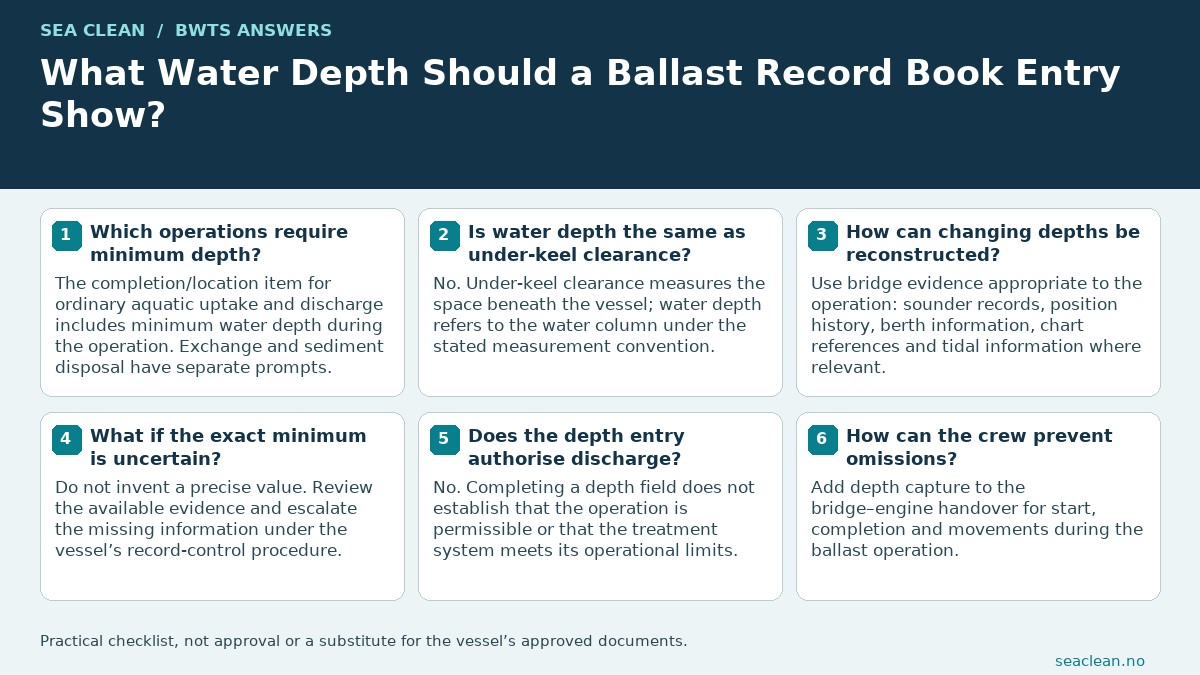
Which operations require minimum depth?
The completion/location item for ordinary aquatic uptake and discharge includes minimum water depth during the operation. Exchange and sediment disposal have separate prompts.
Use the correct code’s requirements rather than assuming one depth field applies identically to every operation, facility transfer or exceptional event.
Is water depth the same as under-keel clearance?
No. Under-keel clearance measures the space beneath the vessel; water depth refers to the water column under the stated measurement convention.
Check the echo-sounder reference: transducer, keel or surface. An uncorrected display can be misleading if its offset is not understood.
Related guidance: Ballast Water Record Book: Printable PDF, IMO Requirements and Calibration
How can changing depths be reconstructed?
Use bridge evidence appropriate to the operation: sounder records, position history, berth information, chart references and tidal information where relevant.
Identify the basis and limitations. A charted depth alone may not capture tidal change or the vessel moving during a long operation.
What if the exact minimum is uncertain?
Do not invent a precise value. Review the available evidence and escalate the missing information under the vessel’s record-control procedure.
Any estimate should be identified honestly with its basis and uncertainty, subject to flag guidance; a convenient default is not evidence.
Does the depth entry authorise discharge?
No. Completing a depth field does not establish that the operation is permissible or that the treatment system meets its operational limits.
Check the approved plan, local restrictions and actual treatment status separately. Depth is one recorded fact, not a discharge approval.
Related guidance: Why Do Ballast Tank Soundings and Flow Totals Disagree?
How can the crew prevent omissions?
Add depth capture to the bridge–engine handover for start, completion and movements during the ballast operation.
Reconcile the final entry with location and time evidence before page signature; correct omissions visibly rather than inserting an unexplained number later.
Frequently asked questions
Can I enter the vessel’s draught as depth?
No. Draught and water depth are different quantities.
Is a charted depth always sufficient?
Not necessarily. Tide, movement and measurement references can affect the actual minimum.
Do facility transfers use the same depth item?
Code D has its own required items; use those rather than copying the A/B checklist.
What should happen when depth is missing?
Review reliable source evidence, identify any uncertainty and follow flag/company correction and escalation procedures.
Sources
- IMO — MEPC.369(80): revised record-book form
- IMO — BWM.2/Circ.80/Rev.1: record-keeping and reporting — The linked PDF is the revised circular dated 24 October 2024, despite its shorter filename.
- IMO — BWM Convention and implementation guidelines
Related articles
- How Do You Record Ballast Operations Across Midnight?
- Why Do Ballast Tank Soundings and Flow Totals Disagree?
- Ballast Water Record Book: Printable PDF, IMO Requirements and Calibration
- BWMS Hard-Copy Records and Onboard Document Control
- What Records Are Needed When Water Quality Challenges the BWMS?
- What Is a Ballast Water Treatment System? Explained
Request spares, calibration or ballast-water testing
Include BWMS brand/model, vessel/IMO number, port/terminal, date/ETA and scope or part numbers. These links prepare an email draft; you must send it yourself.
- Request a parts quote — Sensors, TRO reagents, calibration kits and replacement parts. Confirm compatibility, availability and delivery for your installed system.
- Request a calibration booking — Annual instrument calibration with a calibration certificate for the work completed. OEM instructions, drift or applicable rules may require earlier work.
- Request testing coordination — Arrange sampling and testing with an appropriately qualified party for your IMO D-2, commissioning or other stated purpose.
Authorised Headway agent. Other-brand enquiries are independently reviewed; no OEM authorisation is claimed. Sea Clean is not an accredited laboratory or approving authority. Calibration does not demonstrate biological D-2 compliance. Attendance, testing scope and parts delivery are confirmed per enquiry.