Troubleshooting High TRO Alarms at Ballast Discharge
Updated
A high total residual oxidant (TRO) alarm at ballast discharge usually has one of four causes: under-dosing of sodium thiosulfate (wrong rate, empty tank or salt-form error), a drifted or fouled TRO analyser reading falsely, poor mixing between injection and the sample point, or unusually high residual from short holding time or bromine chemistry. Work through them systematically, and halt discharge until the residual is confirmed below the approved limit.
Request BWTS spare parts, annual calibration or ballast-water testing
Key takeaways
- On a high-TRO alarm, stop or throttle discharge immediately and confirm the reading with a manual DPD grab-sample test.
- Under-dosing is the most common real cause: check pump output, stock concentration, reagent stock and salt-form basis.
- A drifted or fouled analyser can read falsely high or low; check calibration, DPD reagent age, optics and salinity match.
- Poor mixing between injection and the sample tap can cause a false high from an unreacted oxidant spike.
- Genuinely high residual from short holding time, cold water or bromine chemistry needs more neutralisation capacity, not a different diagnosis.
- Keep the analyser calibrated, verify pump output and confirm reagent before each discharge, and record every alarm and corrective action.
What Should You Do First When the Alarm Sounds?
Stop or throttle the discharge immediately. A high-TRO alarm means the overboard residual may exceed the approved discharge limit, which is both a compliance breach and an environmental risk, so continuing to discharge while diagnosing is not acceptable.
Confirm the alarm is real by checking the analyser reading against expectation and, if possible, a manual DPD test on a grab sample from the overboard point. Distinguishing a true high residual from a false alarm caused by a faulty sensor determines which branch of the diagnosis you follow.
Check the obvious first: is the reagent day tank empty or low, is the dosing pump running and priming, and are the pump suction and discharge valves open. A large fraction of high-TRO alarms trace to a simple loss of reagent delivery rather than a subtle fault.
How Do You Diagnose Under-Dosing?
Under-dosing is the most common real cause. Verify the dosing pump is delivering its set volume by checking stroke, speed and actual output, and confirm the stock solution is at the expected concentration, since a weak or partly crystallised solution delivers less thiosulfate than the pump volume implies.
Check the salt form and dosing basis: if the ship has been supplied anhydrous salt but the procedure assumes pentahydrate, or vice versa, the dose can be badly wrong. Recall the rule of about 2.5 to 3.0 mg pentahydrate per mg Cl2, and confirm the procedure matches the reagent actually stocked.
Confirm the reagent is not degraded or the suction line air-locked or blocked by undissolved crystals. Flushing lines, re-priming the pump and verifying delivered volume against a measured drawdown from the tank will usually confirm or rule out under-dosing.
How Do You Diagnose an Analyser Fault?
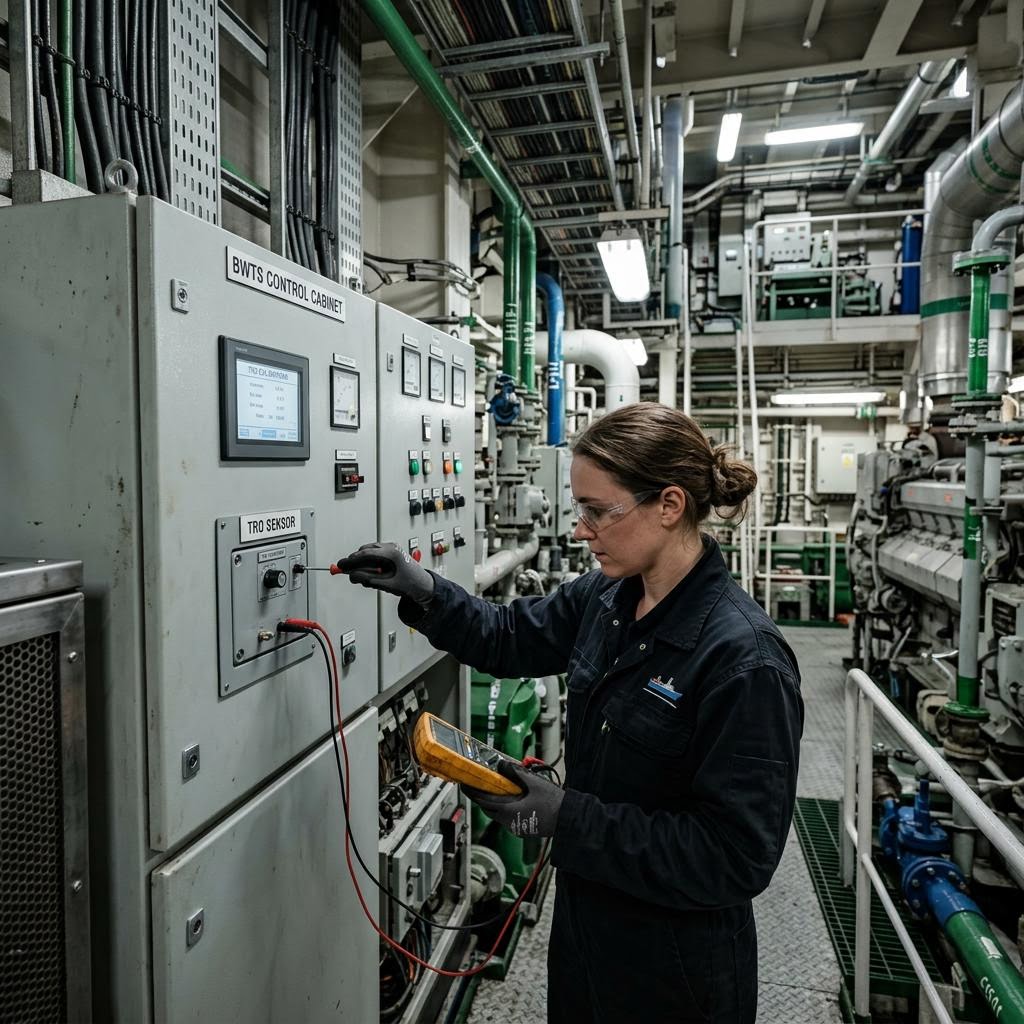
A drifted or fouled analyser can read high (false alarm) or low (hidden exceedance). Check the calibration date and status, the age and condition of DPD reagent for colorimetric units, and the cleanliness of the optics or the condition of an amperometric cell.
Salinity and temperature mismatch is a frequent culprit, because DPD and amperometric responses depend on water chemistry; confirm the analyser is calibrated for the salinity range being discharged. A grab-sample manual DPD test cross-checks the online reading.
If the analyser is confirmed faulty, do not simply silence the alarm and continue; the safe response is to correct the instrument or use a validated alternative measurement before resuming discharge. An unreliable analyser undermines the whole compliance basis of the discharge.
How Does Poor Mixing Cause False Highs?
If the injection point is too close to the overboard sample tap or the flow is poorly mixed, the analyser can read an unreacted spike of oxidant even though the reagent would neutralise it fully with proper contact. This presents as a high reading that does not respond normally to increased dosing.
Check the geometry: there should be adequate distance and turbulent, well-mixed flow between injection and sampling, ideally with a static mixer or sufficient pipe run. A sample tap drawing from a stagnant branch rather than representative flow can also give misleading readings.
This is often a commissioning defect that only surfaces under certain flow conditions. Sea Clean provides independent, brand-agnostic support to review injection and sampling arrangements across makers when mixing is suspected.
When Is the Residual Genuinely High?
Sometimes the alarm is correct and the residual is genuinely high because of the water chemistry. Short holding times leave less natural decay, cold water decays oxidant slowly, and high-bromide seawater forms persistent bromine species that keep measured TRO elevated and demand more reagent.
In these cases the fix is more neutralisation capacity, not a different diagnosis: confirm the pump can deliver the higher dose the conditions require, that reagent stock is sufficient, and that the controller setpoint and pump sizing cover the worst case. The dosing rule scales directly with TRO.
If the residual exceeds what the system can neutralise within its approved envelope, the discharge must not proceed, and contingency measures under the ship's procedures and MEPC guidance apply. Recognising a genuine high residual prevents wasting time chasing a non-existent instrument fault.
How Do You Prevent Recurrence and Record It?
Prevention centres on the three high-leverage tasks: keep the analyser calibrated on the maker's interval, verify dosing pump output and stock concentration regularly, and confirm reagent stock and salt form before each discharge. Most recurring alarms trace to lapses in one of these.
Record the event in the ballast water record book and the maintenance system: the alarm, the diagnosis, the corrective action and the confirmed residual before resuming. This record both satisfies inspection expectations and builds a history that reveals patterns, such as a sensor that drifts predictably.
Where analytical confirmation is needed, Sea Clean coordinates sampling with independent ISO 17025 laboratories and is not itself an accredited laboratory. For vessels in Norway and the North Sea region we can typically attend within 0 to 24 hours to help diagnose recurring high-TRO alarms; elsewhere response depends on logistics and port access.
Frequently asked questions
What causes a high TRO alarm at ballast discharge?
Usually under-dosing (wrong rate, empty tank or salt-form error), a drifted or fouled analyser, poor mixing between injection and the sample point, or a genuinely high residual from short holding time or bromine chemistry.
Should I keep discharging while I troubleshoot?
No. Stop or throttle the discharge, because a high reading may mean the residual exceeds the approved limit, which is a compliance breach and an environmental risk. Resume only after confirming the residual is below the limit.
How do I know if the analyser is at fault?
Cross-check the online reading with a manual DPD grab-sample test, and verify calibration date, DPD reagent age, optics cleanliness and salinity calibration. If confirmed faulty, correct it before resuming rather than silencing the alarm.
Why does my reagent seem to run out too fast?
Genuinely high residual from short holds, cold water or high-bromide seawater raises consumption, and a drifted analyser or poor mixing can cause over-injection. Check calibration, mixing and salt form to find the real cause.
Sources
Related articles
- Total Residual Oxidant (TRO) Monitoring and Neutralisation
- TRO Neutralization Before Ballast Discharge: Requirements
- Sodium Thiosulfate Dosing Calculation for Ballast Water
- TRO Measurement: The DPD Method Explained
- TRO Neutralisation Before Ballast Discharge
- What Is a Ballast Water Treatment System? Explained
Request spares, calibration or ballast-water testing
Include BWMS brand/model, vessel/IMO number, port/terminal, date/ETA and scope or part numbers. These links prepare an email draft; you must send it yourself.
- Request a parts quote — Sensors, TRO reagents, calibration kits and replacement parts. Confirm compatibility, availability and delivery for your installed system.
- Request a calibration booking — Annual instrument calibration with a calibration certificate for the work completed. OEM instructions, drift or applicable rules may require earlier work.
- Request testing coordination — Arrange sampling and testing with an appropriately qualified party for your IMO D-2, commissioning or other stated purpose.
Authorised Headway agent. Other-brand enquiries are independently reviewed; no OEM authorisation is claimed. Sea Clean is not an accredited laboratory or approving authority. Calibration does not demonstrate biological D-2 compliance. Attendance, testing scope and parts delivery are confirmed per enquiry.