How Do You Record Ballast Operations Across Midnight?
Updated
An operation crossing midnight needs two explicit dates, not a single date followed by ambiguous times. IMO record-keeping guidance recommends recording UTC and ship’s mean time and making the entry after completion without delay.
Request BWTS spare parts, annual calibration or ballast-water testing
Key takeaways
- Show both start and completion dates.
- Label UTC and SMT explicitly.
- Check the controller’s timezone.
- Preserve evidence of clock changes.
- Record interruptions separately.
- Correct discrepancies transparently.
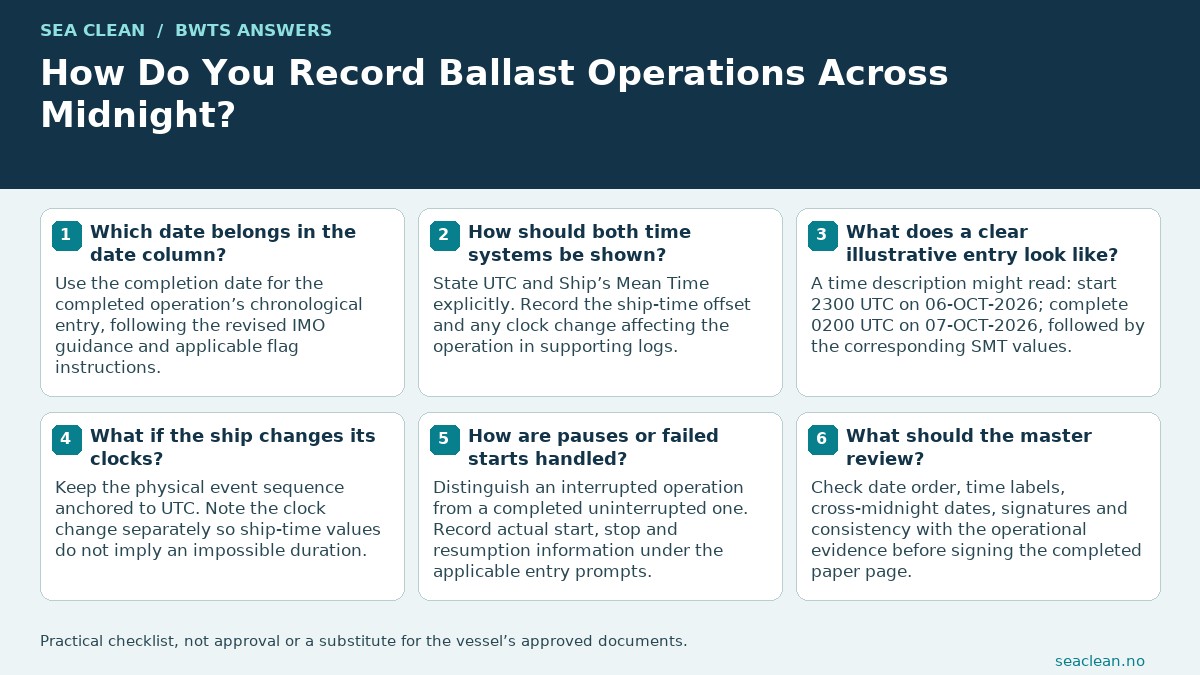
Which date belongs in the date column?
Use the completion date for the completed operation’s chronological entry, following the revised IMO guidance and applicable flag instructions.
Include the start date inside the operation details whenever it differs. A start time of 2300 and finish of 0200 alone is ambiguous.
How should both time systems be shown?
State UTC and Ship’s Mean Time explicitly. Record the ship-time offset and any clock change affecting the operation in supporting logs.
Do not silently reinterpret a controller timestamp as UTC. Check its configured timezone before copying the time into an operational entry.
Related guidance: Ballast Water Record Book: Printable PDF, IMO Requirements and Calibration
What does a clear illustrative entry look like?
A time description might read: start 2300 UTC on 06-OCT-2026; complete 0200 UTC on 07-OCT-2026, followed by the corresponding SMT values.
This illustrates dates only. Add every applicable code item: locations, tanks, volumes, plan conformity and treatment method for the actual operation.
What if the ship changes its clocks?
Keep the physical event sequence anchored to UTC. Note the clock change separately so ship-time values do not imply an impossible duration.
Compare bridge, engine and BWMS records before resolving a discrepancy. Preserve the original exported timestamps instead of editing them to match.
How are pauses or failed starts handled?
Distinguish an interrupted operation from a completed uninterrupted one. Record actual start, stop and resumption information under the applicable entry prompts.
Where a BWMS failure occurred, add the required Code F entry; a midnight notation must not conceal the interruption or treatment status.
Related guidance: What Water Depth Should a Ballast Record Book Entry Show?
What should the master review?
Check date order, time labels, cross-midnight dates, signatures and consistency with the operational evidence before signing the completed paper page.
If an error is discovered later, make a transparent signed and dated correction. Do not alter old timestamps to create apparent agreement.
Frequently asked questions
Can one date cover a cross-midnight operation?
Only if the details explicitly identify both start and completion dates; otherwise the sequence can be ambiguous.
Is UTC the same as ship time?
Not necessarily. Ship time may have an offset and may change during the voyage.
Should the entry wait until the next watch?
No. Record the completed operation without delay and follow the required officer-signature procedure.
Can I rewrite the BWMS export’s timestamp?
Preserve the original. Explain timezone or clock differences in a traceable note instead of changing source evidence.
Sources
- IMO — MEPC.369(80): revised record-book form
- IMO — BWM.2/Circ.80/Rev.1: record-keeping and reporting — The linked PDF is the revised circular dated 24 October 2024, despite its shorter filename.
- IMO — BWM Convention and implementation guidelines
Related articles
- What Should a Ballast Reception-Facility Receipt Confirm?
- What Water Depth Should a Ballast Record Book Entry Show?
- Ballast Water Record Book: Printable PDF, IMO Requirements and Calibration
- BWMS Hard-Copy Records and Onboard Document Control
- How Do You Record a Partial Ballast Discharge from Several Tanks?
- What Is a Ballast Water Treatment System? Explained
Request spares, calibration or ballast-water testing
Include BWMS brand/model, vessel/IMO number, port/terminal, date/ETA and scope or part numbers. These links prepare an email draft; you must send it yourself.
- Request a parts quote — Sensors, TRO reagents, calibration kits and replacement parts. Confirm compatibility, availability and delivery for your installed system.
- Request a calibration booking — Annual instrument calibration with a calibration certificate for the work completed. OEM instructions, drift or applicable rules may require earlier work.
- Request testing coordination — Arrange sampling and testing with an appropriately qualified party for your IMO D-2, commissioning or other stated purpose.
Authorised Headway agent. Other-brand enquiries are independently reviewed; no OEM authorisation is claimed. Sea Clean is not an accredited laboratory or approving authority. Calibration does not demonstrate biological D-2 compliance. Attendance, testing scope and parts delivery are confirmed per enquiry.