Sodium Thiosulfate Dosing Calculation for Ballast Water
Updated
The theoretical stoichiometric demand is only about 0.9 mg of sodium thiosulfate pentahydrate (Na2S2O3·5H2O, molar mass 248.18 g/mol) per 1 mg/L of Cl2-equivalent TRO, but real-world marine practice doses well above that. Typical field guidance is roughly 2.5 to 3.0 mg of pentahydrate per mg TRO, about a 3x stoichiometric excess, to guarantee complete neutralization under varying temperature, mixing and contact-time conditions. Multiply that practical dose by the discharge volume and the measured TRO to get the total mass, then divide by your stock-solution concentration to set the injection rate. Always follow the BWTS maker's type-approved dosing tables.
Request BWTS spare parts, annual calibration or ballast-water testing
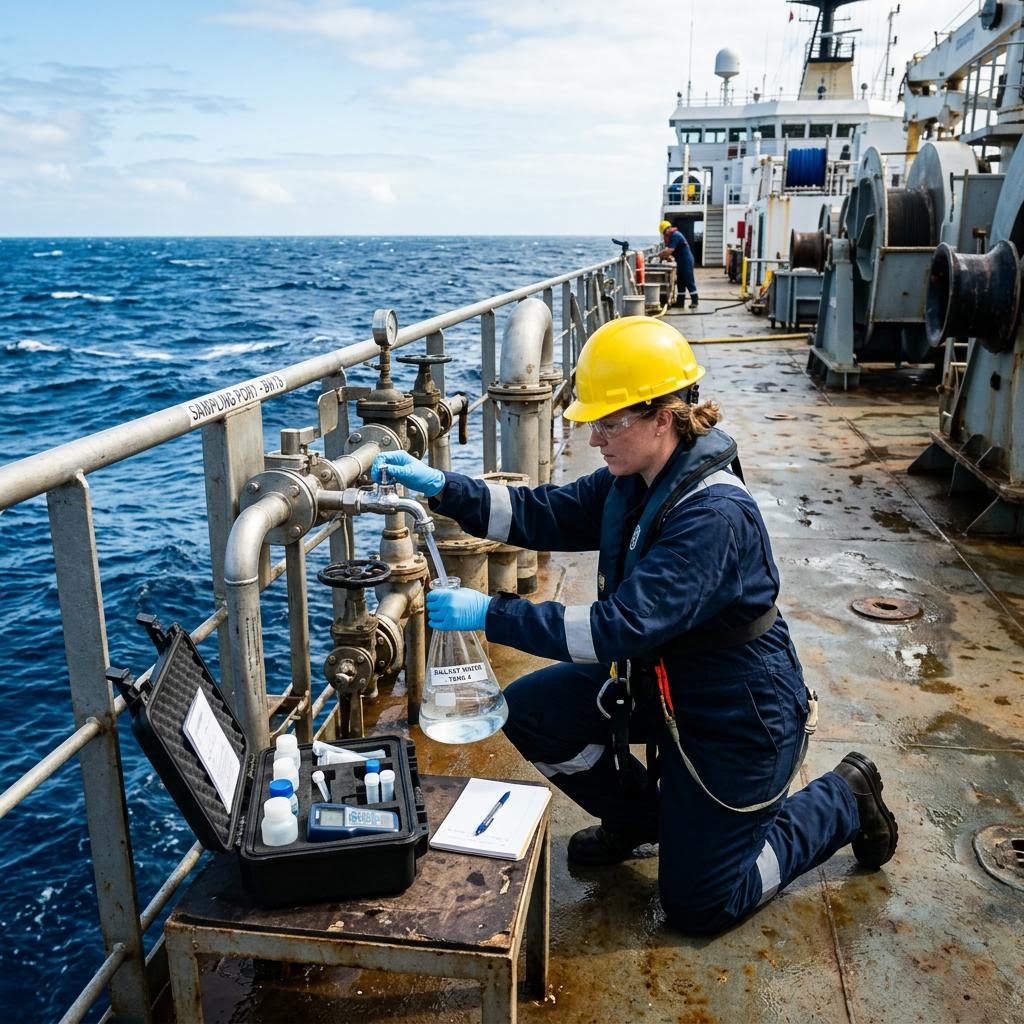
Key takeaways
- Theoretical demand is only about 0.9 mg pentahydrate per mg TRO; field practice uses 2.5 to 3.0 mg per mg TRO, roughly a 3x stoichiometric excess.
- Sodium thiosulfate pentahydrate is Na2S2O3·5H2O with a molar mass of 248.18 g/mol; British documents spell it sodium thiosulphate.
- Total reagent mass equals discharge volume times measured TRO times the specific dose; divide by stock concentration to set the pump.
- Pentahydrate dissolves to roughly 701 g/L at 20 degrees Celsius, so concentrated 100 to 300 g/L stock solutions keep tanks small.
- Let a calibrated TRO analyser trim the dose in closed loop to a near-zero setpoint rather than run a fixed rate.
- Reaction products are harmless sulfate and chloride, so modest overdosing is safe while underdosing risks a residual-oxidant exceedance.
What Is the Basic Dosing Ratio?
Sodium thiosulfate reduces residual chlorine and other oxidants to harmless products, and the stoichiometry sets the theoretical floor. In the reaction Na2S2O3 + 4Cl2 + 5H2O the thiosulfate is oxidised to sulfate while the chlorine is reduced to chloride, so one mole of thiosulfate can neutralise several moles of chlorine. On a mass basis this works out to roughly 0.9 mg of pentahydrate per mg of Cl2-equivalent TRO in pure theory. In practice, marine dosing runs well above this minimum because mixing, side reactions and measurement uncertainty all consume reagent.
The practical rule of thumb used across chemical-injection and electrochlorination systems is about 2.5 to 3.0 mg of pentahydrate per 1 mg of Cl2-equivalent TRO, roughly a 3x stoichiometric excess. This generous excess is deliberate: it guarantees complete neutralization under varying temperature, mixing and contact-time conditions, which is why field dosing is far higher than a textbook mole balance would predict. Always follow the BWTS maker's type-approved dosing tables.
The British spelling sodium thiosulphate refers to exactly the same compound, so European supplier documents, safety data sheets and older class references use the two spellings interchangeably. Always confirm whether a quoted dose refers to the pentahydrate (Na2S2O3·5H2O) or the anhydrous salt, because the water of crystallisation changes the mass you must weigh out per mg of oxidant.
How Do You Turn TRO Into Kilograms of Reagent?
Start with the three numbers you control at discharge: measured TRO in mg/L, the discharge flow rate in cubic metres per hour, and the total volume to be discharged. As a worked example, a ship discharging 2,000 m3 with a residual TRO of 2.0 mg/L carries a Cl2-equivalent load of 2,000,000 L multiplied by 2.0 mg/L, which is 4,000,000 mg, or 4.0 kg of Cl2 to neutralise.
Apply the specific dose of 2.5 to 3.0 mg pentahydrate per mg Cl2: 4.0 kg of Cl2 needs roughly 10 to 12 kg of sodium thiosulfate pentahydrate for that whole discharge. Dividing by the discharge duration gives the mass flow the injection pump must deliver, and dividing that by your stock-solution strength gives the volumetric pump setting.
Because TRO is not constant through a discharge, the correct engineering approach is to let the TRO analyser trim the dose in closed loop rather than set a single fixed rate. Program a target residual near zero at the overboard sample point, size the pump for the worst-case TRO plus margin, and log both the measured TRO and the reagent volume used so the ballast record supports the neutralisation claim.
What Stock Concentration Should You Prepare?
Sodium thiosulfate pentahydrate is highly soluble, roughly 701 g/L in water at 20 degrees Celsius, so you can prepare concentrated stock solutions that keep tank sizes small. Many shipboard neutralisation skids run stock solutions in the range of 100 to 300 g/L, comfortably below the saturation limit so that a temperature drop does not cause crystallisation in the dosing lines.
To convert your kilograms of reagent into a solution, divide the required mass by the chosen concentration: 12 kg of pentahydrate dissolved to 200 g/L makes 60 litres of stock. Preparing solution from the 25 kg bags Sea Clean supplies is straightforward, but use fresh water rather than seawater, and dissolve fully before the solution reaches the injection pump to avoid abrasive undissolved crystals.
Concentrated solutions have a slightly alkaline pH and are stable for weeks if kept cool and dark, but they can support microbial growth and slowly oxidise on standing, so batch small volumes that you will use within a reasonable period. If in doubt about a specific system, follow the maker's dosing procedure; the figures here are typical industry values, not a substitute for the type-approved operating manual.
How Does Temperature and Salinity Affect the Dose?
Oxidant demand and decay both change with water chemistry. Warm water accelerates natural chlorine decay, which can lower the TRO reaching the neutralisation point, while high organic load or high bromide seawater can shift the oxidant speciation toward bromamines that still register as TRO and still require reduction. Relying on the measured TRO rather than an assumed value handles most of this automatically.
Cold conditions are the main operational concern for the reagent itself. Below about 5 degrees Celsius concentrated stock can begin to precipitate, so trace-heat or insulate dosing lines on winter North Sea routes and keep the day tank inside a heated space. Sea Clean, based in Norway, routinely advises operators on cold-climate handling of thiosulfate stock.
Salinity does not materially change the neutralisation chemistry, but it does affect the TRO sensor calibration, since DPD and amperometric methods respond to total oxidant. Confirm the analyser is calibrated for the salinity range you discharge in, because an under-reading sensor will cause under-dosing and a residual-oxidant exceedance even if your calculation is correct.
What Safety Margin Should You Build In?
The generous excess embedded in the 2.5 to 3.0 mg/mg rule, roughly 3x the stoichiometric demand, exists because the cost of overdosing is low while the cost of underdosing is a regulatory exceedance. Excess thiosulfate simply discharges as additional sulfate and chloride, which are natural seawater constituents, so a modest overdose has negligible environmental consequence within the approved operating envelope.
There is, however, a practical upper bound. Large overdoses waste reagent, can slightly depress dissolved oxygen locally through excess reductant, and complicate any downstream monitoring, so aim for a residual TRO close to zero rather than deliberately swamping the water. A closed-loop analyser that trims the pump to a small positive TRO setpoint is the cleanest way to stay both compliant and economical.
Document the margin you use. When port state control or an inspector reviews the ballast water record book, showing that measured TRO was driven below the discharge limit with a defined and repeatable dosing basis is far stronger evidence than a bare statement that thiosulfate was added. Sea Clean provides independent, brand-agnostic support to set up and document these dosing procedures across BWTS makers.
Where Do Common Dosing Errors Come From?
The single most common error is confusing anhydrous and pentahydrate masses. The pentahydrate is about 63 percent thiosulfate by mass because of its five waters of crystallisation, so dosing anhydrous salt using a pentahydrate rule overdoses substantially, while the reverse underdoses and risks an exceedance. Fix the salt form in your procedure and match the reagent you actually stock.
The second common error is a stale or wrongly calibrated TRO analyser feeding the dose loop. If the sensor drifts low, the controller injects too little and the true overboard residual stays high; DPD reagent age, fouled optics and salinity mismatch are the usual culprits. Verify the analyser against a known standard on the interval the maker specifies.
The third is inadequate mixing and contact time between injection and the overboard sample point. Thiosulfate reacts quickly, but if the injection point is too close to the sample tap or the flow is poorly mixed, the analyser can read an unreacted spike. Locating injection well upstream, ensuring turbulent mixing, and confirming the residual at the actual discharge point closes that gap.
Frequently asked questions
How much sodium thiosulfate per mg of TRO?
Theoretical stoichiometric demand is about 0.9 mg pentahydrate per mg TRO, but field practice uses roughly 2.5 to 3.0 mg per 1 mg/L of Cl2-equivalent TRO, about a 3x excess. Multiply by discharge volume to get total mass, then divide by discharge time to set the injection rate.
Does salt form change the dose?
Yes. Pentahydrate is about 63 percent thiosulfate by mass, so an anhydrous salt is far more concentrated per kilogram. Match your dosing rule to the exact salt form you stock to avoid over- or under-dosing.
What concentration stock solution should I prepare?
Typically 100 to 300 g/L, well below the roughly 701 g/L solubility at 20 degrees Celsius so it will not crystallise if the temperature drops. Use fresh water and dissolve fully before the solution reaches the pump.
Is overdosing thiosulfate harmful?
A modest overdose is low risk because the products are sulfate and chloride, both natural seawater constituents. Aim for a near-zero residual TRO setpoint to stay compliant and economical rather than deliberately overdosing.
Sources
Related articles
- Neutralisation Systems and Sodium Thiosulfate Dosing in BWTS
- How Much Sodium Thiosulfate Per Ballast Discharge?
- Total Residual Oxidant (TRO) Monitoring and Neutralisation
- TRO Measurement: The DPD Method Explained
- Sodium Thiosulfate vs Sodium Bisulfite for TRO Neutralization
- What Is a Ballast Water Treatment System? Explained
Request spares, calibration or ballast-water testing
Include BWMS brand/model, vessel/IMO number, port/terminal, date/ETA and scope or part numbers. These links prepare an email draft; you must send it yourself.
- Request a parts quote — Sensors, TRO reagents, calibration kits and replacement parts. Confirm compatibility, availability and delivery for your installed system.
- Request a calibration booking — Annual instrument calibration with a calibration certificate for the work completed. OEM instructions, drift or applicable rules may require earlier work.
- Request testing coordination — Arrange sampling and testing with an appropriately qualified party for your IMO D-2, commissioning or other stated purpose.
Authorised Headway agent. Other-brand enquiries are independently reviewed; no OEM authorisation is claimed. Sea Clean is not an accredited laboratory or approving authority. Calibration does not demonstrate biological D-2 compliance. Attendance, testing scope and parts delivery are confirmed per enquiry.