Techcross ECS BWTS: An Owner's Operating Guide
Updated
Techcross ECS is one of the most widely fitted electrochlorination ballast water systems afloat, built around an in-line Electro-Cleen electrolysis unit and an Automatic Neutralization Unit. This guide covers how the ECU and ANU work, TRO sensing on ballasting and discharge, the sodium thiosulfate neutralisation chain, the consumables and alarms an operator meets, and how spares planning works. Sea Clean AS provides independent parts, consumables and service support for Techcross — not as an authorized agent.
Key takeaways
- Techcross ECS is a full-flow electrolysis system: the Electro-Cleen Unit (ECU) electrolyses seawater chloride in the main stream, with no filter in the base configuration.
- The process is salinity-dependent; brackish and fresh water reduce available chloride, so the installed model's salinity limit governs low-salinity ports.
- The Automatic Neutralization Unit (ANU) doses sodium thiosulfate on discharge to drop residual oxidant below the limit, commonly around 0.1 mg/L TRO.
- Most alarms are sensor drift or thiosulfate/pump issues, not the ECU; diagnose the sensing and dosing chain before the reactor.
- Critical spares are in-date TRO reagents or electrolyte, a calibration standard, the ANU pump kit and adequate thiosulfate stock; electrodes are long-lead planned parts.
- Sea Clean AS provides independent parts, consumables and service for Techcross ECS — it is not an authorized Techcross agent, and this is stated on every quote.
How Does the Techcross ECS Treat Ballast?
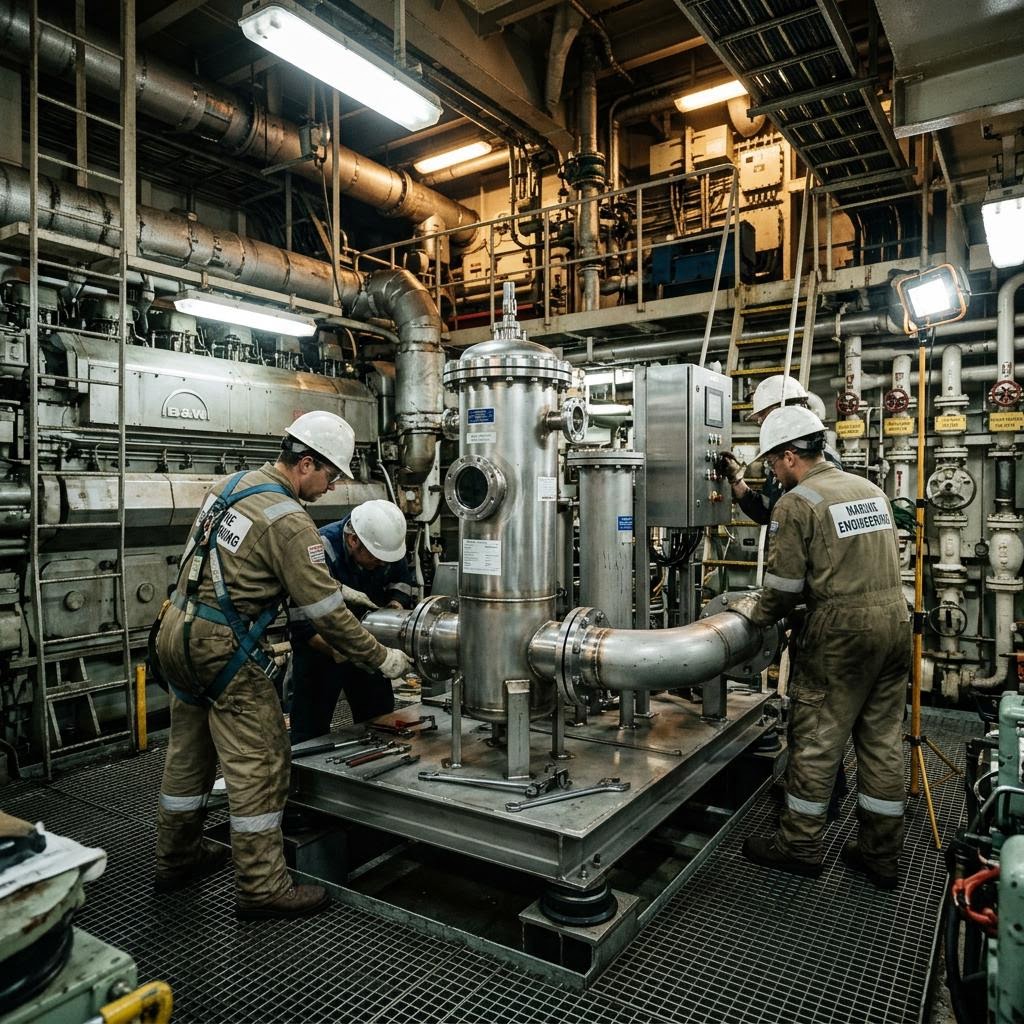
ECS is a full-flow electrolysis system, distinct from side-stream designs that treat only a diverted slipstream. Ballast passes through the Electro-Cleen Unit (ECU), an in-line electrolytic chamber where DC current across the electrodes electrolyses the chloride in seawater to generate free chlorine and other oxidants in the main stream. There is no separate filter in the base ECS configuration — treatment is chemical-electrochemical rather than mechanical — which is one reason it is favoured on tankers and some bulk trades where a filter's backflush water and sediment handling are awkward.
The oxidant produced inactivates organisms during ballasting and holds a residual through the tank holding time. Because the process electrolyses chloride, it is inherently salinity-dependent: in full seawater the ECU reaches dose easily, while in brackish water the available chloride drops and the unit needs more current or longer contact, and in genuinely fresh water the base system cannot reach its target without a supplementary chloride source. Owners running low-salinity ports must confirm the installed model's salinity limit.
On the deballast leg the system checks residual oxidant and neutralises before discharge. The whole cycle is governed by TRO measurement at defined points and by the vessel's ballast water management plan, and the ECS is engineered to deliver the IMO D-2 standard when operated inside its rated flow and salinity envelope. Running it outside that envelope is the most common reason an otherwise healthy unit fails to meet dose.
What Are the ECU and ANU?
The ECU is the electrolysis reactor and the main power consumer. Its electrodes are coated titanium, and like any electrolytic cell the coating is a wearing surface whose life is counted in amp-hours, not calendar years. Scaling from hardness in the water and gradual coating loss both raise cell voltage over time, so an engineer trends cell voltage at constant current and plans an acid clean or an eventual electrode replacement from that trend rather than waiting for a hard fault.
The ANU is the Automatic Neutralization Unit, the dosing skid that meters sodium thiosulfate into the discharge line to bring residual oxidant below the discharge limit before ballast goes overboard. It comprises a thiosulfate tank or mixing arrangement, a metering pump, and the control loop tied to the discharge TRO sensor. The neutralisation dose is proportional to measured residual and discharge flow, so an empty thiosulfate tank or a failed metering pump stops compliant discharge even when treatment on the uptake was perfect.
Between the two sit the TRO sensors and the control system. Techcross installations typically use amperometric or colorimetric TRO measurement on the treatment and discharge lines, and these sensors — with their reagents or membranes and electrolyte — are the components that most often need attention. The ECU and ANU are mechanically hard-wearing; the sensing chain is where drift, fouling and reagent expiry create the day-to-day work.
How Is TRO Measured and Controlled?
TRO drives the system. On ballasting the treatment-line sensor confirms the ECU is producing oxidant to target — the working band depends on the model and water but sits in the low single-digit mg/L range as Cl2 in seawater — and the control ramps ECU current to hold it. If the unit cannot reach target within a set time, it alarms rather than let under-dosed water into the tanks. That alarm is a compliance signal, not a nuisance, and should be investigated rather than acknowledged and ignored.
On discharge the ANU's sensor decides neutralisation. Overboard water must fall below the residual limit, commonly around 0.1 mg/L TRO, and the metering pump doses thiosulfate proportionally until it does. A discharge TRO that will not fall despite dosing points at an empty or weak thiosulfate solution, a failed pump, or a sensor reading falsely high — and telling which is which starts with checking the thiosulfate stock and the pump stroke before touching the sensor.
Sensor drift is the recurring theme. Colorimetric reagents have a shelf life of a few months once opened and amperometric cells need periodic electrolyte and membrane service, and either drifting undetected is how a vessel's own TRO log ends up disagreeing with a port state control detailed sample. Calibrate against a known standard on every reagent change, keep the calibration record with the ballast records, and never mask a persistent TRO fault by widening the alarm band.
What Consumables and Neutralisation Chemicals Are Needed?
The headline consumable is sodium thiosulfate for the ANU. The vessel's consumption depends on how often and how much it deballasts and on the residual it needs to knock down, so stock is sized against the trade, not a fixed figure. Running the tank low is a common way to fall out of compliant discharge, so thiosulfate reorder belongs in the passage plan alongside bunkers, and the neutraliser should be stored dry and within any stated shelf life.
The second consumable stream is TRO measurement: colorimetric reagents and calibration standards, or amperometric electrolyte and membranes, depending on the analyser fitted. These have limited shelf life and are the items most often found expired at inspection. Ordering fresh stock timed to when it will be used, rather than holding it long, keeps the readings honest and the log defensible.
Sea Clean AS supplies sodium thiosulfate neutraliser, TRO reagents, calibration standards and general consumables for Techcross ECS as independent support — Sea Clean is not an authorized Techcross agent, and this is stated plainly on every quote so there is no confusion over warranty or OEM status. Reagents are supplied in date with remaining shelf life stated and labelled for the receiving vessel. Send the analyser make and model with the enquiry, since colorimetric and amperometric chemistries are not interchangeable.
What Alarms and Faults Come Up in Service?
The most frequent alarms are low treatment TRO, high discharge TRO, and ECU electrical faults. Low treatment TRO in seawater with normal current usually means the sensor or its reagent; the same alarm with low current in brackish water is the salinity envelope, not a defect. High discharge TRO despite the ANU running points at thiosulfate stock or the metering pump before the discharge sensor. Working the diagnosis in that order saves changing parts that were never at fault.
ECU faults split into cleaning-recoverable and parts-level. A cell voltage that has crept up but recovers after an acid clean is scaling; a cell that will not hold current after cleaning, or a rectifier that trips on load, is coating wear or a power module — planned parts, not a berth fix. Hydrogen management is also live on any electrolysis system: gas generated at the electrodes is vented and diluted per design, and a degassing or ventilation alarm is a safety item that must be resolved, never bypassed.
The slow, dangerous fault is documentary. Expired reagents plus a calibration never redone after a reagent change lets the system keep running while its TRO record quietly drifts from reality, only to be exposed by a detailed sample at inspection. The remedy is procedural discipline: track reagent lot and expiry, recalibrate on every change, reconcile the record book against the alarm history, and carry the calibration certificate. Sea Clean can attend for independent fault diagnosis or verification — contact post@seaclean.no, 0–24h in Norway and the North Sea and by arrangement elsewhere.
How Should You Plan Techcross Spares and Support?
The critical-spares core for ECS is the sensing and dosing chain: TRO reagents or electrolyte and membranes in date, a calibration standard, the ANU metering-pump repair kit, and a working thiosulfate stock sized to the trade. These are the parts and consumables that stop compliant operation for the price of a small parcel, and they are the items inspectors reach for first. The ECU electrodes and rectifier modules are long-lead planned items sourced against the ballast log's amp-hours, not carried as ship's spares.
Because ECS has no filter in the base configuration, the mechanical spares list is shorter than on a filtration-plus-treatment system, but the valve and instrumentation spares around the treatment and neutralisation lines still matter. Seals, O-rings and gasket sets in the correct material grade for the wetted service are worth carrying, since a leaking joint on a chlorinated line is both a compliance and a corrosion problem.
Sea Clean provides independent parts and consumables supply and independent service attendance for Techcross — sourcing components through its supplier network and cross-referencing to the vessel's model and serial so the correct revision ships. Sending the exact part number, model and serial with an enquiry lets fitment be confirmed before dispatch. The independent-support distinction is stated on every quote and matters for how warranty and class treat the work.
Frequently asked questions
Does the Techcross ECS have a filter?
The base ECS is a full-flow electrolysis system without a mechanical filter; treatment is electrochemical in the Electro-Cleen Unit. Some installations add filtration for specific requirements, but the core process electrolyses chloride in the main stream and relies on TRO measurement rather than a screen to control performance.
Why won't my discharge TRO fall even though the ANU is running?
Check the thiosulfate stock and the metering pump before the sensor. Neutralisation dose is proportional to measured residual and flow, so an empty or weak thiosulfate solution or a failed pump stroke will leave the discharge TRO high even when the ECU treated the uptake correctly. A falsely high sensor is the third thing to check, not the first.
Can the Techcross ECS treat fresh water?
Not in the base configuration without a chloride source. Because the ECU electrolyses seawater chloride, low-salinity water reduces the oxidant it can make, and genuinely fresh water leaves it unable to reach dose. Confirm the installed model's salinity limit before ballasting in brackish or fresh ports.
Can Sea Clean supply Techcross parts and service?
Yes, as independent support. Sea Clean AS supplies sodium thiosulfate, TRO reagents, calibration standards, seals and general spares for Techcross ECS and can attend for independent fault diagnosis and verification. Sea Clean is not an authorized Techcross agent; the independent-support status is stated on every quote. Contact post@seaclean.no.
Sources
- IMO BWM Convention (D-2 standard) — Ballast Water Management Convention