Headway OceanGuard BWTS: The Complete Engineer's Guide
Updated
Headway's OceanGuard is a filtration-plus-electrocatalysis ballast water management system fitted across bulkers, tankers and offshore tonnage. This guide walks through the architecture, the EUT electrocatalytic unit, TRO dosing and discharge control, the filter and its wear pattern, the failure modes an engineer actually sees, a spares strategy, and how commissioning and PSC preparation work. Sea Clean AS is an authorized Headway Technology agent for OceanGuard parts and service.
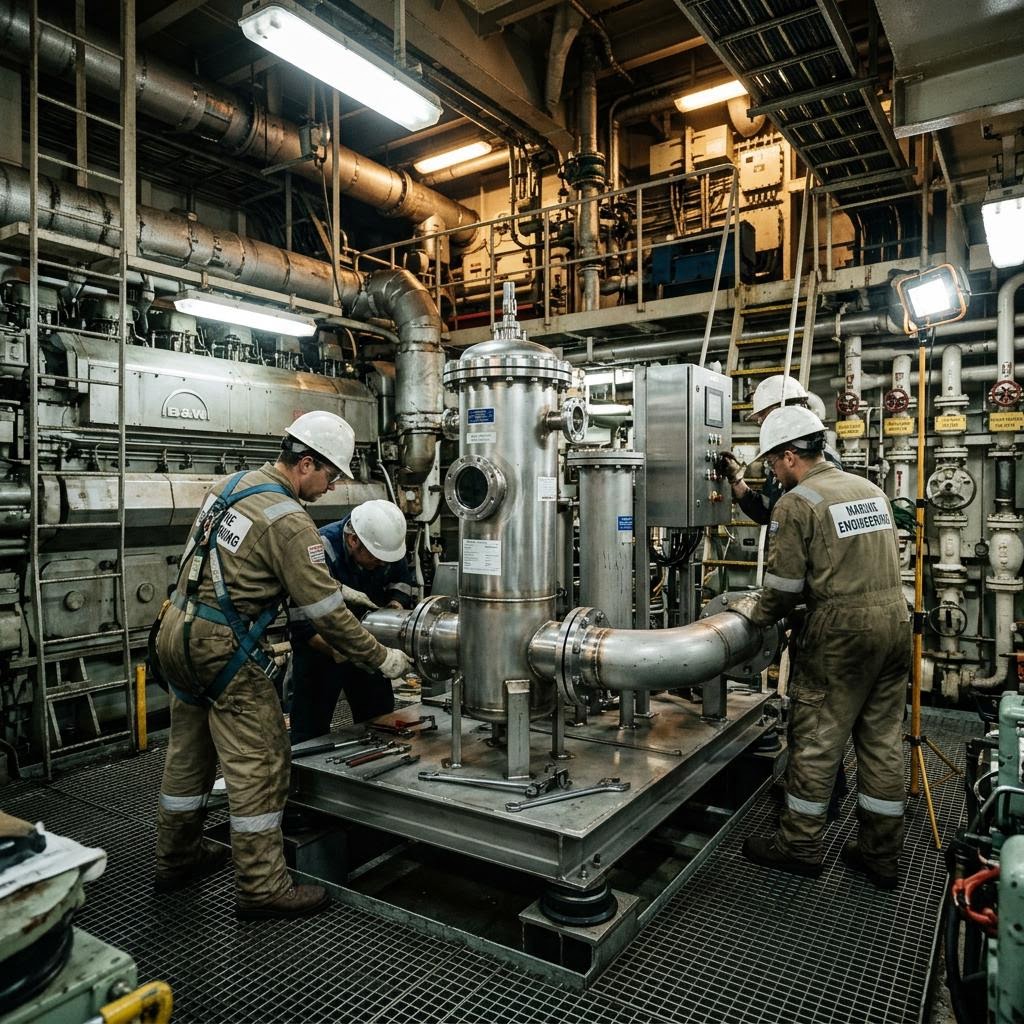
Key takeaways
- OceanGuard pairs a 50-micron backflushing screen filter with an EUT electrocatalytic reactor that treats the full filtered stream in line, with no stored liquid biocide.
- The EUT is conductivity-dependent, so low-salinity ballasting can pull it outside its approval envelope; always read the installed model's salinity window.
- TRO is the control variable: reactor output trims to a dosing band on ballasting, and thiosulfate neutralises residual above roughly 0.1 mg/L on discharge.
- Most nuisance alarms are the filter (screen, dP transmitter, backflush valve) or TRO sensor drift from expired reagent, not the reactor itself.
- Carry a spare screen element, backflush valve kit, dP transmitter, in-date reagents, calibration standard and dosing-pump kit as critical spares.
- Sea Clean AS is an authorized Headway agent supplying genuine OceanGuard parts, reagents and service; genuine parts protect type-approval integrity at survey.
How Is the OceanGuard System Built?
OceanGuard is a two-stage in-line system: an automatic backflushing screen filter on the uptake side, followed by an electrocatalytic reactor Headway builds around its Electrolytic Unit (EUT). Raw ballast passes the filter first, typically a 50-micron screen, which strips sediment, larger zooplankton and the bulk of suspended solids before the water reaches the treatment stage. The filtered stream then runs through the EUT reactor, where a titanium-based electrocatalytic process generates short-lived oxidants that break down organism cell membranes.
The point of the design is that treatment happens on the ballasting leg, in the pipe, without dosing or storing a liquid biocide on board. A small side-stream and the TRO analyser sit downstream of the reactor to confirm the oxidant is being produced at the target concentration. On the deballast leg, the same TRO loop checks residual oxidant and, where it exceeds the discharge limit, sodium thiosulfate is metered in to neutralise before the water goes overboard.
Electrically the unit is demanding on the ballasting leg. The EUT draws a substantial DC load through its power supply, and the current the rectifier delivers scales with the treatment-rated capacity and, in practice, with the conductivity of the water. That electrical envelope is why the type approval certificate specifies a treatment-rated capacity in cubic metres per hour and a minimum salinity or conductivity window that the operator has to respect, not treat as a suggestion.
What Does the EUT Unit Actually Do?
The EUT is the heart of the system and the component that most differentiates OceanGuard from a conventional side-stream electrochlorination rig. Rather than electrolysing a diverted slipstream at high concentration and injecting the product back into the main flow, OceanGuard's electrocatalytic reactor treats the full filtered stream in line. The electrodes are coated titanium plates or cells, and the coating is a sacrificial working surface: it degrades slowly with amp-hours through it, and coating loss is the dominant long-term consumable question on the reactor side.
Because the process still relies on electrochemistry, it is sensitive to conductivity. In seawater the reactor reaches its oxidant target comfortably; in brackish or low-conductivity water the current available to the electrodes falls, and the system either extends contact time, throttles flow, or in genuinely fresh water may not reach the required dose at all. Any operator running a fresh-water ballasting profile needs to read the specific approval envelope for the installed model rather than assume salinity independence.
Practically, an engineer keeps three things in view on the EUT: rectifier DC output against the expected current for the water being treated, the cell voltage trend across cleanings, and the TRO the reactor produces at rated flow. A slow rise in cell voltage at constant current usually points to scaling or coating wear; a TRO that drifts low while current looks normal points at the sensor before it points at the cell. Both readings should be trended, not just read once at commissioning.
How Does TRO Control and Neutralisation Work?
Total residual oxidant is the control variable for the whole system. On ballasting the analyser confirms the reactor is holding a target oxidant band — the setpoint depends on the installed model and water, but a working seawater dosing band in the low single-digit mg/L range as Cl2 equivalent is typical, and the system trims reactor output to stay inside it. If the analyser reads below target, the control logic ramps the EUT; if it cannot reach target after a set time, it raises a low-TRO alarm rather than discharge treated water that has not met dose.
On deballasting the same TRO reading decides whether neutralisation is needed. Discharge to the environment has to sit below a residual limit, commonly around 0.1 mg/L TRO, and where the measured residual is above that the thiosulfate metering pump doses the reducing agent into the overboard line. The dosing rate is proportional to the measured residual and the discharge flow, so a healthy thiosulfate stock and a working dosing pump are as much a compliance item as the reactor itself.
The analyser is the single most common source of nuisance alarms and PSC questions. OceanGuard installations generally use a colorimetric TRO analyser, and its reagents have a limited shelf life — typically a few months once opened — after which readings drift. Calibration against a known standard, distinct from a routine verification, restores the reference; an engineer should never resolve a persistent low-TRO alarm by widening the alarm band without first confirming the sensor reads true against a fresh standard.
What Are the Common OceanGuard Failure Modes?
The filter is where most of the day-to-day trouble lives. A screen that backflushes constantly in muddy estuarine water, a differential-pressure transmitter reading high because its sensing lines are silted, or a backflush valve that has lost its seat all show up as frequent backflush cycles, high dP alarms or reduced ballasting flow. Nine times out of ten a filter dP alarm is the screen, the dP instrument or the backflush valve, in that order, not the treatment stage.
On the treatment side, the recurring items are TRO sensor drift, thiosulfate dosing faults, and EUT power-supply or cell issues. Low TRO with normal rectifier current is almost always the sensor or its reagent. Low TRO with low rectifier current in brackish water is the salinity envelope biting, not a fault. A tripping rectifier or a cell that will not hold current after cleaning points at coating wear or a failing power module, and that is a planned-parts conversation, not a quick fix at the berth.
The failure that catches crews out is a slow one: reagent expiry combined with a calibration that was never redone after a reagent change. The system keeps running, the log keeps filling, and then a detailed sample at a port state control inspection disagrees with the vessel's own TRO record. The fix is procedural — track reagent lot and expiry, recalibrate on every reagent change, and keep the calibration certificate with the ballast records — but it has to be built into the maintenance routine to hold.
What Spares Should You Carry for OceanGuard?
The critical-spares list starts at the filter: a spare screen element for the installed mesh, the backflush valve rebuild kit, the dP transmitter, and the seals and O-rings for the filter housing. These are the parts that idle the ballast system if they fail during a tight port call, and they are cheap relative to the cost of not being able to ballast. A vessel that trades muddy loading ports should carry two screen elements, not one.
On the treatment and control side, carry TRO analyser reagents well inside shelf life with the lot and expiry logged, a calibration standard, the thiosulfate dosing pump repair kit, and a stock of neutralising agent sized to the vessel's discharge pattern. Reagents are the item most often found expired at inspection, so build reorder into the passage plan rather than waiting for a low-stock alarm. The EUT cells and the rectifier are long-lead planned items sourced against the ballast log's amp-hours, not carried as ship's spares.
Sea Clean AS is an authorized Headway Technology agent and supplies genuine OceanGuard filter and Z-Filter wear parts, TRO reagents, neutraliser and field service. Genuine parts matter here beyond reliability: the type approval certificate is issued for the system as approved, and substituting a non-approved screen, cell or sensor can undermine the certificate's validity at survey. Supplying the model, serial and nameplate data with an enquiry lets the correct revision ship the first time.
How Do Commissioning and PSC Preparation Go?
Commissioning testing under MEPC.325(75) verifies that the installed system's mechanical, physical, chemical and biological processes operate according to specification once the vessel has the system fitted and running; it is a one-time exercise with indicative biological analysis and does not, on its own, prove the unit meets the D-2 numeric limits. In practice an attending engineer confirms the filter backflushes cleanly, the EUT reaches TRO target at rated flow on real ballast water, the neutralisation loop drops residual below the discharge limit, and every alarm and interlock does what the drawing says before the indicative sample is taken. Skipping the dry checks and going straight to sampling is how a commissioning test fails on something mechanical.
For a port state control inspection the vessel needs the ballast water management plan, the type approval certificate matching the installed model and rated capacity, a completed and current ballast water record book, and — increasingly — its own self-monitoring TRO records that agree with the system's behaviour. An inspector who finds expired reagents, a TRO log with impossible flat readings, or a record book that does not reconcile with the alarm history has grounds to look harder.
The engineer's PSC prep is unglamorous: confirm reagents are in date and calibration is current, print the calibration certificate, reconcile the last few ballasting operations in the record book against the system's own log, and make sure the crew can demonstrate a ballasting and a neutralised discharge on request. Sea Clean can attend for commissioning support, fault diagnosis or pre-inspection verification; contact post@seaclean.no with the model, serial, ETA and scope. Attendance is 0–24h in Norway and the North Sea and by arrangement elsewhere.
Frequently asked questions
Does OceanGuard store chemicals on board?
No liquid biocide is stored in the standard configuration. The EUT reactor generates oxidants in line from the filtered ballast water itself. The only chemical normally required is a reducing agent such as sodium thiosulfate, dosed on discharge to neutralise residual oxidant above the discharge limit.
Why is my OceanGuard raising a low-TRO alarm?
Check the sensor before the reactor. Low TRO with normal rectifier current is almost always the analyser or an expired reagent; recalibrate against a fresh standard. Low TRO with low current in brackish water is usually the conductivity envelope biting, which is a limitation of the water, not a fault.
Is OceanGuard suitable for fresh-water ballasting?
It depends on the installed model's approval envelope. Because the EUT is electrochemical, it needs conductivity to reach oxidant target, and performance falls in brackish or fresh water. Read the specific type approval certificate for the salinity window rather than assuming the technology is salinity-independent.
Where can I get genuine OceanGuard spare parts?
Sea Clean AS is an authorized Headway Technology agent and supplies genuine OceanGuard and Z-Filter wear parts, TRO reagents, neutraliser and field service. Genuine components preserve treatment performance and the integrity of the type approval certificate. Send the model, serial and nameplate data to post@seaclean.no for the correct revision.
Sources
- IMO MEPC.300(72) BWMS Code — Type approval framework replacing Guidelines (G8)
Related articles
- Headway OceanGuard BWTS: Technology Overview and Service
- Headway OceanGuard Spare Parts and Consumables
- BWTS Selection and Troubleshooting: Master Guide
- TRO Monitoring in Ballast Water Systems: Measuring Total Residual Oxidant
- Erma First FIT BWTS: An Engineer's Operating Guide
- Techcross ECS BWTS: An Owner's Operating Guide