SunRui BalClor BWTS: A Practical Operating Guide
Updated
SunRui BalClor is a side-stream electrochlorination ballast water system widely fitted on Chinese-built tonnage, pairing an automatic filter with an Electrolysis Unit that generates a concentrated hypochlorite solution dosed into the main flow. This guide covers the EDU, the filter, TRO reagent supply and control, the typical alarms an operator meets, and how spares and service planning works. Sea Clean AS provides independent parts, consumables and service support for BalClor — not as an authorized agent.
Key takeaways
- BalClor is filtration plus side-stream electrolysis: a ~50-micron filter, then an Electrolysis Unit (EDU) generating hypochlorite concentrate injected into the main flow.
- The EDU is salinity-dependent and its coated titanium electrodes wear by amp-hours; trend cell voltage to separate scaling from coating loss.
- TRO controls dosing on ballasting and neutralisation on discharge, with thiosulfate dropping residual below roughly 0.1 mg/L; colorimetric reagents last only a few months once opened.
- Filter dP and backflush issues cause most ballasting-flow alarms; low/high TRO usually traces to the sensor, salinity envelope or thiosulfate stock before the cell.
- Carry a spare screen element, backflush valve kit, dP transmitter, dosing-pump kit, in-date reagents and thiosulfate; electrodes are long-lead planned parts.
- Sea Clean AS provides independent parts, consumables and service for BalClor — not as an authorized SunRui agent — and coordinates ISO 17025 labs for detailed analysis.
How Is BalClor Configured?
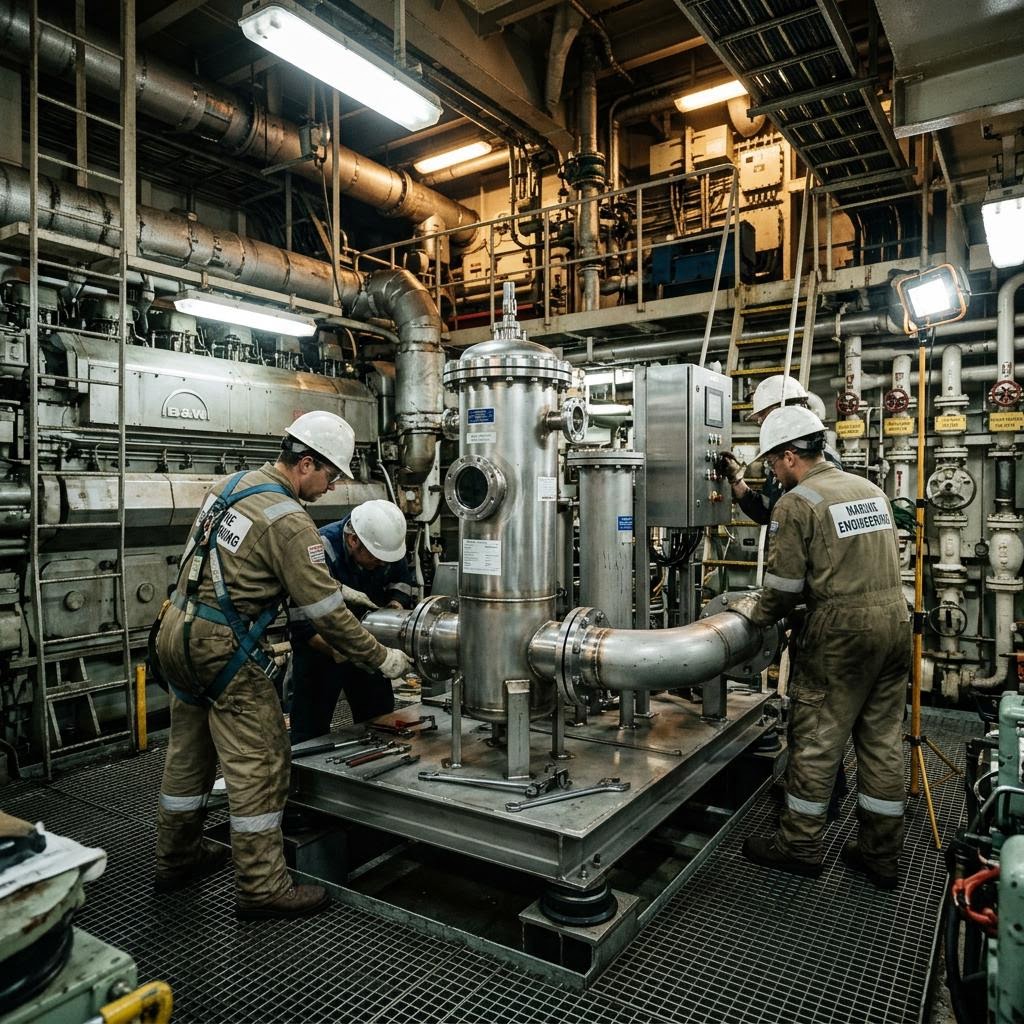
BalClor is a filtration-plus-side-stream-electrolysis system. On uptake the full ballast flow passes an automatic backflushing filter, typically around 50 micron, which removes sediment and larger organisms. A small slipstream is then diverted to the Electrolysis Unit, where seawater chloride is electrolysed into a concentrated sodium hypochlorite solution, and that concentrate is injected back into the main filtered stream to hold a target oxidant residual through ballasting and the tank holding time.
The side-stream approach means the electrolyser treats only a fraction of the flow at high concentration, which keeps the electrolytic unit compact relative to a full-flow design. The trade-off is a dosing-injection arrangement and the associated flow and concentration control that has to be kept in tune. As with any chlorine-generating system, BalClor is salinity-dependent: the concentrate strength falls as chloride drops, so brackish and fresh-water ballasting sit against the installed model's salinity limit.
On deballasting the system measures residual oxidant and neutralises with sodium thiosulfate before discharge. The whole operation is governed by TRO measurement and the ballast water management plan, and BalClor is engineered to meet the IMO D-2 standard when run inside its rated flow and salinity envelope. Operators trading to US waters must confirm the installed model carries valid USCG type approval under 46 CFR 162.060, since an IMO certificate alone does not authorise discharge in the US; US discharge standards now sit under the Vessel Incidental Discharge Act (VIDA), whose EPA national standards were finalized in 2024 with EPA/USCG implementing regulations still pending, superseding the 2013 Vessel General Permit (VGP).
What Is the EDU and How Does It Wear?
The Electrolysis Unit — the EDU in BalClor's arrangement — is the concentrate generator and the system's main electrical consumer. It runs coated titanium electrodes fed by a DC power supply, and the electrolytic cell produces hypochlorite from the diverted seawater slipstream. Like every electrolytic cell, the electrode coating is a sacrificial working surface whose life is measured in amp-hours, and scaling plus gradual coating loss both raise cell voltage over time.
The maintenance rhythm on the EDU is acid cleaning to remove scale and, eventually, electrode replacement when the coating is spent. An engineer trends cell voltage at constant current: a rise that recovers after cleaning is scale, a rise that does not is coating wear heading toward replacement. Because electrode packs are a long-lead planned item, that trend is what drives the reorder decision, not a hard fault at an inconvenient port.
Hydrogen is generated at the electrodes in any electrolysis process, so the EDU has a degassing and dilution arrangement with its own ventilation and gas alarms. Those interlocks are safety-critical and must never be bypassed to clear a nuisance trip. A degassing alarm is investigated at the source — ventilation fan, gas sensor, dilution flow — not defeated to keep ballasting.
How Does TRO Control and Reagent Supply Work?
TRO measurement controls dosing and discharge. On ballasting the analyser confirms the injected concentrate is holding the target oxidant band — model and water dependent, but in the low single-digit mg/L range as Cl2 in seawater — and the control trims concentrate injection to stay inside it. If the system cannot reach target, it alarms rather than under-dose the tanks. On discharge the analyser decides neutralisation, and thiosulfate is metered until residual falls below the discharge limit, commonly around 0.1 mg/L TRO.
BalClor installations generally use a colorimetric TRO analyser, and its reagents are a recurring consumable with a shelf life of only a few months once opened. Once the reagent ages, readings drift, and a drifting sensor is the single most common source of BalClor TRO alarms and of a vessel's own log disagreeing with a port state control sample. Calibration against a known standard on every reagent change, kept on file, is what keeps the reading honest.
Sea Clean AS supplies TRO reagents, calibration standards and sodium thiosulfate neutraliser compatible with BalClor's analysers as independent support — Sea Clean is not an authorized SunRui agent, and this is stated on every quote. Reagents are shipped in date with remaining shelf life stated and labelled for the vessel. Because colorimetric and amperometric chemistries are not interchangeable, the analyser make and model must accompany the enquiry so the correct reagent ships.
What Are the Typical BalClor Alarms?
The filter is the usual source of ballasting-flow trouble: frequent backflush in muddy water, a high differential-pressure alarm from a silted dP line or a blinded screen, or a backflush valve that has lost its seat. A filter dP alarm is the screen, the dP instrument or the backflush valve far more often than it is the treatment stage, and working it in that order avoids chasing the wrong fault.
On the treatment side the recurring alarms are low TRO, high discharge TRO and EDU electrical faults. Low TRO in seawater with normal current is usually the sensor or reagent; the same alarm with low current in brackish water is the salinity envelope. High discharge TRO despite dosing points at thiosulfate stock or the metering pump. EDU low-flow or concentration alarms often trace to the side-stream pump, a fouled injection point or the concentrate line rather than the cell itself.
As on any electrochlorination system, the quiet documentary failure — expired reagents plus a calibration never redone — lets the log drift from reality until a detailed sample exposes it. The fix is procedural: track reagent lot and expiry, recalibrate on every change, reconcile the record book against the alarm history, and keep the calibration certificate with the ballast records. Sea Clean can attend for independent diagnosis or verification; contact post@seaclean.no, 0–24h in Norway and the North Sea and by arrangement elsewhere.
What Spares Should You Carry for BalClor?
Start at the filter: a spare screen element for the installed mesh, the backflush valve rebuild kit, the dP transmitter, and the housing seals and O-rings. A vessel trading muddy loading ports should carry two screen elements. On the dosing side, carry the side-stream and concentrate injection spares, the neutralisation metering-pump repair kit, and a thiosulfate stock sized to the discharge pattern.
On the control side, keep TRO reagents in date with lot and expiry logged and a calibration standard on board. Reagents are the item most often found expired at inspection, so build reorder into the passage plan. The EDU electrode packs and rectifier modules are long-lead planned items sourced against the ballast log's amp-hours, not carried as ship's spares, but the amp-hour trend should be watched so the reorder is placed before the coating is spent.
Sea Clean provides independent parts and consumables supply and independent service attendance for SunRui BalClor, sourcing through its supplier network and cross-referencing to the vessel's model and serial so the correct revision ships. Sending the exact part number, model and serial with the enquiry lets fitment be confirmed before dispatch. The independent-support status is stated on every quote and matters for how warranty and class treat the work — Sea Clean does not claim SunRui authorization or OEM status.
How Do Compliance and Support Come Together?
For an inspection the vessel needs its ballast water management plan, a type approval certificate matching the installed model and rated capacity, a current ballast water record book, and self-monitoring TRO records that reconcile with how the system actually behaved. An inspector who finds expired reagents, a flat impossible TRO log, or a record book that does not match the alarm history has grounds to look harder, so the documentary discipline is as important as the hardware.
Commissioning testing under MEPC.325(75) verifies that the installed BalClor's mechanical, physical, chemical and biological processes operate according to specification once fitted and running, using indicative biological analysis rather than proving the D-2 numeric limits on its own. In practice an attending engineer confirms the filter backflushes cleanly, the EDU holds concentrate and TRO target at rated flow on real ballast water, and the neutralisation loop drops residual below the discharge limit before the indicative sample is taken. Doing the mechanical and control checks first is what stops a commissioning test failing on something avoidable.
Sea Clean coordinates the parts, consumables and independent service that keep a BalClor unit compliant between yards — reagents, neutraliser, filter wear parts, dosing spares and engineer attendance — and, where detailed laboratory analysis is required, coordinates ISO 17025 laboratories rather than performing accredited testing itself. Send the model, serial, ETA and scope to post@seaclean.no to start coordination.
Frequently asked questions
Is BalClor a full-flow or side-stream system?
BalClor is a side-stream electrochlorination system with an automatic filter. The full flow is filtered, then a small slipstream is diverted to the Electrolysis Unit to make concentrated hypochlorite, which is injected back into the main stream to hold the oxidant residual. This keeps the electrolyser compact relative to a full-flow design.
Why is my BalClor TRO reading drifting?
The most common cause is aged colorimetric reagent, which loses accuracy within a few months of opening. Recalibrate against a known standard with fresh reagent and log it. If the reading stays wrong with fresh reagent and correct current, look at the sensor and its sample line before assuming the electrolyser is at fault.
Can BalClor discharge in US waters?
Only if the installed model carries valid USCG type approval under 46 CFR 162.060; an IMO certificate alone does not authorise US discharge. US discharge standards now fall under the Vessel Incidental Discharge Act (VIDA), whose EPA national standards were finalized in 2024 with EPA/USCG implementing regulations still pending, superseding the 2013 VGP. Confirm the specific model and rated capacity on the certificate match the installed unit.
Can Sea Clean supply BalClor reagents and parts?
Yes, as independent support. Sea Clean AS supplies TRO reagents, calibration standards, sodium thiosulfate, filter wear parts and dosing spares for BalClor, and can attend for independent diagnosis. Sea Clean is not an authorized SunRui agent; the independent-support status is stated on every quote. Contact post@seaclean.no with the model and serial.
Sources
- IMO MEPC.325(75) — Commissioning testing of BWMS
- USCG 46 CFR 162.060 — USCG BWMS type approval requirements
- EPA Vessel Incidental Discharge Act (VIDA) — Standards finalized 2024; implementing regs pending