Sodium Thiosulfate vs Sodium Bisulfite for TRO Neutralization
Updated
Sodium thiosulfate and sodium bisulfite (and metabisulfite) are the two main reducing agents used to neutralize total residual oxidant before ballast discharge. Sodium thiosulfate is the more common marine choice because it is a stable solid with a long shelf life, produces harmless sulfate and chloride, and does not lower dissolved oxygen or release sulfur dioxide fumes the way bisulfite can under acidic conditions.
Request BWTS spare parts, annual calibration or ballast-water testing
Key takeaways
- Both sodium thiosulfate and sodium bisulfite reduce residual oxidant, but thiosulfate produces harmless sulfate and chloride across a wide pH range.
- Sodium thiosulfate pentahydrate is a stable solid with a two to three year shelf life; bisulfite degrades faster and can release sulfur dioxide.
- Bisulfite systems are more pH-sensitive and can have a higher dissolved-oxygen demand when overdosed.
- Lifecycle cost is driven more by wastage of degraded stock than by per-kilo price, which favours the longer-lived thiosulfate.
- Always use the neutraliser named in the BWTS type-approval package; switching reagents can invalidate the active-substance approval.
- Sea Clean supplies sodium thiosulfate from Norway in 25 kg bags, 50 kg drums and 1000 kg bulk bags.
How Do the Two Chemicals Neutralize Oxidant?
Both chemicals are reducing agents that convert residual chlorine and bromine oxidants to harmless halide ions. Sodium thiosulfate (Na2S2O3, British spelling sodium thiosulphate) is oxidised to sulfate while reducing chlorine to chloride, so its end products are simply sulfate and chloride ions already abundant in seawater.
Sodium bisulfite and its solid form sodium metabisulfite work through the sulfite ion, which is oxidised to sulfate while reducing the oxidant. The chemistry is similarly effective at removing TRO, and both are used across water-treatment industries, so the difference for ballast water comes down to handling, stability and secondary effects rather than raw neutralising ability.
A practical distinction is that thiosulfate reacts cleanly across a wide pH range, whereas the sulfite systems are more pH-sensitive and can generate sulfur dioxide gas if the solution becomes acidic. For a shipboard dosing skid operated by watchkeepers rather than chemists, the wider tolerance of thiosulfate is a meaningful operational advantage.
Which Is More Stable in Storage?
Sodium thiosulfate pentahydrate is a stable crystalline solid with a typical shelf life of two to three years when kept cool and dry, and it does not readily release fumes in the bag or drum. This makes it well suited to long voyages and to ships that dose only intermittently, where a reagent may sit in the store for months.
Sodium bisulfite solutions are less stable and slowly oxidise in air, losing strength over time, and solid metabisulfite can release sulfur dioxide, which has a pungent, irritating odour and demands more careful ventilation and container management. That degradation means bisulfite stock often needs more frequent testing and replacement.
For a ship that wants a reagent it can buy, stow and forget until needed, the stability profile of thiosulfate is the decisive factor. Sea Clean supplies sodium thiosulfate pentahydrate from Norway in 25 kg bags, 50 kg drums and 1000 kg bulk bags, formats chosen so operators can match stock to consumption without holding excessive quantities.
What About Dissolved Oxygen and Aquatic Impact?
Both reducing agents consume some dissolved oxygen when overdosed, but the concern is more pronounced with sulfite systems, which have a higher oxygen demand per unit of oxidant removed in some conditions. In a receiving water body already low in oxygen, excess reductant can locally worsen the deficit, which is why minimising overdose matters for either chemical.
Thiosulfate's neutral, high-solubility products keep its aquatic footprint low when dosed to a near-zero residual, and it does not acidify the discharge. Regulators assess residual toxicity of active-substance BWTS under the IMO G9 procedure, and thiosulfate's benign by-products help such systems demonstrate acceptable discharge chemistry.
The environmental verdict for either chemical hinges on dose control, not chemistry alone. A well-instrumented neutralisation loop that trims to a small positive TRO setpoint avoids meaningful oxygen depletion regardless of the reagent, whereas sloppy fixed-rate overdosing can create a local impact with any reductant.
How Do Costs and Availability Compare?
On a mass basis the two chemicals are broadly comparable commodity reagents, and pricing varies with region, packaging and order size, so a firm cost ranking is not honest to state in the abstract. What tends to dominate lifecycle cost is not the per-kilo price but wastage from degraded stock, which favours the longer-lived thiosulfate.
Availability is generally good for both through marine chemical suppliers, but the specific grade and packaging you can get on short notice varies by port. Standardising on one reagent and one supplier route simplifies procurement, safety data sheet management and crew training, which is itself a cost saving that rarely appears on the purchase order.
Because Sea Clean provides independent, brand-agnostic support across BWTS makers rather than only its agency line, we can advise which reagent a given type-approved system specifies and help set up resupply so a ship is not caught with expired or wrong-grade stock at a critical discharge.
When Might Bisulfite Still Be Preferred?
Bisulfite is not a poor choice everywhere. Where a shore facility already stocks and doses sulfite for other water-treatment duties, or where a system maker specifies it, using the same reagent can simplify logistics and inventory. Some high-throughput fixed installations also favour liquid bisulfite for continuous automated dosing.
For occasional intermittent dosing, cold-climate storage and crew-operated skids, however, thiosulfate's stability, wide pH tolerance and low fume risk usually win. The right answer is always the reagent named in the type-approval documentation for the specific BWTS, because dosing outside the approved active-substance package can invalidate compliance.
If a system's manual is silent or generic on neutraliser choice, treat thiosulfate as the safe default for marine use and confirm with the maker before switching. Sea Clean can help interpret the type-approval package and coordinate the right reagent so the neutralisation step stays inside the approved envelope.
What Should Drive the Final Decision?
Decide on three axes: what the type-approved system specifies, how the crew will handle the reagent, and how the ship trades. A vessel doing frequent short coastal legs with a dedicated engineer differs from one doing months-long ocean passages with intermittent ballast operations, and the reagent should suit the operating pattern.
For most ballast-water applications the balance favours sodium thiosulfate: stable solid, long shelf life, wide pH tolerance, harmless products and low fume hazard. Sodium bisulfite remains a legitimate alternative where a maker specifies it or where shore logistics already centre on sulfite.
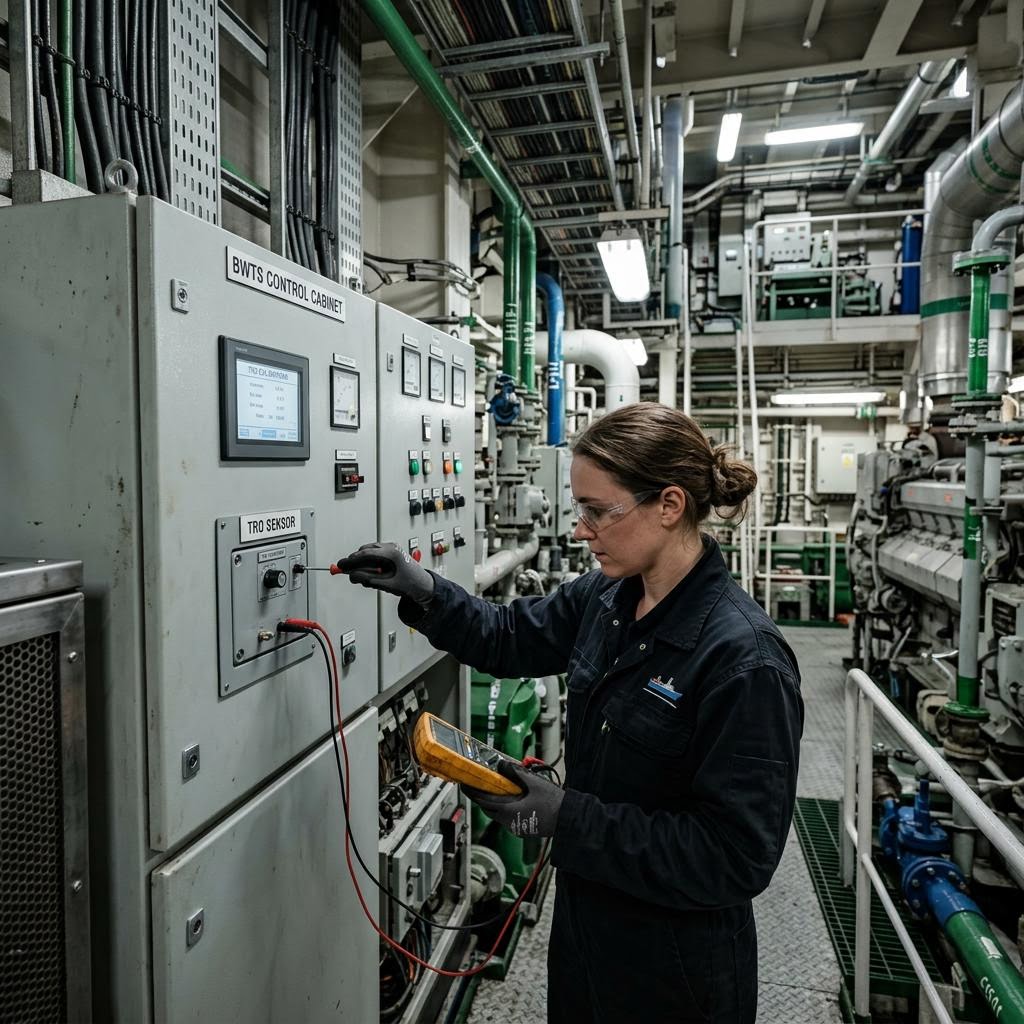
Whichever you choose, the neutralisation must be provable at discharge through calibrated TRO monitoring and clear record-keeping. The chemical is only half the compliance picture; the instrumentation and documentation are the other half, and both should be reviewed together rather than in isolation.
Frequently asked questions
Which is better for ballast water, thiosulfate or bisulfite?
For most marine use sodium thiosulfate is preferred because it is a stable solid, tolerates a wide pH range, and produces harmless sulfate and chloride. Bisulfite is a valid alternative where a system maker specifies it or shore logistics already use sulfite.
Does bisulfite release toxic gas?
Sodium bisulfite and metabisulfite can release sulfur dioxide, an irritating gas, particularly if the solution becomes acidic. Thiosulfate does not release fumes under normal handling, which is one reason it suits crew-operated dosing skids.
Do both chemicals lower dissolved oxygen?
Both consume some dissolved oxygen when overdosed, but sulfite systems tend to have a higher oxygen demand. Dosing to a near-zero TRO setpoint keeps oxygen impact negligible with either reagent.
Can I switch my BWTS from bisulfite to thiosulfate?
Only if the type-approval package allows it, because the neutraliser is part of the approved active-substance treatment. Confirm with the maker before switching; Sea Clean can help interpret the documentation.
Sources
Related articles
- Neutralisation Systems and Sodium Thiosulfate Dosing in BWTS
- Sodium Thiosulfate Dosing Calculation for Ballast Water
- What Is Antiklor? Sodium Thiosulfate Explained
- BWTS Reagents and Consumables: What to Keep Onboard
- Sodium Thiosulfate Safety and Handling: MSDS Guide
- What Is a Ballast Water Treatment System? Explained
Request spares, calibration or ballast-water testing
Include BWMS brand/model, vessel/IMO number, port/terminal, date/ETA and scope or part numbers. These links prepare an email draft; you must send it yourself.
- Request a parts quote — Sensors, TRO reagents, calibration kits and replacement parts. Confirm compatibility, availability and delivery for your installed system.
- Request a calibration booking — Annual instrument calibration with a calibration certificate for the work completed. OEM instructions, drift or applicable rules may require earlier work.
- Request testing coordination — Arrange sampling and testing with an appropriately qualified party for your IMO D-2, commissioning or other stated purpose.
Authorised Headway agent. Other-brand enquiries are independently reviewed; no OEM authorisation is claimed. Sea Clean is not an accredited laboratory or approving authority. Calibration does not demonstrate biological D-2 compliance. Attendance, testing scope and parts delivery are confirmed per enquiry.