Erma First FIT BWTS: An Engineer's Operating Guide
Updated
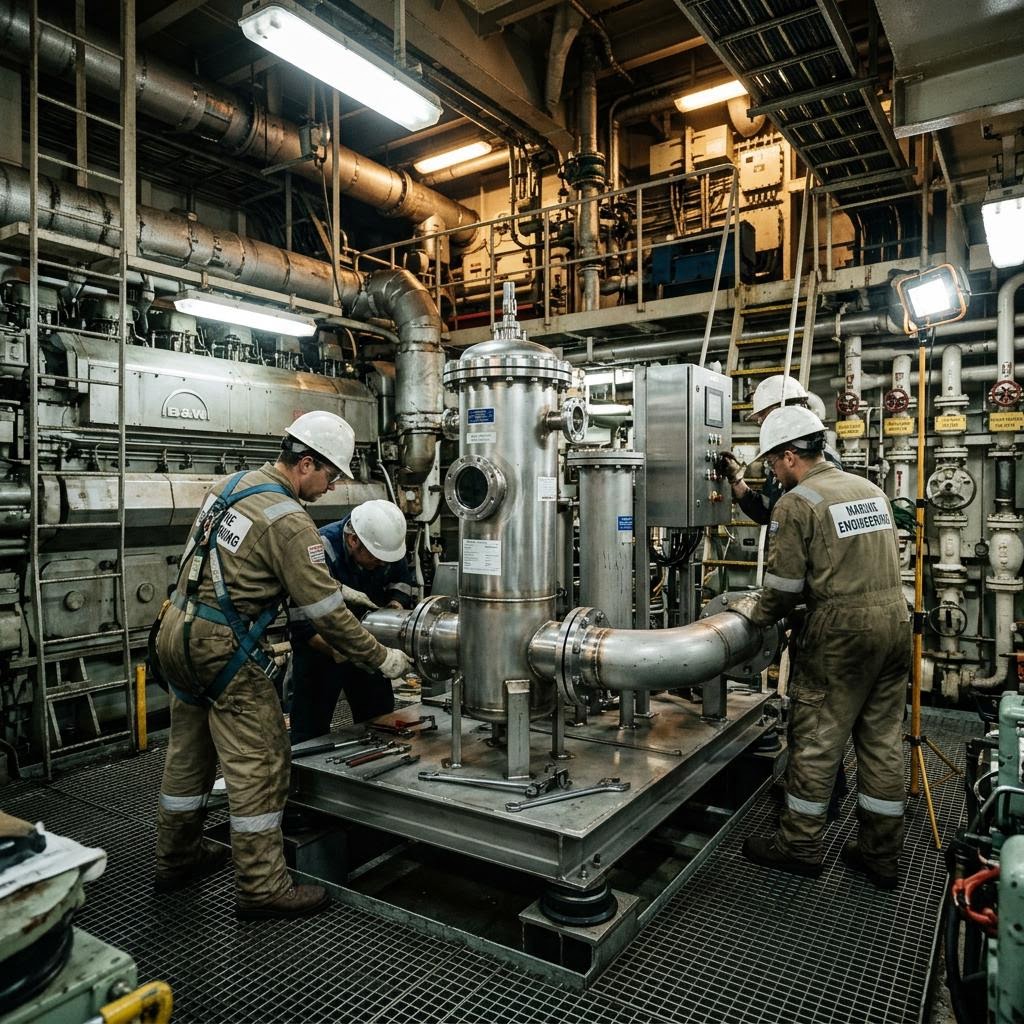
Erma First's FIT is a compact electrolysis ballast water system built around a solids-separation stage — a hydrocyclone and/or filter — ahead of a side-stream electrolyser that doses hypochlorite into the treated flow. This guide covers the separation and electrolysis stages, reagent and neutralisation supply, realistic maintenance intervals, and how spares planning works. Sea Clean AS provides independent parts, consumables and service support for Erma First systems — not as an authorized agent.
Key takeaways
- Erma First FIT is electrochlorination with a solids front end — a hydrocyclone, a ~50-micron filter, or both — ahead of a side-stream electrolyser dosing hypochlorite.
- The hydrocyclone separates by centrifugal swirl with no screen to blind; its wear is liner erosion and underflow blockage, checked at intervals rather than serviced often.
- The electrolyser is salinity-dependent and runs on an amp-hour clock: acid-clean on rising cell voltage, replace electrodes from the voltage trend when the coating is spent.
- TRO controls dosing and neutralisation, with thiosulfate dropping discharge residual below roughly 0.1 mg/L; colorimetric reagents last only a few months once opened.
- Carry in-date reagents, a calibration standard, dosing-pump kit, thiosulfate, and filter element/valve/dP spares; electrode packs are long-lead planned parts.
- Sea Clean AS provides independent parts, consumables and service for Erma First — not as an authorized agent — and coordinates ISO 17025 labs for detailed analysis.
How Does the Erma First FIT Treat Ballast?
FIT is an electrochlorination system with a solids-removal front end. On uptake the ballast passes a separation stage — depending on the configuration a hydrocyclone, a backflushing filter, or both in series — to strip sediment and larger organisms before treatment. A side-stream is then electrolysed to generate a concentrated hypochlorite solution, which is injected back into the main flow to hold a target oxidant residual through ballasting and the tank holding time.
The hydrocyclone, where fitted, uses centrifugal separation rather than a screen, which suits water with a high suspended-solids load because there is no mesh to blind. Where a screen filter is fitted, typically around 50 micron, it backflushes automatically on differential pressure. Some FIT arrangements pair both so the cyclone takes the heavy load and the filter polishes; the exact configuration is what determines the maintenance profile, so an engineer reads the specific installation rather than assuming.
As with any chlorine-generating system, FIT is salinity-dependent: the concentrate strength falls as chloride drops, so brackish and fresh-water ballasting sit against the installed model's salinity limit. On deballasting the system measures residual oxidant and neutralises with sodium thiosulfate before discharge, governed by TRO measurement and the ballast water management plan, and is engineered to meet the IMO D-2 standard inside its rated flow and salinity envelope.
How Do the Hydrocyclone and Filter Behave?
The hydrocyclone is largely maintenance-light in normal operation because it has no moving screen to wear or blind — separation is by the swirl set up in the cyclone body, and heavier solids drop to an underflow that is purged. Its failure modes are erosion of the cyclone liner over long service in abrasive sediment, and blockage of the underflow purge, which shows as poor separation and carry-over of solids into the treatment stage. It is checked at intervals for liner wear and clear purging rather than serviced frequently.
The screen filter, where fitted, behaves like any backflushing filter: it backflushes on differential pressure, and its wear items are the screen element, the backflush valve and the dP transmitter. In muddy loading ports it backflushes often, and a high dP alarm is usually the screen, the dP line or the backflush valve before it is anything downstream. A vessel trading heavy-sediment ports should carry a spare element sized to the installed mesh.
The value of understanding which separation stage is fitted is diagnostic: a solids carry-over that fouls the injection point or the TRO sample line usually traces back to the separation stage — a worn cyclone liner, a blocked underflow, or a blinded screen — not to the electrolyser. Sorting the front-end behaviour first stops an engineer chasing a treatment fault that is really a separation problem.
What Reagents and Chemicals Does FIT Need?
The headline chemical is sodium thiosulfate for discharge neutralisation, dosed by a metering pump to bring residual oxidant below the discharge limit, commonly around 0.1 mg/L TRO, before ballast goes overboard. Consumption scales with how much and how often the vessel deballasts and with the residual it must knock down, so thiosulfate stock is sized to the trade and reorder belongs in the passage plan. Running the tank low is a common route to non-compliant discharge.
The second stream is TRO measurement. FIT installations use a TRO analyser on the treatment and discharge lines, and its reagents or electrolyte have a limited shelf life — colorimetric reagents typically only a few months once opened. Aged reagent drifts, and a drifting sensor is the usual source of TRO alarms and of a vessel's own log disagreeing with a port state control sample, so calibration against a known standard on every reagent change is the discipline that keeps readings honest.
Sea Clean AS supplies TRO reagents, calibration standards and sodium thiosulfate neutraliser compatible with Erma First analysers as independent support — Sea Clean is not an authorized Erma First agent, and this is stated on every quote. Reagents ship in date with remaining shelf life stated and labelled for the vessel. Because colorimetric and amperometric chemistries differ, the analyser make and model must accompany the enquiry so the correct reagent ships.
What Are the Maintenance Intervals?
Maintenance splits by component life. TRO analyser reagents are the shortest interval — replaced on a shelf-life basis of a few months and recalibrated on every change. Thiosulfate stock is monitored per operation. The filter screen is inspected and cleaned on a condition basis driven by backflush frequency and dP behaviour rather than a fixed calendar, and the backflush valve and dP transmitter are checked at the same time.
The electrolyser follows an amp-hour clock rather than a calendar. Acid cleaning to remove scale is done when cell voltage at constant current has risen, and electrode replacement is planned from the same voltage trend when the coating is spent — typically after several years of service, but the amp-hours through the cell are what actually count, not the years. Because electrode packs are long-lead, the reorder is placed from the trend, not from a hard fault.
The hydrocyclone, where fitted, is inspected at longer intervals for liner wear and clear underflow purging, and the degassing and ventilation arrangement is checked at every service because hydrogen management is safety-critical on any electrolysis system. A degassing or ventilation alarm is resolved at the source and never bypassed. These intervals are guidance; the vessel follows the maker's manual and the ballast water management plan for the installed model.
What Spares Should You Carry for FIT?
The critical-spares core is the sensing and dosing chain plus the filter: in-date TRO reagents or electrolyte, a calibration standard, the neutralisation metering-pump repair kit, an adequate thiosulfate stock, and — where a screen filter is fitted — a spare element, backflush valve kit and dP transmitter. These are the parts that stop compliant operation for the price of a small parcel and the items an inspector reaches for first.
Seals, O-rings and gasket sets in the correct material grade for chlorinated and separation-stage service are worth carrying, since a leaking joint on an oxidant line is both a compliance and a corrosion problem. Where a hydrocyclone is fitted, the underflow purge valve spares and any liner wear parts are planned items driven by inspection. The electrolyser electrode packs and rectifier modules are long-lead planned parts sourced against the ballast log's amp-hours.
Sea Clean provides independent parts and consumables supply and independent service attendance for Erma First, sourcing through its supplier network and cross-referencing to the vessel's model and serial so the correct revision ships. Sending the exact part number, model and serial with the enquiry lets fitment be confirmed before dispatch. The independent-support status is stated on every quote — Sea Clean does not claim Erma First authorization or OEM status. Contact post@seaclean.no, 0–24h in Norway and the North Sea and by arrangement elsewhere.
How Do Commissioning and Compliance Work?
Commissioning testing under MEPC.325(75) verifies that the installed FIT's mechanical, physical, chemical and biological processes operate according to specification once fitted and running, using indicative biological analysis rather than proving the D-2 numeric limits on its own. An attending engineer confirms the separation stage clears solids, the electrolyser holds concentrate and TRO target at rated flow on real ballast water, and the neutralisation loop drops residual below the discharge limit before the indicative sample is taken. Doing the mechanical and control checks first is what stops a commissioning test failing on something avoidable.
For a port state control inspection the vessel needs its ballast water management plan, a type approval certificate matching the installed model and rated capacity, a current ballast water record book, and self-monitoring TRO records that reconcile with the system's behaviour. Operators trading to US waters confirm the installed model carries valid USCG type approval under 46 CFR 162.060, since an IMO certificate alone does not authorise US discharge; US discharge standards now sit under the Vessel Incidental Discharge Act (VIDA), whose EPA national standards were finalized in 2024 with implementing regulations still pending, superseding the 2013 VGP.
Sea Clean coordinates the parts, consumables and independent service that keep a FIT unit compliant between yards, and where detailed laboratory analysis is required, coordinates ISO 17025 laboratories rather than performing accredited testing itself. Send the model, serial, ETA and scope to post@seaclean.no to start coordination.
Frequently asked questions
What is the hydrocyclone in the Erma First FIT for?
The hydrocyclone is a solids-separation stage that uses centrifugal swirl rather than a mesh screen, so it handles high suspended-solids water without a filter blinding. Heavier solids drop to an underflow purge. Its failure modes are liner erosion over long abrasive service and a blocked underflow, which shows as solids carrying over into the treatment stage.
How often do Erma First electrodes need replacing?
The electrolyser runs on an amp-hour clock, not a calendar, so life depends on trade and water rather than a fixed number of years. Trend cell voltage at constant current: a rise recovered by acid cleaning is scale, a rise that persists is coating wear. Plan electrode replacement from that trend, since the packs are a long-lead item.
Does the Erma First FIT need chemicals on board?
It generates its oxidant in line by electrolysis, so no biocide is stored, but it needs sodium thiosulfate for discharge neutralisation and TRO analyser reagents for control. Both are consumables sized to the trade; thiosulfate empties with use and reagents expire within a few months of opening, so both belong in the reorder plan.
Can Sea Clean supply Erma First parts and service?
Yes, as independent support. Sea Clean AS supplies TRO reagents, calibration standards, thiosulfate, filter wear parts and dosing spares for Erma First systems and can attend for independent diagnosis. Sea Clean is not an authorized Erma First agent; the independent-support status is stated on every quote. Contact post@seaclean.no.
Sources
- IMO MEPC.325(75) — Commissioning testing of BWMS
- USCG 46 CFR 162.060 — USCG BWMS type approval requirements
- EPA Vessel Incidental Discharge Act (VIDA) — Standards finalized 2024; implementing regs pending