BWTS Alarm Troubleshooting: Common Sensor Faults
Updated
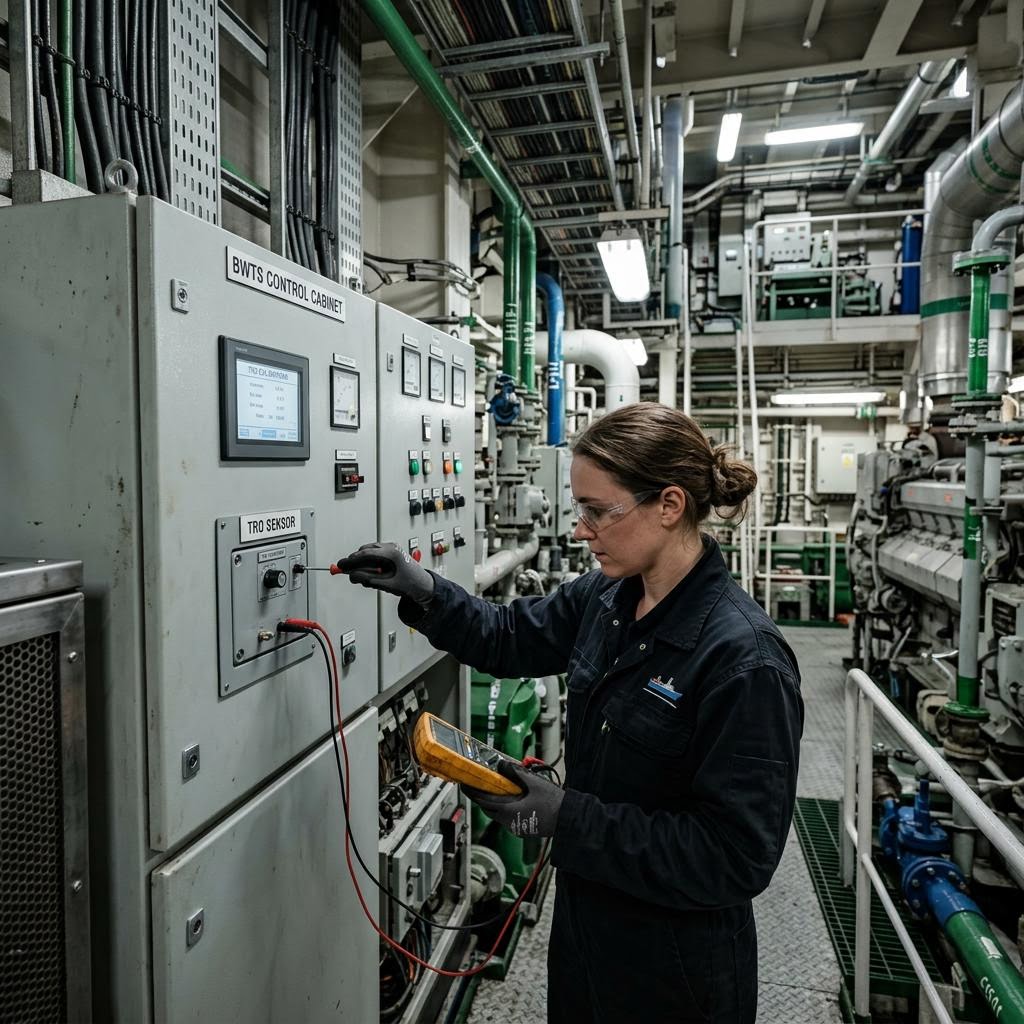
Most BWTS alarms are sensor or consumable issues, not treatment failures. Low-TRO alarms are usually reagent/sensor drift or the salinity envelope; high-discharge-TRO alarms are usually low thiosulfate or a failed dosing pump; filter dP alarms are the screen, the dP transmitter or the backflush valve; low-UV-dose alarms are fouling, low UVT or lamp age. Diagnose from cheapest and most common inward, and never mask an alarm.
Request BWTS spare parts, annual calibration or ballast-water testing
Key takeaways
- Most BWTS alarms are sensor or consumable issues, not treatment failures; diagnose from the cheapest and most common cause inward.
- Low TRO on ballasting is usually reagent/sensor drift or the salinity envelope (low TRO plus low current in brackish water) before the reactor.
- High discharge TRO is usually low or weak thiosulfate or a failed dosing pump before the discharge sensor - never discharge over the limit.
- Filter dP alarms are, in order, the screen element, the dP transmitter/sensing lines, or the backflush valve; carry spares for all three.
- Low UV dose is diagnosed as fouling, then low UVT water, then lamp run-hours, then flowmeter, and only then the intensity sensor.
- Never mask an alarm by widening its band; a BWTS alarm is often a compliance signal, so diagnose, fix and record every event.
Why Do Most BWTS Alarms Point at Sensors?
The reactors, filters and UV chambers at the heart of a BWTS are mechanically robust and change slowly; the sensing and consumable chain around them is what needs frequent attention. As a result, the large majority of day-to-day alarms trace to a sensor reading, a reagent state, or a dosing consumable, not to a failure of the treatment process itself.
This matters because the instinctive response to an alarm - assume the treatment has failed - usually sends the engineer to the wrong place. A disciplined diagnostic order that checks the cheapest and most common causes first resolves most alarms quickly and avoids replacing expensive components that were never at fault.
The one rule that overrides all others: never mask an alarm by widening its band or acknowledging it away without diagnosis. A BWTS alarm is often a compliance signal, and silencing it can turn a fixable sensor issue into an undocumented discharge that fails a PSC sample. Diagnose, fix, and record.
Low TRO on Ballasting
A low-TRO alarm on the ballasting leg means the system is not reading the target oxidant dose. The first and most common cause is the sensor or its reagent: expired DPD reagent, a fouled cell, or a spent amperometric membrane all read low. Check reagent lot and expiry and verify the sensor against a fresh standard before concluding the reactor is under-dosing.
The second most common cause is the salinity envelope, not a fault. Electrochlorination and electrocatalysis systems electrolyse chloride, so in brackish or low-conductivity water the reactor produces less oxidant and may not reach target at rated flow - the readings are honest, and the fix is respecting the salinity limit or reducing flow, not chasing a sensor. Low TRO with low rectifier current in brackish water is the classic signature.
Only after sensor and salinity are ruled out is the reactor itself suspect: scaled or worn electrodes, a rectifier fault, or a flow error corrupting the dose calculation. Low TRO with normal current in full seawater and a verified sensor points here. Trending cell voltage and rectifier current distinguishes a scaling issue (recoverable by cleaning) from coating wear (planned parts).
High TRO on Discharge
A high-discharge-TRO alarm means residual oxidant is above the discharge limit (commonly around 0.1 mg/L) despite neutralisation. The first checks are the neutralising chemical and the dosing pump: an empty or weak sodium thiosulfate solution, or a failed metering pump stroke, leaves residual high even when uptake treatment was perfect. Check thiosulfate stock and pump operation before the sensor.
Neutralisation dose is proportional to measured residual and discharge flow, so a flow error or an under-sized dose setting can also leave residual high. Confirm the dosing pump is actually delivering, the thiosulfate is within any shelf life, and the dose logic matches the measured residual and flow.
A discharge TRO sensor reading falsely high is the third possibility, checked after stock and pump - verify it against a standard. Whatever the cause, do not discharge over the limit and do not silence the alarm: hold the operation, resolve the neutralisation, and record the event. High residual overboard is a direct environmental and compliance breach.
Filter Differential-Pressure Alarms
On filtration systems a high filter dP alarm is, nine times out of ten, one of three things in order: the screen element, the dP transmitter, or the backflush valve. A screen blinded by heavy sediment in muddy estuarine water raises genuine dP and backflushes constantly; this is often a water-condition issue rather than a defect, though a damaged or fouled element also raises dP.
The dP transmitter and its sensing lines are the next suspect: silted sensing lines or a drifting transmitter report high dP that is not really there, causing needless backflush cycles and reduced ballasting flow. Verify the transmitter reading against expected values before condemning the screen.
A backflush valve that has lost its seat or stuck fails to clear the screen, so dP stays high after backflush - the cycle runs but the pressure does not drop. Frequent backflushing plus persistent high dP points here. Carrying a spare screen element, a dP transmitter and a backflush valve rebuild kit lets the crew resolve most filter alarms without idling the ballast system.
Low UV Dose Alarms
On UV systems a low-dose alarm is diagnosed in order: fouling first, then water, then lamp, then flow. Clean the UV intensity sensor window and the quartz sleeve - fouling attenuates UV and reads as low intensity, and this is the most common and cheapest cause. If intensity recovers after cleaning, that was it.
If cleaning does not restore intensity, check whether the incoming water has genuinely low UV transmittance. Turbid or coloured water (challenging waters) absorbs UV, so the system genuinely cannot reach dose at rated flow - the fix is reduced flow, not cleaning, and it is a water limitation within the approval envelope, not a defect.
Next check lamp run-hours against the rated life; end-of-life lamps lose output and read as low intensity that cleaning cannot restore. Verify the flowmeter too, since a flow error corrupts the dose calculation independently of intensity. Only after fouling, UVT, lamp age and flow are excluded is the intensity sensor itself the likely fault, verified against a reference.
How Do You Work an Alarm Safely?
Adopt a fixed method: read the alarm and the related process values together, work from the cheapest and most common cause inward, verify sensors against a standard before replacing hardware, and check consumables (reagent, thiosulfate) before condemning components. Distinguishing a genuine water/salinity limitation from a fault is central - both look like alarms but need opposite responses.
Record every alarm and its resolution in a way that reconciles with the ballast water record book and the self-monitoring log. A consistent alarm-and-action history is exactly what demonstrates to a surveyor or PSC officer that the system is managed properly, and it is far easier to keep in real time than to reconstruct under inspection.
When an alarm survives correct diagnosis - a reactor that will not hold dose with a verified sensor in full seawater, a UV sensor that fails against a reference, a persistent electrical fault - it is a genuine fault needing parts or support. Sea Clean AS provides independent, brand-agnostic fault diagnosis and authorized Headway support for OceanGuard; attendance is 0-24h in Norway and the North Sea and by arrangement elsewhere. Contact post@seaclean.no.
Frequently asked questions
Why is my BWTS showing a low-TRO alarm?
Check the sensor and reagent first - expired DPD reagent or a fouled/spent sensor reads low. Then check the salinity envelope: low TRO with low current in brackish water is the water, not a fault. Only after those is the reactor (scaling, electrode wear, flow error) the likely cause.
My discharge TRO alarm won't clear even though the neutraliser is running - why?
Check the sodium thiosulfate stock and the metering pump before the sensor. An empty or weak thiosulfate solution or a failed pump stroke leaves residual high even when uptake treatment was perfect. A falsely high discharge sensor is the third thing to check, not the first. Do not discharge over the limit.
What causes a high filter differential-pressure alarm?
Usually one of three, in order: a blinded or damaged screen element, a drifting dP transmitter or silted sensing lines reporting false high dP, or a backflush valve that has lost its seat so the screen never clears. Carry a spare element, transmitter and backflush valve kit.
How do I troubleshoot a low UV dose alarm?
Work in order: clean the sensor window and quartz sleeve (fouling), check for genuinely low incoming UVT (turbid water), check lamp run-hours against rated life, verify the flowmeter, and only then suspect the intensity sensor and verify it against a reference.
Sources
- IMO MEPC.300(72) BWMS Code — BWMS type approval and self-monitoring
- IMO BWM Convention (D-2 standard) — Ballast Water Management Convention
Related articles
Request spares, calibration or ballast-water testing
Include BWMS brand/model, vessel/IMO number, port/terminal, date/ETA and scope or part numbers. These links prepare an email draft; you must send it yourself.
- Request a parts quote — Sensors, TRO reagents, calibration kits and replacement parts. Confirm compatibility, availability and delivery for your installed system.
- Request a calibration booking — Annual instrument calibration with a calibration certificate for the work completed. OEM instructions, drift or applicable rules may require earlier work.
- Request testing coordination — Arrange sampling and testing with an appropriately qualified party for your IMO D-2, commissioning or other stated purpose.
Authorised Headway agent. Other-brand enquiries are independently reviewed; no OEM authorisation is claimed. Sea Clean is not an accredited laboratory or approving authority. Calibration does not demonstrate biological D-2 compliance. Attendance, testing scope and parts delivery are confirmed per enquiry.