How to Procure Port-Side Ballast Water Treatment
Updated
Procure port-side ballast-water treatment from a defined operating case, not a catalogue flow-rate comparison. The tender should make bidders address hydraulics, berth access, utilities, permits, monitoring, solids and operational support.
Key takeaways
- Define the operating scenario and responsibility split before choosing a port-side treatment concept.
- Size flow from vessel hydraulics, hoses, berth windows and transfer tasks, not a nominal equipment rating.
- The 2021 HarborBallast figures are dated catalog concepts and require project-specific engineering assessment.
- Plan utility, access, solids handling, monitoring and emergency-stop interfaces as one operating system.
- G5 is guidance, while permits, authority acceptance and vessel documentation must be verified project by project.
- Procurement should test assumptions, exclusions, records and operational support before service deployment.
Define the operational case
Convert the feasibility work into comparable technical and operational requirements for bidders. The expected vessel mix and ballast timing establish the real service case. A concept should not be selected from a flow-rate figure alone.
A procurement scope should distinguish mandatory operating needs from options that depend on future demand. Compare planned calls with contingency calls because their response windows and evidence needs differ. Identify who is authorised to request the service.
The duty statement should identify volume, location, transfer direction and the point at which the operation ends. These details become the basis for procedures and procurement. It should also name the party responsible for confirming the operating boundary before mobilisation.
Match the treatment concept to the berth
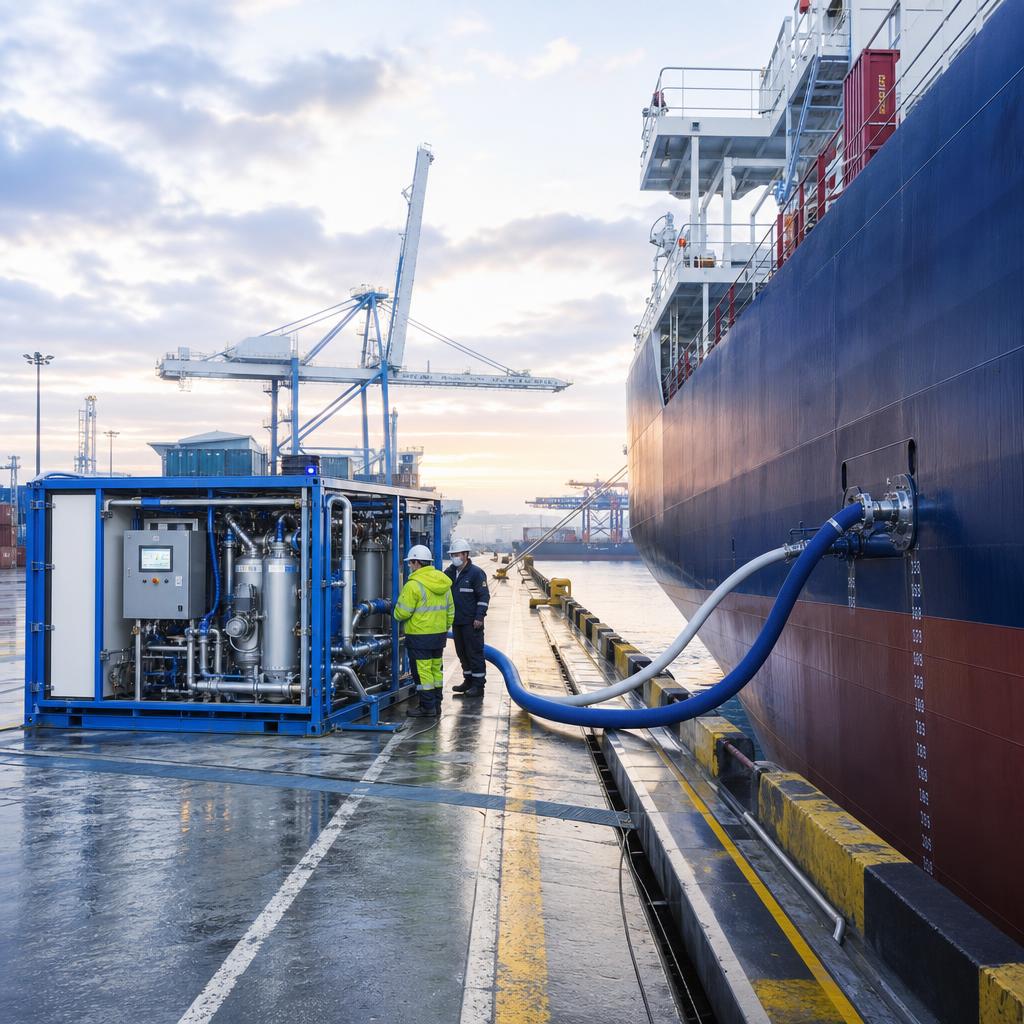
Trailer, container, fixed and barge concepts have different access and mobilisation constraints. The 2021 HarborBallast catalog presents indicative trailer/mobile 50–500 m³/h, fixed 50–5,000 m³/h, and barge 1,000–5,000 m³/h concepts. These dated values are not Sea Clean capacity promises or approvals.
A trailer needs a secure landside route and hose reach, while a barge needs safe waterside positioning and marine coordination. A fixed facility trades flexibility for permanent utility and civil interfaces. Hydraulic, utility, local permitting and acceptance assessment is required for every project.
Calculate pressure loss through hose, adapters, filters, elevation and vessel piping at the intended duty point. Include connection, flushing and shutdown time in the berth-window calculation. Confirm that throttling will not upset the vessel's pump operation.
Control the physical interfaces
Survey hose routing, crane or lifting needs, tide movement, gangway clearance, emergency access and vehicle segregation at the actual berth. Define adapters, pressure ratings and custody before the first call. A compatible flange alone does not establish a safe transfer.
Check shore power, earthing, cable routing, communications and any generator controls early. Mobile equipment can still create noise, fuel, emissions and refuelling issues for the terminal. Utilities must be assessed against the real operating cycle.
Contract boundaries must make clear who provides access, utilities, waste handling, approvals and vessel coordination. Put stop-work authority, weather limits, alarm responses and traffic controls in the joint procedure. Test those controls during a tabletop or supervised exercise. Revise the interface register when berth conditions change.
Plan treatment residuals and evidence
Pre-filtration can create separated sediment and solids that need a defined containment and disposal route. Determine whether local waste rules require characterization, manifests or a licensed contractor. Never assume terminal waste arrangements accept ballast-derived material.
PACT's public onboard description states a 40 μm self-cleaning filter with medium-pressure UV at 200–280 nm, and secondary UV during de-ballasting. It states a published 200–4,000 m³/h range. That is a published design description, not a type-approval statement or D-2 guarantee for a port project.
Acceptance evidence should be agreed in the tender so performance claims are checked against the stated duty. Agree sample access, data retention and alarm handling before operations. Sea Clean can coordinate with independent ISO 17025 laboratories and flag/class-authorised parties where required. Sea Clean is not an accredited laboratory or independent certifier.
Apply the approval and record route
IMO G5 is guidance for reception facilities, not an automatic licence or a one-size-fits-all design. Port, flag, class, authority, discharge-permit and acceptance requirements must be checked for the project. A treatment arrangement should never be presented as guaranteeing D-2 compliance.
The vessel record should identify location, date, volume, equipment status, reason for the operation and supporting communications. Entries should match the approved ballast water management plan. Retain facility receipts and transfer logs with the operational file.
Use controlled versions of procedures, checklists, calibration records and exception reports. A clear timeline is especially important for a contingency. It allows an inspector to understand actions without reconstructing them from correspondence.
Turn the study into a workable service
Specify the operating scenario, hydraulic basis, safety controls, monitoring, waste route, records and acceptance evidence in one tender package. Require suppliers to identify exclusions and dependencies. This makes proposals comparable.
Assess mobilisation, crew competence, maintenance access, parts and support alongside equipment. An arrangement that cannot reach the berth or survive its access restrictions has no practical capacity. Acceptance should demonstrate the agreed operation, not merely energisation.
Sea Clean AS can support early coordination as PACT Marine's European partner. Any deployment remains subject to project-specific authority acceptance and readiness confirmation. Keep the final file available to operations and auditors.
Frequently asked questions
What is the first step for how to procure port-side ballast water treatment?
Convert the feasibility work into comparable technical and operational requirements for bidders. Establish the vessel, berth and authority boundaries before choosing equipment. That creates a defensible scope for the later technical work.
Do catalog flow rates establish project capacity?
No. Flow depends on vessel hydraulics, hose losses, utilities, access and the full transfer sequence. The dated HarborBallast catalog figures require project-specific assessment.
Does G5 automatically approve the facility?
No. G5 is guidance, not a licence or an automatic design approval. Local permits and authority acceptance still have to be confirmed.
Can Sea Clean certify treatment results?
Sea Clean is not an accredited laboratory or independent certifier. It can coordinate with independent ISO 17025 laboratories and flag/class-authorised parties where required.