Ballast Water Test Kits vs Laboratory Analysis
Updated
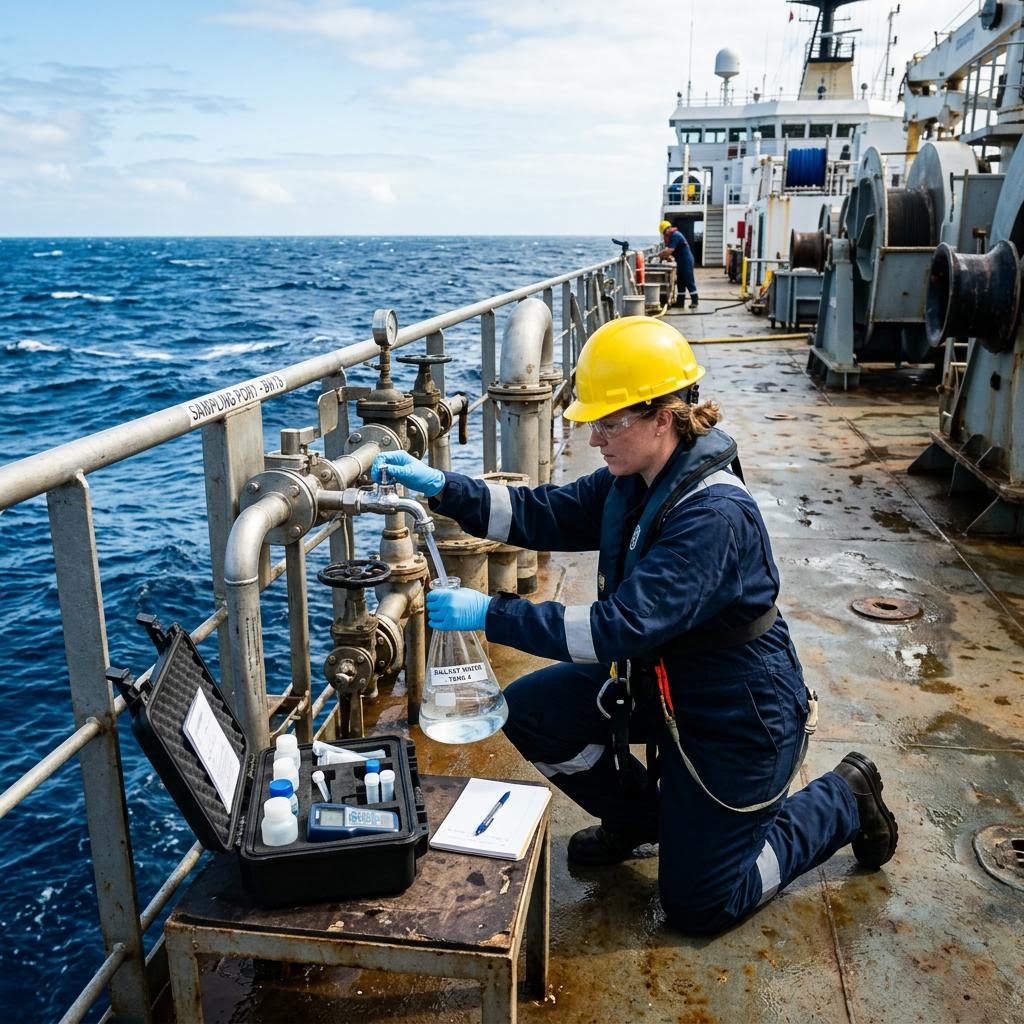
Onboard test kits give an indicative pass/fail in minutes to hours for a low per-test cost and are ideal for routine self-checks, but they do not prove D-2 compliance. Laboratory analysis at an ISO 17025-accredited facility quantifies organisms against the numeric limits and is definitive but slow (hours to days) and costlier. Use kits to catch problems early; use the laboratory when a defensible result is required.
Request BWTS spare parts, annual calibration or ballast-water testing
Key takeaways
- Onboard kits give an indicative pass/fail in minutes to hours at low cost but cannot quantitatively prove D-2 compliance.
- Laboratory analysis at an ISO 17025-accredited facility quantifies organisms against the numeric limits - definitive but slow (hours to days) and costlier.
- Kits are least reliable at the margin; a near-threshold result is a prompt to investigate the system, not a verdict.
- Use kits for routine self-checks to catch faults early; use the laboratory for disputes, post-repair validation and formal compliance statements.
- Neither method survives a bad sample - a proper in-line sampling point, correct handling and chain of custody are prerequisites for both.
- Sea Clean coordinates detailed analysis with independent ISO 17025 laboratories and is not itself an accredited laboratory.
What Does Each Method Actually Do?
An onboard test kit performs indicative analysis: a rapid screen using ATP, fluorescence, staining or rapid-microbial chemistry that estimates whether viable organisms are likely within or over the D-2 thresholds. It gives a fast pass/fail-style indication, not a precise organism count, and is designed for use by ship's crew rather than laboratory analysts.
Laboratory analysis performs detailed analysis: trained analysts quantitatively count viable organisms in the 50-micrometre-and-larger and 10-to-50-micrometre size classes and culture the microbial indicators against the numeric D-2 limits. It is the definitive method and the basis on which a formal compliance or non-compliance determination rests.
The two are complementary, not competing. The kit is a fast, cheap early-warning and self-check tool; the laboratory is the slow, authoritative confirmation. Understanding what each proves prevents the common mistake of treating a kit result as a compliance certificate or paying for laboratory analysis when a self-check would do.
Speed and Cost Compared
Onboard kits win decisively on speed: most give a result in minutes to a few hours, on the ship, without shipping anything ashore. Per-test cost is low, low enough to run regularly, though the recurring cost of consumables and the need to keep kits in date must be planned. This makes frequent self-checking economically realistic.
Laboratory analysis is slow by comparison - hours to days depending on the viable-count and microbial-culture methods - because organisms must be counted and cultures grown, and the sample must physically reach the laboratory. The per-analysis cost is substantially higher, and sampling logistics and chain of custody add to it.
The economic pattern most vessels adopt is frequent low-cost indicative self-checks, reserving costly laboratory analysis for when it is genuinely needed: a disputed result, post-repair validation, or a required formal statement. Running laboratory analysis routinely is rarely justified; never running a self-check is a false economy that lets faults go undetected.
Accuracy and What Each Proves
Kits trade precision for speed. They indicate likely compliance well when a result is clearly within or clearly over the threshold, but they are least reliable exactly at the margin, where a near-limit reading is ambiguous. A kit cannot deliver a defensible quantitative count and so cannot, by itself, prove D-2 compliance.
Laboratory analysis is quantitative and definitive: it produces an organism count per size class and microbial results against the numeric limits, with the analytical rigour and documentation to withstand challenge. This is why a formal non-compliance finding rests on detailed analysis, not on an indicative screen.
Credibility hinges on accreditation. Detailed analysis must be performed by a laboratory accredited to ISO 17025 for the relevant methods, and the sample must arrive correctly preserved within its holding time with intact chain of custody. Sea Clean AS coordinates this with independent ISO 17025 laboratories and is not itself an accredited laboratory.
When Are Onboard Kits Enough?
Kits are enough for routine operational assurance: confirming the system is performing between OEM validations, sanity-checking a treated batch, and catching a developing fault - a drifting TRO sensor, a fouled UV chamber, a salinity-envelope problem - before it becomes a compliance failure at a port. This is the highest-value use of testing for most crews.
They also support the vessel's compliance case as supplementary evidence alongside the self-monitoring log and record book, showing an inspector that the operator actively verifies performance. A pattern of in-date, method-correct indicative results reinforces a well-documented, well-maintained system.
Kits are not enough when a definitive answer is required or when a result is contested. A marginal kit result, a formal compliance statement, or validation after a major repair all need the quantitative certainty only accredited laboratory analysis provides. Knowing that boundary keeps testing effective and proportionate.
When Do You Need the Laboratory?
Use the laboratory to resolve disputes - if an indicative result or a PSC screen is marginal, detailed analysis settles it quantitatively. Use it to validate the system after major work such as electrode or lamp replacement, a control-system change, or a period of suspected malfunction, where you need certainty the system is back to standard.
Use it whenever a formal, documented compliance statement is needed, for example to satisfy a specific commercial, flag or port requirement. In these cases the accreditation and chain of custody are the point - the result must be defensible to a third party, which an onboard kit cannot deliver.
For these situations Sea Clean coordinates sampling and detailed analysis with independent ISO 17025 laboratories, managing sampling logistics, chain of custody and laboratory liaison. Attendance and sampling support are 0-24h in Norway and the North Sea and by arrangement elsewhere; contact post@seaclean.no with the vessel, system and scope.
How Should You Combine the Two?
The effective strategy is layered. Keep in-date indicative kits aboard and run them as routine self-checks so problems surface early and cheaply. Maintain the system in calibration and keep records reconciled so the day-to-day compliance evidence stands on its own without any test.
Escalate to accredited laboratory analysis only on a defined trigger: a marginal indicative result, a post-repair validation, a disputed PSC screen, or a formal-statement requirement. This keeps costly analysis proportionate while ensuring a defensible result is always available when it matters.
Underpinning both is sampling discipline - a proper in-line sampling point, correct handling, and chain of custody for laboratory samples - because neither a kit nor a laboratory can rescue a bad sample. Get the sampling right, self-check with kits, and reserve the laboratory for definitive answers, and the vessel's compliance posture is both robust and economical.
Frequently asked questions
Can an onboard ballast water test kit prove compliance?
No. Kits provide indicative screening - a fast pass/fail indication - and are excellent for routine self-checks, but they cannot quantitatively prove D-2 compliance. A definitive, defensible result requires detailed analysis at an ISO 17025-accredited laboratory.
How much faster is a test kit than laboratory analysis?
Considerably. Onboard indicative kits give a result in minutes to a few hours on the ship, while laboratory detailed analysis takes hours to days because organisms must be counted and microbial cultures grown, plus the time to ship the sample ashore.
When should I pay for laboratory analysis?
When you need a definitive answer: to resolve a marginal or disputed result, to validate the system after major repairs, or to provide a formal documented compliance statement. Routine reassurance is better served by cheaper, faster onboard indicative kits.
Does it matter which laboratory does the analysis?
Yes. Detailed analysis must be done by a laboratory accredited to ISO 17025 for the relevant methods, with the sample correctly preserved within its holding time and an intact chain of custody. Sea Clean coordinates this with independent ISO 17025 laboratories and is not itself accredited.
Sources
- IMO BWM Convention (Regulation D-2) — Ballast Water Management Convention
- IMO ballast water sampling guidance (G2) — Guidelines for ballast water sampling
Related articles
- Ballast Water Sampling: Indicative vs Detailed
- How to Test Ballast Water for D-2 Compliance
- Ballast Water Sampling and Analysis: Indicative vs Detailed Compliance Testing
- BWTS Reagents and Consumables: What to Keep Onboard
- What Is a Ballast Water Treatment System? Explained
- How Does BWTS Installation Work? Step by Step
Request spares, calibration or ballast-water testing
Include BWMS brand/model, vessel/IMO number, port/terminal, date/ETA and scope or part numbers. These links prepare an email draft; you must send it yourself.
- Request a parts quote — Sensors, TRO reagents, calibration kits and replacement parts. Confirm compatibility, availability and delivery for your installed system.
- Request a calibration booking — Annual instrument calibration with a calibration certificate for the work completed. OEM instructions, drift or applicable rules may require earlier work.
- Request testing coordination — Arrange sampling and testing with an appropriately qualified party for your IMO D-2, commissioning or other stated purpose.
Authorised Headway agent. Other-brand enquiries are independently reviewed; no OEM authorisation is claimed. Sea Clean is not an accredited laboratory or approving authority. Calibration does not demonstrate biological D-2 compliance. Attendance, testing scope and parts delivery are confirmed per enquiry.