Identifying BWTS Spare Parts: Nameplates, Drawings and Bills of Material
Updated
The most common cause of wrong-part deliveries and avoidable BWTS downtime is poor part identification, not poor availability. This guide explains how to read equipment nameplates, system drawings, P&IDs and bills of material so the part you order is the part the system actually needs.
Key takeaways
- Transcribe the full model string and serial number from the nameplate, including suffixes that distinguish voltage, frequency and approval build.
- Use the P&ID tag and the assembly drawing position number to make a part request unambiguous.
- Match material callouts (FKM, EPDM, PTFE), not just dimensions, when ordering seals.
- Classify each part as consumable, wear part or capital spare to drive the right ordering pattern.
- Cross-check nameplate, drawing position and BOM part number before committing an order.
- A photo of the worn part beside its nameplate resolves most identification ambiguity.
Start at the equipment nameplate
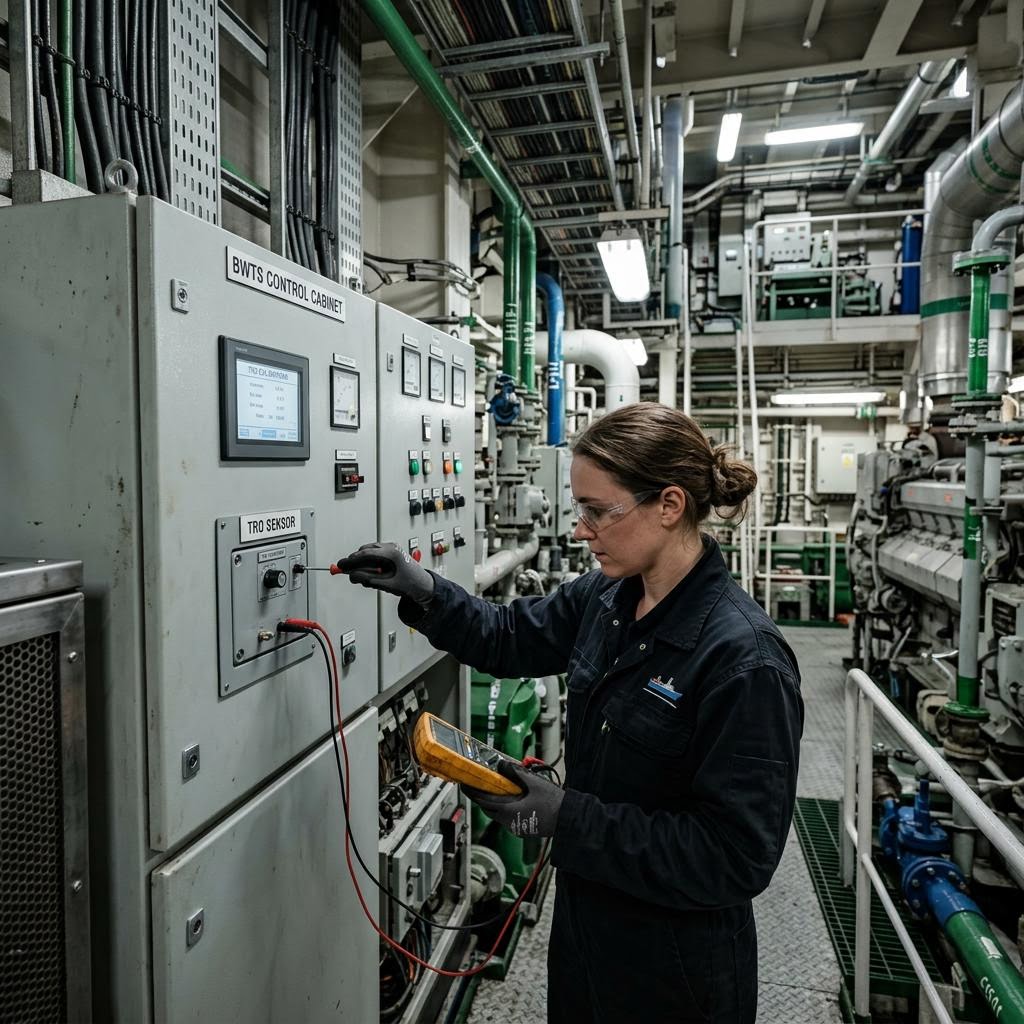
Every major BWTS component carries a nameplate: the filter housing, the UV reactor, the electrochlorination cell, the TRO analyser and the control cabinet each have their own. The nameplate gives the manufacturer, model designation, serial number, and frequently a rating (flow rate, power, voltage). The serial number is the single most useful identifier because manufacturers tie it to the as-built configuration of that specific unit, which matters when a system has been revised across production years.
Record the full model string exactly as printed, including suffixes. A suffix often distinguishes a 50 Hz from a 60 Hz unit, a 440 V from a 690 V supply, or an IMO-only from a USCG-compliant build. Two filters that look identical can take different screen baskets or seals depending on that suffix, so transcribing it precisely prevents the most expensive category of ordering error.
Use the P&ID and system drawings for position numbers
Ballast water treatment systems are documented with a piping and instrumentation diagram (P&ID) that assigns tag numbers to every valve, sensor, pump and instrument. When an alarm references a tag, the P&ID translates that tag into a physical device with a defined function, which narrows a parts search far faster than describing the symptom.
Component drawings go one level deeper, showing exploded assemblies with position numbers that map to the bill of material. A seal described only as 'the big O-ring on the filter' is ambiguous; the same seal identified as position 8 on the filter assembly drawing is unambiguous and matches a single part number. Keeping the drawing pack aboard, or scanned and indexed, turns a vague request into a precise one.
Read the bill of material correctly
The bill of material (BOM) lists every replaceable item with a part number, description, material and quantity per assembly. Wear parts such as filter screens, O-rings, gree circles, UV lamps and quartz sleeves appear here with their position numbers, and the quantity column tells you how many are fitted, which is essential for ordering a complete set rather than a single piece.
Pay attention to material callouts. A seal listed as FKM (fluoroelastomer) is not interchangeable with EPDM even at the same dimensions, because the two behave very differently against oxidants and temperature. Ordering on dimensions alone, without matching the material, is a frequent and avoidable mistake that shortens service life or causes early failure.
Distinguish consumables, wear parts and capital spares
Consumables are items replaced on a planned interval regardless of condition: TRO reagents, UV lamps and certain filter elements. Wear parts are condition-based, replaced when inspection or differential pressure indicates it: seals, gree circles, wiper kits and electrodes. Capital spares are high-value, long-lead items held against failure: control boards, power modules and complete reactor or cell assemblies.
Classifying each line on the BOM into one of these three buckets shapes how you order. Consumables suit standing orders aligned to run hours; wear parts suit a held minimum stock; capital spares suit a documented risk decision because their lead times can run to many weeks. The classification, not the catalogue, drives a sensible procurement plan.
Confirm before you commit
Before placing an order, cross-check three sources: the nameplate model and serial, the position number from the drawing, and the part number and material from the BOM. When all three agree, the risk of a wrong delivery is low. When they conflict, the conflict itself is the signal that the unit may have been modified or that the documentation is for a different revision.
A clear photograph of the worn part next to its nameplate resolves most remaining ambiguity and lets a supplier verify the item against their own records. Sea Clean AS, as an authorized Headway Technology agent, can identify Headway OceanGuard wear parts from a serial number and drawing position, and can help cross-reference equivalents for other systems.
Frequently asked questions
Why do two identical-looking BWTS filters take different parts?
Visually identical housings can be built to different voltages, frequencies or approval standards across production years. The model suffix and serial number capture these differences, which is why screens and seals are matched to the specific build rather than the general model.
What is the single most useful identifier for a BWTS part?
The equipment serial number, combined with the assembly drawing position number. The serial ties the unit to its as-built configuration, and the position number maps directly to one line on the bill of material.
Can I order seals on dimensions alone?
No. Dimensions must be matched together with the material specification. An FKM and an EPDM seal of the same size behave very differently against oxidants and heat, so ordering on size alone risks premature failure.
What documentation should be kept aboard for parts identification?
The system P&ID, the component assembly drawings with position numbers, and the bill of material. Scanned and indexed copies make remote identification and ordering far quicker when a fault occurs at sea.
Sources
- cballast.com — Supplier of ballast water treatment system spare parts and consumables.
Related articles
- Sourcing Genuine vs Equivalent BWTS Spare Parts
- Spare Parts Inventory Planning for BWTS
- Reducing BWTS Downtime: Critical Spares and Parts Availability
- Total Cost of Ownership for BWTS Spare Parts and Consumables
- Common Headway Z-Filter Wear Parts and Replacement Intervals
- UV Lamp Sourcing and Cross-Reference for BWTS