Electrode and Cell Maintenance for Electrochlorination BWTS
Updated
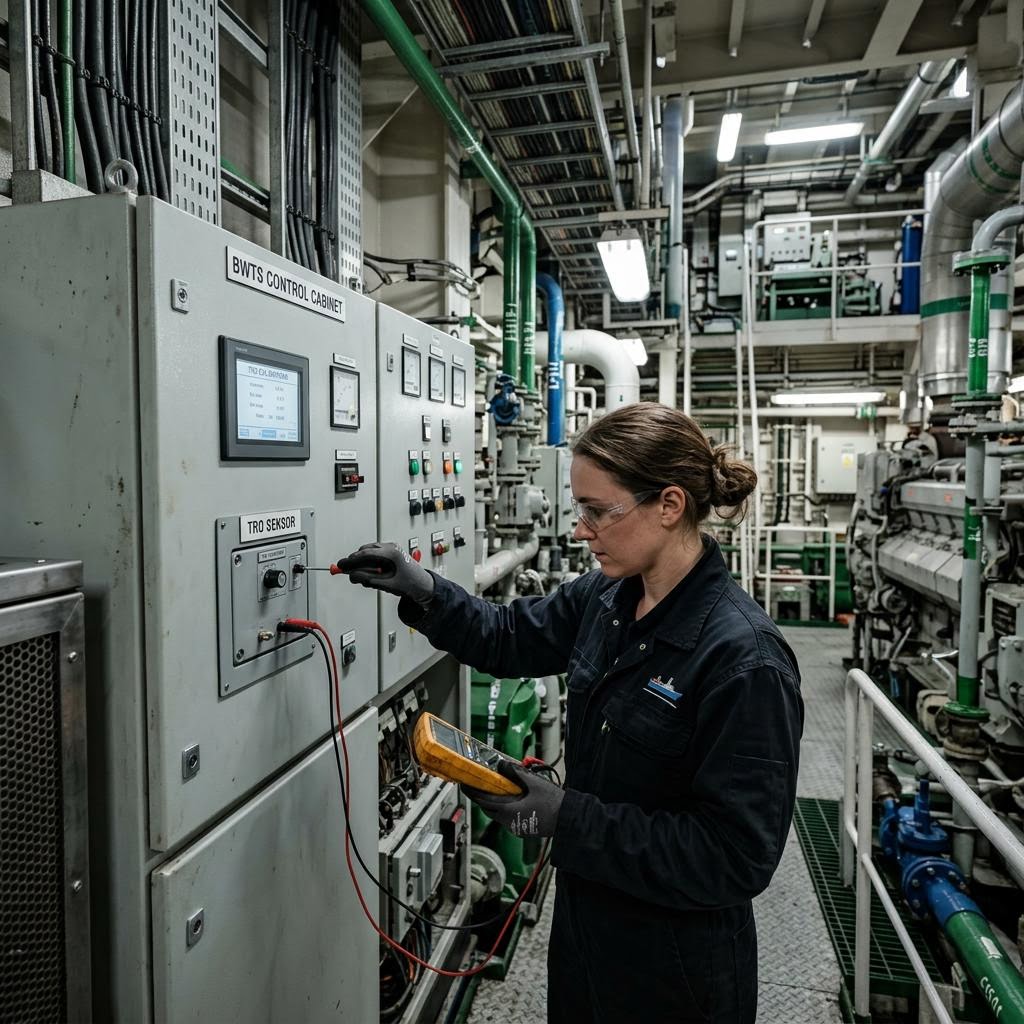
Electrochlorination and electrolysis BWTS generate disinfecting oxidant by passing current through seawater across coated electrodes, and those electrodes are the system's defining wear item. Managing scaling, coating life, polarity reversal and hydrogen safety keeps oxidant generation efficient and the cell reliable over its service life.
Key takeaways
- MMO-coated anodes are consumable; coating erodes with amp-hours, so electrode life is measured in operating hours, not calendar time.
- Cathodic scaling from calcium and magnesium is the main maintenance issue, controlled by polarity reversal plus periodic acid cleaning.
- Follow the OEM acid-cleaning procedure precisely, since over-aggressive acid contact can attack the MMO coating.
- Hydrogen is an unavoidable by-product; maintain degassing, ventilation, detectors and interlocks as safety-critical items.
- Rising cell voltage for a given current signals coating wear or scaling and is the primary condition indicator.
- Forecast electrode replacement from amp-hour data and maintain the rectifier, seals, dosing and TRO loop alongside the cell.
How the cell generates oxidant and why electrodes wear
In an electrolytic or electrochlorination BWTS, seawater passes between anodes and cathodes carrying a DC current. The chloride in seawater is oxidised at the anode to produce hypochlorite and related active species, reported collectively as total residual oxidant (TRO). Systems such as Techcross ECS treat the full flow electrolytically, while side-stream electrochlorination units like Sunrui BalClor and Headway OceanGuard generate concentrated oxidant that is dosed into the main flow.
The anodes are coated with a mixed metal oxide (MMO), typically a precious-metal oxide layer on a titanium substrate, that catalyses the reaction at modest voltage. This coating is consumable: every amp-hour passed gradually erodes it, and once it is depleted the cell needs more voltage to produce the same oxidant, eventually failing to reach the target TRO. Electrode life is therefore measured in operating hours or amp-hours, not calendar time alone.
Cell performance is monitored through the relationship between current, voltage and resulting TRO. A cell that needs rising voltage to hold its current, or that cannot reach target TRO, is signalling coating wear, scaling or a salinity or temperature limitation. Tracking these electrical parameters is the primary condition-monitoring tool for the cell.
Scaling and calcium deposits on the cathode
The dominant maintenance issue in seawater electrolysis is cathodic scaling. The reaction at the cathode raises local pH, which precipitates calcium carbonate and magnesium hydroxide onto the electrode surface. This scale insulates the electrode, increases cell resistance and voltage, reduces oxidant output and eventually narrows the flow gap. Hard, mineral-rich water accelerates the process.
Two strategies control scaling. Polarity reversal periodically swaps anode and cathode roles so that scale formed during one phase is dissolved electrochemically during the next; many systems do this automatically on a set cycle. Even with polarity reversal, periodic acid cleaning is needed, where a dilute acid solution, commonly inhibited hydrochloric or sulfamic acid, is circulated through the cell to dissolve accumulated deposits.
Acid cleaning frequency depends on water hardness, operating hours and cell design, and the OEM procedure specifies acid concentration, contact time and rinsing. The cleaning must be done carefully, since over-aggressive or excessively long acid contact can attack the MMO coating itself. Following the documented procedure protects both the coating and the operator, because acid handling demands proper PPE and ventilation.
Hydrogen generation and safety systems
Electrolysis of seawater produces hydrogen gas at the cathode as an unavoidable by-product. Hydrogen is flammable across a wide concentration range, so every electrolytic BWTS includes hydrogen management: a degassing or gas-liquid separation stage, dilution air or ventilation, and gas detection with alarms and interlocks. These safety components are as important to maintain as the cell itself.
Maintenance of the hydrogen system includes checking the degas unit, confirming dilution blower or fan operation, testing hydrogen detectors and verifying that interlocks shut the system down on detection or ventilation failure. A blocked vent, a failed blower or a dead sensor turns a routine by-product into a hazard, so these checks belong on the planned maintenance schedule and are a focus of class and PSC attention.
Crews working on the cell must follow lockout and gas-freeing procedures, because hydrogen can accumulate in pockets within the cell and associated piping. Purging and ventilation before opening the cell, and confirming no current is applied, are basic but non-negotiable steps before any internal inspection or acid cleaning.
Electrode life, inspection and replacement
MMO electrode coatings have a finite life expressed in operating hours, which the OEM defines and which can extend to several years of normal service depending on usage and water chemistry. As the coating depletes, the cell voltage required for a given current rises and oxidant output falls; the controller often tracks this and flags when the cell is approaching end of life.
Periodic internal inspection, where the cell design allows, reveals coating condition, scaling, flow-gap fouling and any mechanical damage to electrode plates or tubes. Inspection is best aligned with acid cleaning and with the dry-dock overhaul scope, when the cell can be opened safely. Worn or damaged electrodes are replaced as assemblies according to the OEM specification, since coating and substrate geometry are matched to the cell.
Electrode replacement is a significant cost and lead-time item, so it should be forecast from amp-hour or running-hour data rather than discovered as an end-of-life alarm in port. Sea Clean AS supports electrochlorination operators with cell maintenance, acid-cleaning consumables and electrode supply through its Headway agency and partner network.
Power supply, connections and ancillary wear items
The transformer-rectifier or power supply that drives the cell is a critical ancillary. It converts ship's power to the regulated DC the cell needs, and its cooling, connections and control electronics are maintenance points. Loose or corroded DC busbar connections create heat and voltage loss, so torque checks and inspection of cabling and terminals are part of routine maintenance.
Seals, gaskets and the cell housing also wear, particularly where they are exposed to oxidant-rich water and acid cleaning. Elastomer selection matters here, with oxidant-resistant materials such as FKM commonly specified, and these seals are renewed at overhaul. Flow and pressure sensors around the cell that inform the control logic need periodic verification like any other instrument.
Finally, the dosing arrangement on side-stream systems, including dosing pumps, injection points and the TRO analyzer that closes the control loop, must be maintained alongside the cell. The cell can be in perfect condition, but if dosing or TRO measurement is faulty the system still will not deliver compliant treatment, so the whole oxidant generation and control chain is maintained together.
Frequently asked questions
Why does my electrolytic cell voltage keep rising?
Rising voltage for the same current usually means scaling on the cathode or depletion of the anode coating, both of which increase cell resistance. Start with acid cleaning to remove calcium and magnesium scale; if voltage remains high after cleaning, the MMO coating may be approaching end of life and electrode replacement should be planned.
How often does the cell need acid cleaning?
It depends on water hardness, operating hours and whether polarity reversal is used, so follow the OEM schedule and adjust to observed scaling. Hard-water trades require more frequent cleaning. Always use the specified acid type, concentration and contact time, since excessive acid exposure damages the electrode coating.
Is the hydrogen produced by electrolysis dangerous?
Hydrogen is flammable, so it must be managed, but properly maintained systems handle it safely through degassing, dilution ventilation and gas detection with interlocks. The risk arises when these safety components fail, such as a blocked vent or dead detector, which is why they are tested as part of planned maintenance and gas-free procedures are followed before opening the cell.
How long do electrochlorination electrodes last?
MMO electrode coatings typically last several years under normal service, with life defined by the OEM in operating or amp-hours rather than calendar time. Usage intensity and water chemistry shorten or extend this. Forecast replacement from running-hour data so the long-lead electrode assembly is ordered before an end-of-life alarm forces a port purchase.
Sources
Related articles
- Electrochlorination BWTS Explained: Electrolysis, TRO Generation and Neutralisation
- Sunrui BalClor Electrochlorination BWTS Overview
- Techcross ECS / Electro-Cleen System Overview
- TRO Monitoring in Ballast Water Systems: Measuring Total Residual Oxidant
- Sourcing Genuine vs Equivalent BWTS Spare Parts
- Common Headway Z-Filter Wear Parts and Replacement Intervals